
Thai Hoa: A highlight of tourism in the Mekong Delta.
(Baonghean)Thai Hoa – the gateway to the Northwest region of Nghe An province, a place where unique local cultural values intersect, connecting the past and present through historical relics of epochal significance. All of this paints a vibrant and captivating picture of life, becoming a highlight in the "Up to the West" tour.
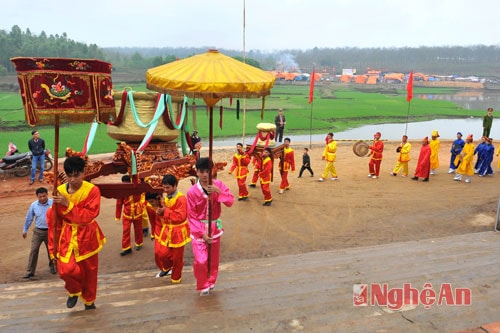 |
| The procession of the Bronze Cauldron during the Cauldron Village Festival. |
While southwestern Nghe An is characterized by a range of rolling hills embracing the Lam River, laden with alluvial soil, the northwestern region boasts the expansive and fertile Phu Quy plateau and a unique cultural landscape of ethnic communities, all nestled within the picturesque Hieu River. Amidst this vast and expansive landscape, Thai Hoa town serves as a crossroads, connecting transportation hubs and local cultural values. Therefore, Thai Hoa today holds profound and fascinating secrets awaiting discovery by visitors.
Not far from the town center, about 5 km southeast, away from the hustle and bustle of city life, we will find a peaceful countryside nestled behind lush green rubber forests called Vac Village (Nghia Hoa Commune) - a place that still preserves the values of the Dong Son culture from thousands of years ago. After 5 excavations, 347 tombs have been discovered in Vac Village, yielding 1,228 artifacts, including 665 bronze objects. The 5th excavation in Dinh Hamlet in the northeast revealed their dwelling place. Therefore, Vac Village belongs to the category of residential and burial sites, which helps us understand the life of the Dong Son people quite completely, a fact rarely found elsewhere. Professor Hoang Xuan Chinh, in his article "The Significance of Lang Vac Village - A Major Cultural Center in the Ca River Basin," affirmed: "Lang Vac is a Dong Son culture residential and burial site of paramount importance in our country... With the presence of Lang Vac village, the Nghe Tinh region is no longer a peripheral area of the Dong Son culture, but an important distribution area of the Dong Son culture, similar to the Red River and Ma River basins."
In 1999, Vac Village was recognized as a National Historical Relic Site and began organizing its annual festival. Visiting Vac Village is like returning to one's roots, lighting an incense stick to pay tribute to the ancestors who pioneered the land, established the village, and passed down their traditions to future generations. In 2011, the Provincial People's Committee issued Decision No. 24/QD.UBND-CN on the detailed planning for the construction of an archaeological site conservation area combined with ecotourism to develop Vac Village into a destination, a spiritual tourism site connecting to the origins. Accordingly, the relic site will have a total area of 155.94 hectares with functional zones such as: the archaeological zone, Vac Village communal house, landscape green areas, administrative and tourism service areas; a resort area; a reclamation area; a development reserve area; and a green protection area combined with reforestation.
Therefore, in the near future, the National Historical and Cultural Relic Site of Lang Vac Village will not only have archaeological research value but also become an eco-tourism, resort, and recreational area, combining research and understanding of the identity and customs of the ethnic minorities in the region. Comrade Hoang Nghia Thai - Secretary of the Party Committee and Chairman of the People's Committee of Nghia Hoa commune, said: While honored to have the relic site in the commune, Nghia Hoa recognizes its high responsibility in preserving and promoting its historical value. Therefore, the commune has established a Management Board for the relic site, assigning specific departments to guide and welcome visitors as needed. At the same time, it is effectively managing the planning, creating all favorable conditions for implementation according to the plan.
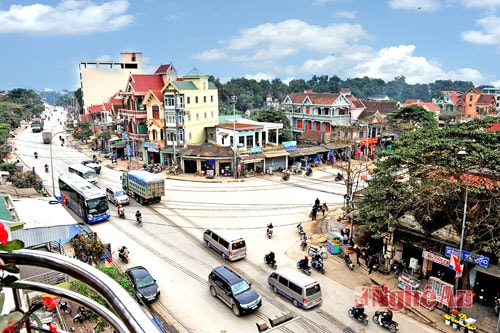 |
| Thai Hoa town today. |
A significant landmark on tours to Thai Hoa and the western part of Nghe An province is the historical site commemorating President Ho Chi Minh's visit and speech to the people of Phu Quy in Dong Hieu commune. The artifacts preserved at the Dong Hieu Farm's Traditional House help recreate the President's visit and speech on December 10, 1961. The microphone he used to speak to the people, the simple single bed where he rested during lunchtime, the bowl and chopsticks he used for lunch with officials from Nghe An province and the farm staff are still there. Many images documenting President Ho Chi Minh's activities during his visit to Dong Hieu are also carefully preserved and displayed. From the moment he stepped off the helicopter, visited the coffee plantation, toured the livestock farm, and spoke with the people... to the image of the plane carrying him departing Phu Quy amidst the emotional farewells of the people.
The mementos and photographs, though simple and unpretentious, truthfully portray and leave a profound impression of the beloved "Father of the Vietnamese Nation." Within the planning approved by the Provincial People's Committee, Thai Hoa Town has put into use the Ho Chi Minh Memorial House in the grounds of Dong Hieu Commune People's Committee. Here, all documentary photos of President Ho Chi Minh's visit to Dong Hieu are displayed in a systematic and vibrant manner. To ensure the historical site always effectively promotes its value, especially its value in educating about traditions, the entire 97,038m2 area of the site is divided into 10 main functional areas, including: the memorial area for President Ho Chi Minh, President Ho Chi Minh's fish pond, the commemorative garden, etc. Comrade Nguyen Van Nien – Secretary of the Party Committee of Dong Hieu Commune emphasized: The Party Committee and people of Dong Hieu always preserve and promote the value of the images and artifacts from President Ho Chi Minh's visit and speech, considering them as motivation to strive to fulfill the local political tasks well.
And then, visitors will immerse themselves in the vibrant and youthful atmosphere of this young town on the banks of the Hieu River. Amidst the hustle and bustle, visitors will find much-needed moments of tranquility and breathtakingly romantic scenery when visiting the Bau Sen Forest Park, savoring the delicious Western Vietnamese cuisine at the Khe Vinh Eco-tourism Area, or enjoying the airy and cool atmosphere at the restaurants along the western bank of the Hieu River...
Based on its potential and advantages, Thai Hoa has planned and implemented a series of destinations for cultural, historical, and ecological tourism tours. With its advantageous location as the center of the Northwest region of Nghe An province, at the intersection of National Highway 48 and the Ho Chi Minh Trail, Thai Hoa has developed tourist routes to historical sites such as Ru Gam Cave - Tru Village Banyan Tree (Nghia Khanh - Nghia Dan), Sao River Lake, and further to Chau Tien Ancient Thai Village, Bua Cave (Quy Chau); Sao Va Waterfall, Chin Gian Temple (Que Phong); and further to Milestone 0 - Lat Town (Tan Ky), the starting point of the legendary Ho Chi Minh Trail... Comrade Le Phuc An - Chairman of the People's Committee of Thai Hoa town, said: Based on the planning of historical sites approved by the Provincial People's Committee, Thai Hoa town is creating conditions to attract investors to develop tourism infrastructure and services. This is one of the solutions to help the town's economy shift in the right direction, in line with the orientation of becoming a regional center for service and tourism economy.
Huu Nghia


