
Thanh Chuong: Addressing the issue with C.uu multi-system rice seeds (factor 1).
(Baonghean) - According to reports from some residents in Thanh Hung, Thanh Lam, Thanh An communes... (Thanh Chuong district), they recently purchased C.uu multi-system hybrid rice seeds (number 1) in the area to soak and germinate seedlings for the spring planting season, but the germination rate was low, resulting in small, weak seedlings, and in some households, the seedlings did not germinate at all...
Ms. Le Thi Hoi from Hamlet 7, Thanh Hung Commune, said: "In previous seasons, I usually produced Khang Dan rice seeds. In the spring of 2013, I saw that the neighboring field of Ms. Nguyen Bich Thuy's family planted the C.uu multi-system number 1 rice variety, which yielded significantly more than pure rice, reaching 3.5 quintals/acre. So this year, I went straight to the District Plant Seed Station to buy 9kg of this rice seed. But after 3 days of soaking and incubating, the germination rate was less than 50%, and the rest turned black and did not germinate." Mr. Nguyen Van Huong A from Tan Son Hamlet – one of the first households in Thanh Lam Commune to soak and incubate the C.uu multi-system number 1 rice seed – explained: "What a strange seed. I soaked it for the right number of days and harvested it at the right time, but it didn't germinate at all. Panicked, I dried the seeds, then scrubbed them thoroughly, and soaked and incubated them again according to the technical instructions provided by the commune." Even after soaking for another 5 days, the seeds remained untouched, with only about 15% germinating. The rice turned dark and emitted a foul, sour smell due to being soaked for too long...
According to Mr. Dang Van Hanh, Vice Chairman of the Thanh Lam Commune Farmers' Association: On January 3rd, the commune received 3.2 tons of C.uu multi-hybrid rice seeds (number 1) to supply farmers for cultivation on 310 hectares in the 2014 spring crop. By January 10th, farmers began soaking and germinating the seeds, and 723 kg failed to germinate. If any germinated, the success rate was very low, about 30%. Tan Son hamlet was the first to discover this seed with a very low germination rate, because according to custom, this hamlet usually soaks and germinates the seeds a few days before the planting season due to having a larger area of acidic soil compared to other hamlets. When the seeds were delivered, each household received a photocopy of the process for soaking and germinating hybrid rice seeds and how to cover the spring seedlings with plastic sheeting, so it cannot be due to farmers not following the correct technical procedures. After receiving feedback from the people, we reported the incident to the district. On the same day, officials from the Department of Agriculture and the Plant Seed Station came to inspect and promptly took action by recalling the substandard rice seeds and planning to reissue 1,949 kg of seeds to the farmers in time for the planting season.
Mr. Phan Dinh Ha, Vice Chairman of the Thanh Chuong District People's Committee, stated: Entering the planting season, in addition to January 10, 2014, some communes had already soaked and incubated rice seeds. Among them, the C.uu multi-system seed No. 1 showed poor germination rates, with small and weak seedlings. Immediately after receiving this information, the District People's Committee coordinated with the Plant Seed Station and the People's Committees of the communes to conduct inspections. The inspection revealed that the 7.8 tons of C.uu multi-system seed No. 1 supplied to Thanh Lam, Thanh Tung, Thanh Mai, Thanh An, Thanh Hung, and Thanh Dong communes by Nghe An Plant Seed Joint Stock Company had low germination rates and did not meet requirements. Given this situation, on January 14, the district requested the six communes to immediately stop soaking and incubating the seeds for sample testing. At the same time, the district issued an urgent directive instructing units that had received the C.ưu multi-system hybrid rice variety No. 1 supplied by the District Seed Station to immediately stop soaking and germinating the seedlings if they had not yet done so. Samples should be taken for testing. When the germination rate is above 80% and the roots are well-developed, proceed with soaking and germination and sowing the seedlings on a large scale. If the germination rate is low and the roots are poorly developed, report to the supplier for appropriate action. For communes that have already soaked and sown seedlings, check the percentage of seedlings that meet the requirements; if there is a shortage of seedlings, supplement them immediately. When switching to other varieties or sowing supplementary seedlings, first use the hybrid rice varieties listed in the district's 2014 spring crop production plan; only switch to other hybrid rice varieties if there is a shortage. Only switch to purebred rice varieties when there are no more hybrid rice varieties available...
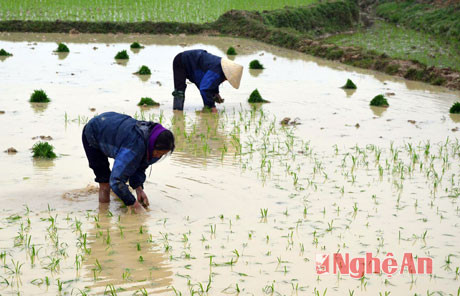 |
| Farmers in Thanh Chuong district are planting rice for the Spring 2014 crop. |
“The C.ưu multi-system rice variety No. 1 has been recognized as a national variety. This is a three-line hybrid rice variety produced in China and distributed through Asia-Thailand Agricultural Co., Ltd. Although it is only the third year it has been grown in Thanh Chuong, this variety is trusted by farmers because of its promising yield and quality, reaching over 65 quintals/hectare, with some localities achieving 70 quintals/hectare, and it has good resistance to pests and diseases, especially blast disease. Initial investigations suggest that the 7.8-ton shipment may have been affected by moisture during transportation from abroad, leading to changes in the sugar content of the seeds, causing them to lose viability and germinate poorly,” Mr. Phan Dinh Ha added.
In agricultural production, rice seeds are one of the crucial factors determining the yield and quality of rice grains. Recognizing this, farmers pay close attention to which rice variety to plant before each season, and the district's seed supply unit, the Plant Seed Station, has made thorough preparations to provide seeds to farmers. However, in some communes, farmers have purchased rice seeds that failed to germinate. In a discussion with us regarding this issue, Mr. Nguyen Huu Huan, Accountant of the Thanh Chuong Seed Station, also stated: "For every shipment imported at the beginning of the season, the station always takes samples for soaking and germination to check if the percentage meets the standards before allowing the seeds to be released. Regarding the batch of C.uu multi-system seeds (number 1) supplied to the six communes mentioned above, the poor germination rate may be due to some bags not being properly stored. During loading and transportation, air entered, weakening the seeds. Currently, Nghe An Seed Joint Stock Company has worked with the commune authorities to ensure the interests of the people by recalling all the substandard seeds that have been released from the warehouse and refunding or exchanging them for other seeds."
According to the 2014 spring crop production plan, the total planted area in Thanh Chuong is 14,200 hectares, of which rice accounts for 8,000 hectares. The main rice varieties are Nhi Uu 986 hybrid rice and C. Uu multi-system variety No. 1; Kinh So Uu 1588, ZZD 001, and ZZD 004 varieties will gradually replace other hybrid rice varieties to gradually expand their cultivation. Immediately after the incident occurred, Nghe An Seed Company worked directly with the people and planned to reissue C. Uu multi-system variety No. 1 seeds or exchange them for other varieties included in the district's production project according to the people's wishes. Accordingly, Thanh Lam commune received 1,900 kg of replacement seeds, and Thanh Dong commune received an additional 18 kg of C. Uu multi-system variety No. 1. Thanh Hung commune returned 230 kg of C.uu multi-system rice seeds (number 1) to the supplier and purchased Kinh So Uu 1588 hybrid rice seeds to remedy the situation; Thanh An commune provided an additional 300 kg of hybrid rice seeds in cash to address the problem (the commune had already purchased ZZD 001 and ZZD 004 hybrid rice seeds to affected households in a timely manner for sowing seedlings)... In a short time, localities quickly rectified the situation and basically replaced the damaged C.uu multi-system rice seeds (number 1) with other varieties that met the planting schedule and seed quality requirements. Depending on the needs of the people, the Plant Seed Station promptly supplied enough seeds for farmers to plant all the area. As of this time, the 8,000 hectares of spring rice in Thanh Chuong district have been basically completed.
This is not the first time farmers in our province have been affected by poor-quality rice seeds. Also during the 2014 spring crop, not only in Thanh Chuong district, but also in Nam Giang Agricultural Cooperative (Nam Dan district), 100 kg of 500 kg of purebred NA2 rice seeds imported from the Agricultural Materials Joint Stock Company had a germination rate below 55%. In Nam Cat commune, 500 kg of NA2 seeds had a germination rate below 35%. Recalling the 2010 spring crop, farmers in Do Luong, Hung Nguyen, and Nam Dan districts bought problematic purebred AC5 rice seeds offered by Dai Nam Agricultural Joint Stock Company... Given these recent incidents involving rice seeds, stricter management of seed quality is needed in light of the current chaotic production and supply of seeds. Relevant authorities should review seed purchase contracts and take appropriate legal action against substandard seeds. This also serves as a lesson in seed management and supply for businesses and specialized management agencies in the province.
Ngoc Anh


