
Changing the mindset regarding the use of investment capital from the state budget.
(Baonghean) - On June 22nd, in Hanoi, to focus on implementing the main tasks and solutions for directing and managing the implementation of the socio-economic development plan and the state budget estimate for 2015, the Ministry of Finance organized a workshop to gather feedback from ministries, sectors, and localities on amending and supplementing the mechanism for managing investment finance, and discussing solutions to accelerate the disbursement progress in 2015.
According to a report presented at the workshop, the Ministry of Finance stated that the total capital investment plan for basic construction projects from the state budget in 2015 allocated to central ministries, agencies, and localities was 181 trillion VND. Of this, 39.4 trillion VND was allocated to central ministries and agencies, and 141.7 trillion VND to localities. Based on this, to date, all ministries, agencies, and localities have implemented their plans, submitting them to the Ministry of Finance for verification and notification of funds to implementing units. Estimated implementation in the first six months of the year reached nearly 82 trillion VND, achieving 45% of the plan. The capital allocated from government bonds was 85 trillion VND, with estimated implementation reaching over 27.5 trillion VND, or 40.3% of the plan.
Disbursement progress in 2015 was quite slow.
According to the Ministry of Finance, although not entirely complete, the total outstanding debt for capital construction investment related to state budget funds reached approximately 11 trillion VND by the end of 2003. By the end of 2005, this debt had decreased to about 9 trillion VND, but by 2011, the outstanding debt for capital construction investment in 63 localities for completed work was very large: over 91 trillion VND (an average of nearly 1.5 trillion VND per province), equivalent to 68.4% of the total capital construction investment plan for 2011 nationwide. The disbursement progress in 2015 was slow compared to the plan and compared to the same period, easily leading to outstanding capital construction debt in the disbursement of state investment funds.
As of the end of 2013, nearly 33 trillion VND from the state budget represented outstanding construction debts for nearly 15,000 investment projects nationwide. Of this amount, 10.5 trillion VND came from the issuance of government bonds (primarily for projects in localities). This debt essentially represents the volume of work completed by contractors according to signed contracts, exceeding the allocated investment capital, but lacking the funds for payment. Without sufficiently strong measures, this situation will continue to arise, severely impacting the mobilization of capital for construction investment.
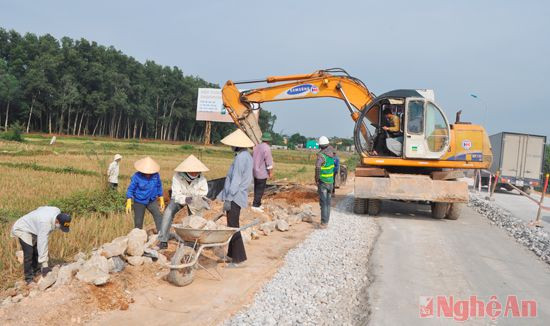 |
| Construction work on the upgrade and expansion project of National Highway 48. Photo: Hoang Vinh |
According to the Ministry of Finance, the reasons for the large amount of outstanding capital investment debt from the state budget have been repeatedly pointed out, such as: the need for investment to serve socio-economic development in ministries, sectors, and localities is very large, while the State's capital balancing capacity is limited. The capital conditions have not met the increasing investment needs, leading to a situation where capital is not allocated according to schedule, and even projects that have been tendered and equipment ordered have not received funding. According to Trinh Nam Tuan, Acting Director of the Investment Department (Ministry of Finance), in terms of macroeconomic management, the management of capital investment debt has not been considered an important aspect of capital investment management; there are no specific regulations on the requirements and content of management, no clear definition of responsibilities, and no specific sanctions for handling violations. Besides the long-standing and widespread problem of scattered investments exceeding the state budget's balancing capacity, there is still a situation where the effectiveness of state management in this field is insufficient to prevent it in a timely manner," said Acting Director Trinh Nam Tuan.
Funds are still being advanced despite the unclear source of payment.
The inadequacy in the decentralized management system (local authorities decide on investments according to the law on investment and construction management, but funding is provided by the central budget based on available resources) has persisted for many years. Furthermore, the lack of a medium-term investment plan to serve as a basis for investment decisions and the allocation of investment capital according to project implementation progress is also a cause of scattered investment and outstanding debts in capital construction. This is compounded by the general difficulty of decreasing budget allocations; to ensure investment efficiency, ministries, sectors, and localities must select, review, and prioritize investment projects, leading to some projects not receiving funding.
At this workshop, many delegates argued that the responsibility of ministries, departments, and localities in management at all levels is not high enough, and even the capacity of investors does not meet management requirements. There are even cases of projects proceeding without capital, bidding, or ordering equipment. Coupled with a short-term mindset in some localities, some leaders, due to haste, have made investment decisions that do not comply with state regulations. Furthermore, lax management, failure to inspect, detect, and supervise in a timely manner; and the lack of monitoring and management of outstanding construction debts have caused difficulties for investors, contractors, and management agencies alike. Even before project funding is allocated, investors have already commenced construction, exceeding the planned volume and expanding investment beyond the budget's capacity.
In many cases, the bidding documents or contract award decisions explicitly state that the contractor must advance capital as a criterion for selecting a contractor. Contractors (especially construction contractors), under pressure to complete the work, continue construction, even advancing capital despite uncertainty about the source of payment, thus contributing to the accumulation of outstanding debts in construction projects. Some contractors believe that important local projects using state budget funds will eventually be reimbursed, leading them to borrow money for construction. The scattered allocation of investment capital, the lack of attention to debt repayment, and the reliance on state budget support are also key contributing factors – Acting Director Trinh Nam Tuan stated frankly.
Tighten the mechanism for managing investment finances.
To avoid outstanding construction debts, an objective and essential requirement is that ministries, local authorities, and contractors must fully comply with and strictly implement current legal regulations on investment management and construction projects. First and foremost, this involves strictly adhering to the provisions of the Public Investment Law; ensuring that no outstanding construction debts arise after 2014.
According to the Ministry of Finance, along with the continued reform of the general investment management mechanism through the promulgation of the Law on Public Investment, the Law on Construction (amended), the Law on Bidding (amended), and guiding decrees, the management and control of budget expenditures must be even more rigorous; the use of investment capital from the state budget must be economical and efficient, and financial discipline and order must be further strengthened. To improve the efficiency of investment capital management, the Ministry of Finance is implementing amendments and additions to a series of mechanisms in the management, payment, and settlement of investment capital to meet new requirements. This revision boldly introduces new management mechanisms that clearly and more fully demonstrate the role and responsibility of financial agencies at all levels in investment capital management; while also expanding the scope of management to meet the requirements of strict management of state budget investment capital at all stages of implementation.
Speaking at the conference, Deputy Minister of Finance Tran Van Hieu stated that the adjustments and amendments aim to concretize the new regulations of the newly issued laws and decrees, synchronously based on the principle of further enhancing the responsibility of financial agencies at all levels. Capital management will be more stringent, and the Ministry of Finance has drafted many circulars to replace old regulations on the management and payment of investment capital from the state budget. At the same time, it will further regulate the responsibility of the Treasury in evaluating the situation of advance payments to contractors and the responsibility of coordinating with the investor to recover advance payments in cases where the funds are not used for the intended purpose, and strengthen cost control of the project management board. Accordingly, the mechanism for managing the costs of the project management board will be unified under a common financial mechanism with a clear revenue and expenditure mechanism, accurately reflecting its nature as a department assisting the investor in managing the project implementation process, which is guaranteed by the state budget – Deputy Minister Tran Van Hieu affirmed.
Specifically to minimize misappropriation and underspending, the new circular will stipulate the responsibility of financial agencies at all levels in verifying annual expenditure estimates; and will regulate the annual settlement of expenses for allocation to investment projects. These new regulations will fundamentally change the awareness and responsibility of implementing agencies at all levels, thereby improving overall management capacity and efficiency, especially limiting negative practices in the settlement of completed projects. It is hoped that with these revised guidelines in the management of investment capital by financial agencies in general, as well as related units, the actual management and use of state investment capital will undergo significant changes, minimizing potential negative practices, in line with the Party and State's directive to strengthen financial discipline.
Red River


