
World in the first six months of the year: "Gray" dominates!
(Baonghean) - Following the rather bleak outlook of the world in 2014, many analysts predicted that a breakthrough in 2015 would be difficult. And indeed, as predicted, the first six months of this year continued to be shrouded in gloom. Baonghean newspaper would like to present some notable events that occurred in the first six months of 2015.
Terrorist attack on the Charlie Hebdo newspaper office.
In the early days of the new year, the world was shaken by the shooting at the Charlie Hebdo newspaper office. On November 7, 2015, at 11:30 AM (Paris time), a car suddenly stopped outside the Charlie Hebdo magazine office in the 11th arrondissement of Paris, France. Two terrorists, armed with Kalashnikovs and rocket launchers, stormed the office and opened fire before fleeing. A total of 12 people were killed and 4 injured. Among the victims were four well-known satirical cartoonists for Charlie Hebdo. At the time of the attack, the gunmen identified themselves as members of the Al-Qaeda terrorist group and stated their motive was revenge for the newspaper's publication of cartoons depicting the Prophet Mohammed. This was the first bloody attack on a newspaper office in France and the deadliest attack in France in at least 40 years.
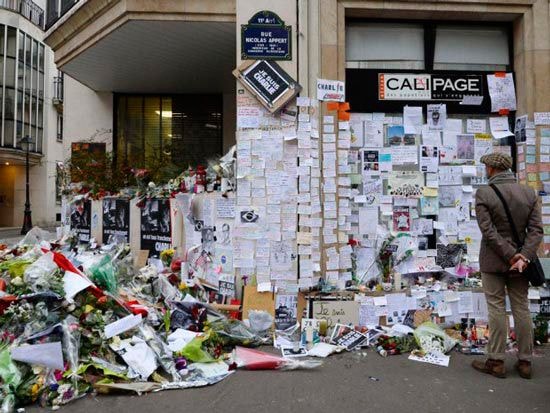 |
| Commemorating the journalists murdered near the Charlie Hebdo editorial office. |
Charlie Hebdo is a French satirical weekly magazine that typically publishes cartoons, news reports, polemics, and jokes. The magazine expresses anti-racist and left-leaning views, therefore its satirical topics are directed towards the far right, religion (Catholicism, Islam, Judaism), politics, culture, etc. Consequently, the magazine has repeatedly been the subject of lawsuits, threats of attack, and attacks from religious extremists.
Despite facing numerous difficulties, culminating in the terrorist attack on January 7th, Charlie Hebdo did not abandon its publishing strategy. Following this bloody terrorist attack, the West and many anti-Muslim countries expressed solidarity against terrorism; or "stood with Charlie Hebdo"...
However, this has sparked considerable debate regarding the boundaries of freedom of information and the limits of freedom of expression on religious matters; and whether or not it is appropriate to make fun of the faith of a religion, specifically the Prophet Mohammed – a figure revered by the Muslim world – through caricatures. This only exacerbates the growing divide between Western civilization and the Islamic world, leading to conflicts that can only be resolved through violence, terrorist attacks, or even war…
Nepal devastated after earthquake.
According to statistics, the earthquake on April 25th destroyed approximately 160,786 homes, damaged 143,673 homes, and devastated 16,000 schools. Most villages in mountainous areas were severely affected. Around 8.1 million people were impacted, with approximately 3.0 million in need of emergency food assistance. According to UNICEF, about 1.7 million children were severely affected by the disaster. An initial assessment report from Nepal's archaeological agency indicates that around 60 temples across the country were destroyed. Reports from the Department of Archaeology under the Ministry of Culture, Tourism and Civil Aviation indicate that more than 200 monuments were damaged…
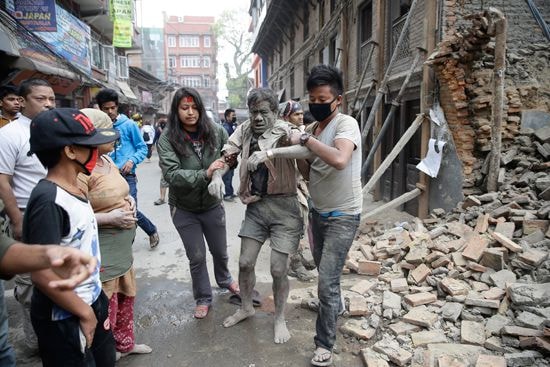 |
| A man was fortunately rescued from the rubble after the earthquake disaster in Nepal on April 25, 2015. |
Statistics show the horrific devastation caused by the 7.8 magnitude earthquake that struck Nepal at 11:56 AM on April 25th. However, even now, nearly two months after the earthquake, the damage is still ongoing. These are only initial statistics; the reality is that the aftermath of the earthquake will bring about countless other problems. Economic experts estimate that the country will need $10 billion to rebuild. Even with continuous international aid pouring into Nepal, restoring and rebuilding this poorest country in the region is no easy task, not to mention the irretrievable loss of valuable assets…
Migration crisis
In the first six months of this year, the world has witnessed a series of humanitarian disasters caused by people from impoverished, violent, and war-torn regions of Africa, the Middle East, and Asia leaving their homelands for Europe in the hope of finding a better life. What is particularly concerning is the intense "European Dream," leading these migrants to disregard the potential cost to their lives. Statistics show that over 20,000 people have died crossing the sea to Europe in the past 15 years. In 2014, 3,500 people died while crossing the Mediterranean Sea. And in 2015, as of April 20th, the number had already exceeded 1,500.
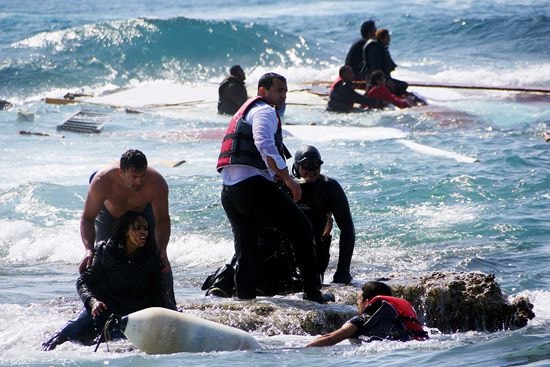 |
| Migrants were rescued when their wooden boat ran aground on the Rhodes reef (Greece) on April 20, 2015. |
So what is the reason why illegal migration has been so rampant in the first six months of 2015, despite the risk to their lives? To answer this question, let's consider Libya, a country with a high number of migrants arriving by sea from across the Mediterranean to Italy. Since the "Arab Spring" political upheaval, orchestrated by the West, which led to the collapse of several African states, including Libya, the subsequent chaos and lack of control of newly established governments have created widespread violence, turning people's lives into hell and providing a fertile ground for traffickers to organize illegal sea crossings and profit from it. Those who fail to cross the sea are captured, brought back to land, and detained in concentration camps along the Mediterranean coast of Libya. They say they would rather die at sea than return home, because returning would also be tantamount to death. This explains why the media consistently reports an increasing number of deaths, yet immigration shows no sign of decreasing.
While not as severe as in Europe in terms of scale and number of fatalities, Southeast Asia recently experienced a humanitarian disaster when thousands of migrants were stranded at sea. These migrants, primarily from the unrecognized Rohingya minority in Myanmar and Bangladeshi citizens, sought refuge abroad in search of a less harsh and oppressive life.
But the truth is, after the governments of Thailand, Indonesia, and Malaysia resolutely refused to accept this influx of migrants, the migrants were left adrift at sea in conditions lacking food, medicine, and fresh water. Fortunately, faced with the threat of a humanitarian disaster, the governments of these countries and the international community joined forces to help.
The South China Sea is once again turbulent.
A year after China unilaterally deployed the Haiyang 981 oil rig, coast guard vessels, and missile frigates, "driving" fishermen deep into Vietnam's continental shelf and exclusive economic zone with the aim of creating a smokescreen to divert domestic and international attention and cover up its insidious actions of monopolizing the South China Sea through the realization of the "nine-dash line," China is frantically transporting raw materials to renovate and build infrastructure on islands in the Paracel and Spratly archipelagos.
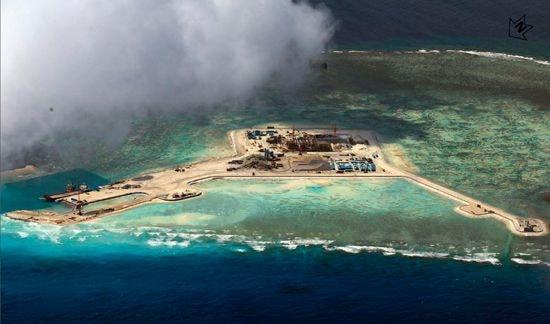 |
| Satellite imagery shows that China is accelerating the illegal construction of artificial islands in the South China Sea. |
Thus, since 2009, when it presented to the United Nations its absurd nine-dash line claim encompassing over 80% of the South China Sea, China has increasingly aggressively implemented measures to turn the South China Sea into its "private pond." Specifically, it brazenly established Sansha City, encompassing the Paracel and Spratly Islands, which belong to Vietnam. This action by China violates the provisions of international law and the Declaration on the Conduct of Parties in the South China Sea (DOC), which China signed with ASEAN in 2002; hinders the process of building a Code of Conduct in the South China Sea (COC); and continues to engage in actions that destabilize and threaten security and peace in the South China Sea.
Alongside the illegal construction on the islands to realize their sinister schemes, the statements of high-ranking leaders such as Chinese Foreign Minister Wang Yi have been unapologetic, even vehemently, in maintaining their stance of "seizing" the South China Sea. Wang Yi once asserted that Beijing "will not waver" on the issue of "protecting sovereignty in the Spratly Islands" during a meeting with his US counterpart John Kerry on May 16th; or, in a statement issued on April 9th, Chinese Foreign Ministry spokesperson Hua Chunying defiantly claimed that China "has indisputable sovereignty" over the Spratly Islands and surrounding waters; that China's construction activities there are "completely reasonable and lawful" and "not only for civilian purposes but also to enhance national defense capabilities."
Notably, in 2015, official statements from the Chinese government regarding land reclamation and construction activities in the South China Sea indicated military purposes, a stark contrast to previous claims that China's construction on the islands was "purely for commercial and civilian purposes."
Using economic and defense power to illegally seize sovereignty in the South China Sea, and employing great-power tactics to oppress smaller nations, will further diminish the prestige of a superpower. Many countries view China as an ambitious and insidious enemy…
Thus, even though only six months of 2015 have passed, the world has witnessed a series of "dark" events: terrorism rampant everywhere; increasing instability in the Middle East and North Africa; natural disasters and humanitarian catastrophes caused by illegal migration waves in Europe and Southeast Asia… However, alongside these events, there are still rare rays of hope, namely the agreement reached between Iran and the P5+1 group on a framework towards signing a historic nuclear deal, and the lifting of sanctions by the US, moving towards normalization with Cuba. Overall, this period, or perhaps the entire year of 2015, remains predominantly gray. The likelihood of any significant breakthroughs in resolving the persistent conflicts and crises in the remaining six months is low.
Canh Nam
| RELATED NEWS |
|---|


