
The world last week: War and Peace
Violence in Türkiye
Starting on Monday evening, October 6th, protests erupted across Türkiye and quickly escalated into violence, with clashes between pro-Kurdish forces and security forces. According to statistics from the Interior Ministry on Friday, October 10th, 31 people were killed and 360 injured.
These actions were in response to a call from the Popular Democratic Party (HDP), the main political representative of the Kurds in Türkiye. On Wednesday, October 8th, the hashtag "KobanelcinSokaga" ("Take to the streets for Kobani") flooded Turkish Twitter. The movement aimed to criticize the Ankara government's indifference to the risk of Kobani – a city with a large Kurdish population in northern Syria – falling into the hands of jihadist elements. Only Turkey has access to the city via the border because the other two Kurdish forces in Syria, Afrine and Qamichle, are separated from Kobani by the vast Muslim-majority territories controlled by ISIS.
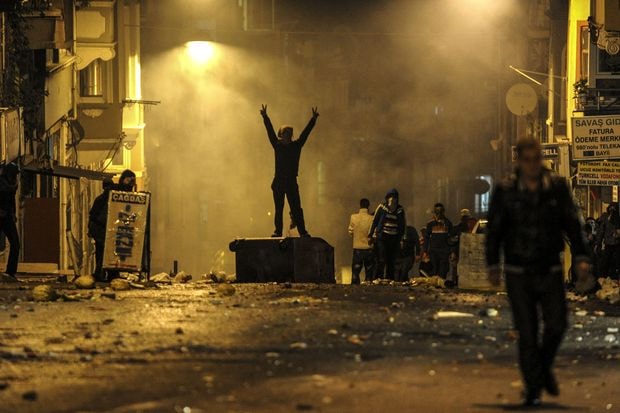 |
| The city of Diyarbakir was devastated. |
By Friday, October 10th, while ISIS had almost completely captured the city of Kobani, the situation in Türkiye was also becoming increasingly complex, favoring Kurdish fighters and their supporters. The protests and violence were no longer confined to Kurdish-populated areas but had spread to major cities like Istanbul and Ankara. There, the movement's initial goals were quickly diverted, sparking riots, arson, looting, and violence that engulfed Turkey (for the first time since the PKK – Kurdistan Workers' Party – and the army in the 1990s).
The situation in Türkiye is likely to become more complicated as clashes occur not only between the army and protesters supporting Kurdish fighters, but also between the armed factions themselves. Members of the PKK are fighting against the Islamists of Hudapar, a Kurdish religious party allied with the Ankara government's AKP party and also the legal branch of the bloody Hezbollah organization – which has been sanctioned since the mid-1990s. Six Hudapar members in Diyarbakir and two others in Markin have been killed. President Erdogan has called for calm, stating that "dark forces" are exploiting the chaos to undermine the peace process that Ankara has committed to with the PKK. Thus, Kobani in Syria is merely a pretext, a spark igniting political, social, and ethnic conflicts in Türkiye. Now, it's all burning, and will continue to burn, perhaps for a very long time, even after the Kobani incident subsides.
Hong Kong: The rain hasn't stopped yet.
The Hong Kong government's announcement on Thursday, October 9th, that it was withdrawing from negotiations, once again fueled discontent among the civil disobedience movement. On Friday, October 10th, thousands of students took to the streets again, responding to Joshua Wong's call to "Bring tents to show your determination to stay put," a call from one of the leaders of the protest movement against the new electoral reforms decided by Beijing.
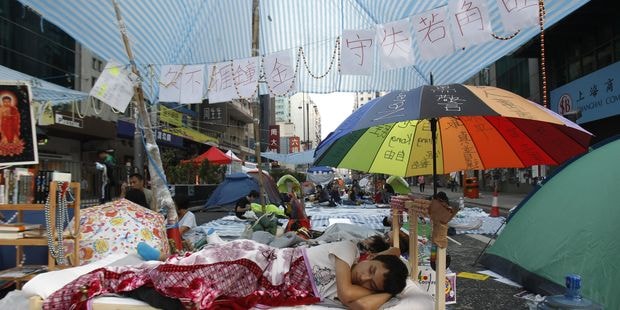 |
| Protesters occupied major streets in Hong Kong on October 10. |
This past week has certainly been difficult for the Hong Kong government, as Chief Executive Leung Chun-ying is alleged to have received a $6.4 million bribe from an Australian company in a real estate project. This incident occurred before Leung took office in July 2012, but was only recently exposed by the Australian press. Although no official statement has been made, the Hong Kong Department of Justice has launched an investigation. This scandal further tarnishes Leung Chun-ying's image, already described as a "puppet of Beijing." However, many are asking why this scandal was exposed at this particular time? Is Beijing "sacrificing a pawn" to secure a dignified exit for itself?
However, it is still too early for the protesters to rejoice, because after the police crackdown and tear gas attacks last weekend, the number of protesters has decreased significantly. Protests and roadblocks are not something that all Hong Kong people approve of, especially when the daily lives of residents living in the protest hotspots are undoubtedly significantly affected.
North Korea: Silence also makes the whole world ask questions.
For over a month now, North Korea has shown absolutely no new moves, neither conciliatory nor aggressive. The irony is that this "unusual" silence is being questioned. It seems that vigilance towards North Korea has never been taken lightly.
The young leader Kim Jong-un has "disappeared" from all media channels. He was even absent from the 69th anniversary celebration of the Workers' Party. The lack of an official explanation from Pyongyang has only fueled speculation and rumors about this mysterious regime. The most widely considered theory is that a coup has overthrown Kim. However, according to Antoine Bondaz, a North Korea expert at the Asia Centre, this is unlikely. If it were a coup, "there would have to be troop movements and transfers. Information would certainly have leaked to South Korea and China. Currently, there are no signs that the ruling regime is in danger." Adam Cathcart of the University of Leeds commented: "If Kim Jong-un doesn't show up in the next three weeks, people will start to have doubts. But again, that basically won't harm the regime. Right now, everything in the country is not just normal, but absolutely normal." Furthermore, sending a high-level delegation to South Korea for the closing of the Asian Games also demonstrates the regime's stability.
There are suggestions that Kim Jong-un will be replaced by his sister Kim Jong-un while he recovers from illness. However, Antoine Bondaz considers this contrary to the regime's tradition: "Kim Jong-un doesn't appear for just one day; there's always a transition." He believes the illness hypothesis is more plausible, with surgery or gout being the most reasonable explanation for a few months' absence: "The leader's image and health are the top priority for this regime. So if Kim Jong-un isn't in good enough shape to appear, his absence is entirely possible."
The Nobel Peace Prize for peace
The Nobel Peace Prize was announced and awarded simultaneously to two people: Malala Yousafzai from Pakistan and Kailash Satyarthi from India, for their contributions to the fight for children's rights. This marks the 29th time that two people have been awarded the Nobel Peace Prize at the same time.
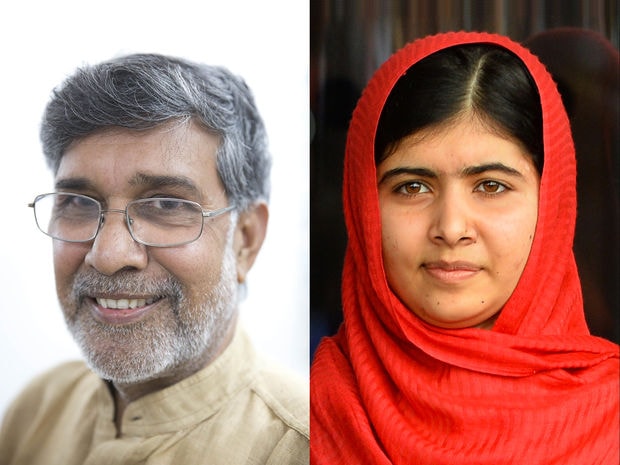 |
| Kailash Satyarthi (left) and Malala Yousafzai, co-recipients of the Nobel Peace Prize. |
Malala Yousafzai, 17, became the youngest Nobel laureate in history. A symbol of the fight against religious extremism worldwide, she is an activist striving for children's right to education. In her speech before the United Nations in June 2013, she said: "Take up pen and paper. That is the most powerful weapon we have." Currently living in the UK, she has established a foundation bearing her name and supports children's education movements in Pakistan, Nigeria, Jordan, Syria, and Kenya. Kailash Satyarthi, 60, is a "continuing Gandhi tradition" by leading peaceful protests against the exploitation and economic abuse of children.
What is most significant is that the Nobel Peace Prize was awarded simultaneously to a Hindu and a Muslim – a Pakistani and an Indian – a young and an old – a woman and a man. This is irrefutable proof of the existence of a common path amidst the myriad differences in ethnicity, religion, and gender that are the source of conflict and bloodshed everywhere in the world. It is a voice worthy of respect, a shared and united struggle against social injustice. That is Peace.
Thuc Anh (compiled from Le Monde)


