
Attracting and utilizing talent: Emphasizing dedication and contribution.
(Baonghean) - Nghe An province has been implementing a policy to attract high-quality human resources since 1999. The target groups include experts, top-performing graduates, master's and doctoral degree holders, high-achieving athletes who have won national and international awards, and specialists (Level 1 and Level 2); primarily, top-performing graduates seeking employment… In reality, talented and skilled individuals always have brilliant ideas and initiatives. And good ideas will be maximized if managers know how to evaluate and appreciate them.
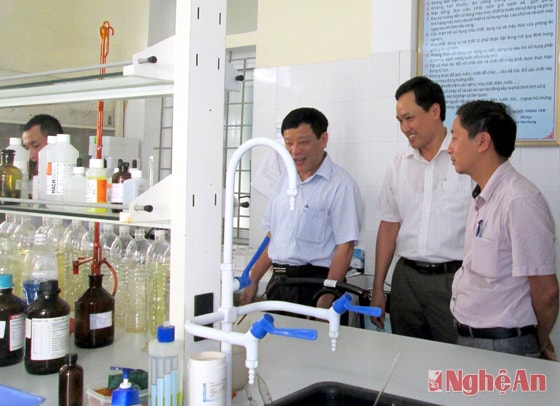 |
| Director of the Environmental Monitoring Center, Department of Natural Resources and Environment, Le Van Hung (center), in the laboratory. |
"Use people like you use wood."
From 1999 to 2014, our province attracted a total of 523 high-quality human resources (including 70 recruited in 2014). The expectations for this workforce to contribute to the province are very high. Attracting talent is not only a "hunt" by localities but also by businesses. After graduating from the Department of Chemical Engineering and Technology at the University of Technology, young engineer Nguyen Hoang started working at the Song Con Sugar Factory. Through practical experience, he recognized shortcomings in the factory's sugar production line, and from there he developed an innovative improvement project that won first prize in the Nghe An Provincial Science and Technology Award in 2012 (in 2011, engineer Hoang also won second prize in the province's Science and Technology Award). Two initiatives by Nguyen Hoang, implemented at the Song Con Sugar Factory, not only helped recover more sugar but also increased sugarcane crushing capacity threefold compared to the initial design capacity. Furthermore, they significantly reduced costs and shortened crushing time, benefiting farmers and improving their production cycle. However, the true value of Hoang's initiatives lies in the fact that the factory's management fully utilized them and invested hundreds of millions of dong in upgrading the production line, resulting in an annual profit of 320 million dong for the factory.
Further research reveals that some individuals who were initially recruited by Nghe An province have now fulfilled their roles and responsibilities in their respective workplaces, such as Bui Van Hung – Chief of the Office of the Department of Labor, War Invalids and Social Affairs; Hoang Thi Thu Trang (born in 1981), formerly Chief of the Office of the Department of Justice, now Deputy Director of the Provincial Enforcement Department; and Le Van Hung (recruited in 2001), a top graduate from the Environmental Science Faculty, Hanoi National University, who joined the Department of Natural Resources and Environment and is now Director of the Department's Environmental Monitoring Center. Most of these individuals have received attention, respect, and favorable working conditions from their superiors.
Mr. Le Van Hung recalled, “When I returned to work in my hometown, the Director of the Department of Natural Resources and Environment at that time, Mr. Dinh Viet Hong (now Vice Chairman of the Provincial People's Committee), strongly supported our new initiatives and solutions. This gave us confidence and enthusiasm in our work. Mr. Hong agreed with most of my proposed solutions. For example, when the incident occurred at the Nghi Yen landfill, I advised on a wastewater treatment plan using physico-chemical technology, sedimentation, filtration, and catalysts to promptly treat the leachate that spilled into the environment, and Mr. Hong immediately agreed to implement it. Similarly, when the dam of the Thanh Chuong cassava processing plant broke, I advised on solutions to reinforce the leak point, reduce the plant's production capacity, and accelerate the construction of the wastewater treatment plant, which he also accepted.”
Since becoming Director of the Environmental Monitoring Center, I have elevated the center's analytical capabilities to meet the international quality management system standard ISO 17025:2005, enabling the analysis of many complex substances.” Engineer Le Van Hung is also known to have participated in several provincial-level scientific projects related to the environment. Meanwhile, Hoang Thi Thu Trang, Deputy Director of the Civil Enforcement Department, said: “Upon taking up my position, I was assigned by the Director of the Department of Justice, Nguyen Huu Thuan, to work in the Legal Document Review and Construction Department. This is the ‘backbone’ of the department. Here, I am always updated on the Party's guidelines and policies, the State's laws, and local management and administration; the work requires critical thinking.” "Those working in the appraisal and review of legal documents have access to other areas of work: economics, internal affairs, finance, land... This first job was an important foundation that helped me to better approach expertise in other areas of work." Having accumulated experience and in-depth knowledge of law, Hoang Thi Thu Trang was assigned the position of Chief of the Office of the Department – a job that encompasses and synthesizes all the work of the agency and the sector. And now, in her new position, she is in charge of inspecting and resolving complaints in the field of civil enforcement, which helps her understand and share the difficulties and hardships of her colleagues. Besides being assigned the right person for the right job, the trust in the younger generation from the leaders of the Ministry, the General Department of Civil Enforcement, the provincial leaders, the Department of Justice, and the Civil Enforcement Department is a driving force for her to strive and improve herself. The working environment is very important for young people to develop their talents and responsibilities…
Thus, "using people is like using wood," truly talented individuals will thrive if they are placed in the right position, given the right opportunities, and receive the attention and care they deserve. Talented people don't wait for age to achieve success. They are young, talented, ambitious, driven by a desire for innovation, who embrace challenges, are always creative, hardworking, and inspiring – these are the keys to the success of any organization or business. They inspire the organization, and their abilities are further enhanced when they are given a deserving position.
Adjusting policies
Currently, Nghe An has not been able to attract leading experts, including professors, PhDs, and specialists (levels I and II), due to unfavorable working environments and inadequate facilities for scientific research. According to Mr. Dinh Xuan Lam, Deputy Director of the Nghe An Department of Internal Affairs, the workforce currently being recruited is primarily comprised of university and college graduates. The majority of them excel in their assigned tasks, as assessed by their employers, thereby contributing to improving the quality of the province's officials and civil servants. A large number of Nghe An residents graduate from universities and colleges annually, approximately 16,000-17,000 people.
The province's talent attraction policy is being adjusted to suit the new situation. Previously, the provincial budget provided initial support for outstanding graduates, but recruitment was through civil service examinations. In 2014, the province implemented direct recruitment of "talented individuals." The Provincial People's Committee issued Decision No. 57/2013/QD-UBND stipulating the target group: "Those who graduated with honors or higher from public universities in Vietnam (excluding transfer programs) with university entrance exam scores as follows: 23 points or higher for exam blocks: A, A1, B, K, T, V; 22 points or higher for exam blocks: D1, D2, D3, D4, D5, D6, M; 20 points or higher for exam blocks: C, N, H, R, S." Before the civil service recruitment exam, the recruiting units will apply a preferential direct recruitment method for those with high university entrance exam scores and excellent university graduation results, meeting the professional degree requirements and other requirements set forth by the units in the province that are currently recruiting.
The remaining candidates will then be selected through a recruitment process. “After the Department of Internal Affairs announced 150 recruitment quotas for 2014, the Provincial People's Committee approved 412 applications from 196 individuals (some submitted 2-3 applications). The Department of Internal Affairs selected 70 positions. These were primarily filled by candidates from the Finance, Law, and Economics sectors. The current problem is that positions in the technical, medical, agricultural, and forestry sectors have not been filled, while other sectors have not been filled, resulting in an oversupply. Following this recruitment drive, the Department of Internal Affairs will propose to the Provincial People's Committee to consider lowering the university entrance scores for the agricultural and forestry sectors (high-achieving students rarely apply to these fields). The management of the recruited civil servants is currently being handled by the relevant departments and districts. The Department of Internal Affairs requires agencies and units to assign suitable jobs to the correct positions,” Mr. Dinh Xuan Lam added.
It's time for transparency in personnel management, similar to financial transparency on the stock exchange, in order to truly integrate into the global economy. Recently, the Ministry of Transport has implemented the slogan "Further innovation, greater decisiveness, higher quality, greater efficiency, faster acceleration, and greater development," and has held competitive examinations for many important positions such as Director of the Traffic Safety Department and Director General of the Road Administration. Recently, Mr. Nguyen Van Thach, Deputy Director of the International Cooperation Department, was selected for the position of Director of the Traffic Safety Department with 87.92 points. While the first examination may have been met with skepticism, with some believing it to be merely a formality, the second, third, and fourth rounds, coupled with stricter laws in many areas and disciplinary actions against incumbent officials for legal violations, have truly created a ripple effect and built trust among the people. Believing that there will be innovation, fairness, and breakthroughs in the province's policies in the coming period, opportunities will become more accessible to more people, especially talented individuals and young people.
 |
| Ms. Hoang Thu Trang, Deputy Director of the Provincial Civil Enforcement Department, was formerly a student under the talent attraction program. |
Emphasizing dedication
Dr. Vu Minh Khuong (National University of Singapore) recently gave an interview to "Tuanvietnam" on the topic of talent selection, which received many positive comments. According to Dr. Khuong, selecting talent can be based on three Ps: Passion – the desire to stay (to contribute), Productivity (must be productive and make real contributions), and Preparation (prioritizing young people because they have the potential to contribute to the future).
Indeed, if we consider Dr. Khuong's three P criteria, we see that young people today have many opportunities to showcase their talents, express themselves, and use their acquired knowledge and intellect to make groundbreaking contributions to their teams, their organizations, and, more broadly, to their homeland and country. The position of young people in a country should not only be measured by their position or the organization they work for, but also by what they accomplish for the country with their youth. Let's look at the reality: severe environmental pollution, a skyrocketing increase in traffic accidents, more deaths annually than diseases, traffic congestion, and unsafe food hygiene threatening human lives… If a young person is truly intelligent and talented, no one would refuse to accept their feasible proposals, solutions, and projects, if those solutions and proposals are truly crafted from mature practical experience, have a solid foundation, are feasible, and the proposed solutions are convincing to the authorities.
The quality of "dedication" is also highly valued by most managers, because talented individuals work with their hearts, selflessly, and are inspired to achieve the unit's goals. Useful talents must first and foremost have a desire to contribute, continuously work more effectively than others, think of things others haven't, and provide strategic and tactical advice for the unit's long-term development. They must travel widely, have broad knowledge, and possess a comparative perspective. The broader their vision, the more strategies and advice they can offer to survive and compete. Furthermore, talented individuals must understand the emotions of managers, know when they need to lend a hand, and, more broadly, understand what the country needs to know what they must do. They are always proactive, finding optimism even in failure to move forward, and when faced with difficulties, they are the ones who always find ways to overcome them.
Policies to attract talented individuals to work in local areas are necessary, but there are too few positions; the streamlining of the bureaucracy still has many shortcomings; and the management and development of this workforce to ensure they truly become talented individuals still require much discussion…
On the other hand, there is no shortage of talented people, but being talented doesn't necessarily mean being truly skilled. For talented individuals to become truly skilled, the role and capabilities of the leader and effective management are crucial. The desire for change and the creation of a strong, competitive, and victorious organization will be the driving force for managers to constantly seek out and train talented individuals. Skilled managers will utilize human resources in the right positions and according to their strengths, allowing talented individuals to fully leverage resources, thereby maximizing their potential and influencing those around them. In short, the core of a talent attraction policy lies in how to inspire the spirit and enthusiasm of talented individuals to contribute to the common cause.
Chau Lan


