
The Prime Minister attended and delivered a speech at the opening ceremony of the 10th ASEM Summit.
On the evening of October 16th (Vietnam time), the 10th Asia-Europe Summit (ASEM 10) officially opened at the Milan Convention Center in Italy, a major economic, trade, and financial hub of Europe.
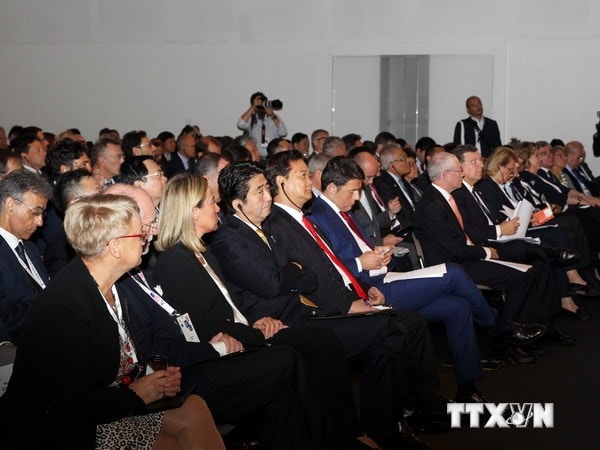 |
| Prime Minister Nguyen Tan Dung attends the opening ceremony of the Asia-Europe Summit. Photo: VNA. |
| RELATED NEWS |
|---|
The high-level Vietnamese delegation, led by Prime Minister Nguyen Tan Dung, attended the conference.
European Commission President Manuel Barroso, European Council President Herman Van Rompuy, and Italian Prime Minister Matteo Renzi co-chaired the official welcoming ceremony for ASEM leaders with solemn protocol.
At the ceremony for the admission of Croatia and Kazakhstan, the leaders warmly congratulated the two new members on officially joining the ASEM family, affirming the Forum's attractiveness and dynamic development.
In his opening remarks at the Conference, President of the European Council Herman Van Rompuy highlighted the significant achievements of the Forum since the 9th ASEM Summit in Vientiane, Laos, in 2012, further emphasizing ASEM's role as a leading mechanism for cooperation and dialogue between the two continents.
Mr. Rompuy emphasized that with the theme "Responsible Partnership for Sustainable Growth and Security," the 10th ASEM Summit will propose measures to strengthen cooperation across all three pillars: political dialogue, economic cooperation, and cooperation in other fields, leading up to the 20th anniversary of the ASEM Forum in 2016.
In subsequent statements, the Prime Minister of host country Italy, the leaders of the coordinating members Mongolia, Malaysia and the European Commission, along with Laos as the host country of ASEM 9, emphasized the importance of increasing ASEM cooperation and contributions in the face of rapid and unpredictable changes in the two continents and the world.
Following the opening ceremony, the leaders held the first plenary session on “Promoting economic and financial cooperation through enhanced Asia-Europe connectivity.” The conference assessed that the global economy is gradually recovering, but remains unsustainable, uneven, and fraught with risks. The Asian economy continues to be a driving force for global growth, and structural reforms in Europe are laying the groundwork for stronger growth in the medium term.
The conference agreed on the need to continue promoting economic and financial reforms, expedite the ratification of the WTO Trade Facilitation Agreement, and strengthen policy coordination with the G-20 to promote sustainable, robust, balanced, and inclusive growth. The conference particularly emphasized connectivity between the two continents in all three aspects: infrastructure, institutions, and people, as well as the potential for enhanced cooperation and connectivity in digital technology, aviation, and space.
Also on the evening of October 16th, at the second plenary session on "Asia-Europe Partnership in Responding to Global Issues in an Integrated World," leaders agreed that global challenges are becoming increasingly acute, especially climate change – humanity's greatest challenge in the 21st century, natural disasters, epidemics, food, water and energy security, and rapid population growth. All these challenges are profoundly and multifacetedly impacting every country and every continent, hindering efforts to achieve the Millennium Development Goals.
Prime Minister Nguyen Tan Dung, along with the President of South Korea, the Chancellor of Germany, and the Prime Minister of Malta, were invited to deliver keynote speeches at the second plenary session.
In his speech, Prime Minister Nguyen Tan Dung emphasized that in just over a decade at the beginning of the 21st century, humanity has been facing more severe and complex global challenges than ever before. These include the most serious economic and financial crisis in over 100 years, the double disaster of earthquake and tsunami in Japan, and more recently, Super Typhoon Haiyan devastating the Philippines, and now Ebola in Africa, the largest pandemic ever.
All these challenges are intertwined, leading to unpredictable consequences in the economic, social, political, and security spheres, hindering efforts to maintain peace, stability, economic recovery, and the lives of people in all regions.
Therefore, Prime Minister Nguyen Tan Dung proposed that, in order to coordinate actions and contribute to global efforts, ASEM should identify sustainable development as a crucial component of cooperation in responding to global challenges, with people being the goal and the center.
The top priority now is to contribute to achieving the Millennium Development Goals and building the post-2015 development agenda, promoting a new global climate agreement at the Paris Conference, and cooperating on disaster risk reduction at the Sendai Conference.
Accordingly, ASEM needs a global development mindset and an interdisciplinary, innovative approach to food security, water resources, and energy in the face of climate change, which is making these challenges complex and unpredictable.
At the same time, it is necessary to strengthen joint efforts in disaster prevention, mitigation, and post-disaster recovery, such as establishing a network for information exchange and cooperation as soon as possible. This is because the two continents of Asia and Europe are suffering the most from natural disasters, such as superstorms, rising sea levels, droughts, and severe floods. The Asia-Pacific region experiences approximately 70% of global natural disasters, and two-thirds of the victims of natural disasters are in Asia.
Prime Minister Nguyen Tan Dung emphasized that ASEM needs to coordinate effectively and synchronously between activities and initiatives within the Forum framework as well as with other mechanisms. In particular, adequate attention should be paid to the participation and support in narrowing the development gap, sub-regional and regional cooperation among ASEM members, especially Mekong-Danube cooperation, and strengthening capacity building for developing members.
Prime Minister Nguyen Tan Dung affirmed that responding to global challenges has always been a key component in efforts to build a dynamic, resilient, and cohesive ASEAN Community, and in cooperation between ASEAN and its partners. These efforts have been realized and strongly implemented through various programs and agreements.
At the informal summit held this morning, ASEAN-EU leaders affirmed their determination to move towards a strategic partnership, prioritizing the promotion of economic and trade relations, connectivity, and addressing global challenges.
The cooperation agreement between Ben Tre province of Vietnam and Tulcea province of Romania, signed during this Summit and within the framework of Mekong-Danube cooperation, is further vivid evidence of the practicality of the Asia-Europe partnership.
Prime Minister Nguyen Tan Dung highly appreciated the support of the members for Vietnam's three new initiatives at the 10th ASEM Summit: "ASEM Workshop on Sustainable Water Management for Food Security," "ASEM Youth Week: Stronger Action to Address the Challenge of Zero Hunger and Poverty," and "Conference on Green Skills Towards Inclusive and Sustainable Growth."
The 10th ASEM Summit will continue its activities on October 17th, including a session on “Strengthening Asia-Europe Dialogue and Cooperation and the Future of ASEM”.


