
Perform the tasks of social monitoring and criticism effectively.
(Baonghean) - The 2013 Constitution continues to affirm the supervisory role, while also adding an important function - the function of social criticism - of the Vietnam Fatherland Front and mass organizations. To better understand the new role of the Vietnam Fatherland Front and mass organizations, a reporter from Nghe An Newspaper interviewed Comrade Nguyen Van Huy - Provincial Party Committee member, Chairman of the Provincial Fatherland Front Committee - on related issues.
(Baonghean) - The 2013 Constitution continues to affirm the supervisory role, while also adding an important function - the function of social criticism - of the Vietnam Fatherland Front and mass organizations. To better understand the new role of the Vietnam Fatherland Front and mass organizations, a reporter from Nghe An Newspaper interviewed Comrade Nguyen Van Huy - Provincial Party Committee member, Chairman of the Provincial Fatherland Front Committee - on related issues.
Reporter:Could you please tell us about the practical implementation of the functions of social supervision and criticism, and participation in building the Party and government by the Vietnam Fatherland Front and other political and social organizations in our province in the past period?
Comrade Nguyen Van Huy:Social monitoring and criticism are important tasks contributing to the building of the Party and the government by the Vietnam Fatherland Front and other mass organizations. The monitoring and criticism of the Vietnam Fatherland Front and mass organizations have been stipulated in the 1992 amended Constitution, the documents of the 10th and 11th Party Congresses, and several state legal documents... Particularly, the 2013 Constitution further affirms the role of monitoring and adds another important function – the function of social criticism – of the Vietnam Fatherland Front and mass organizations.
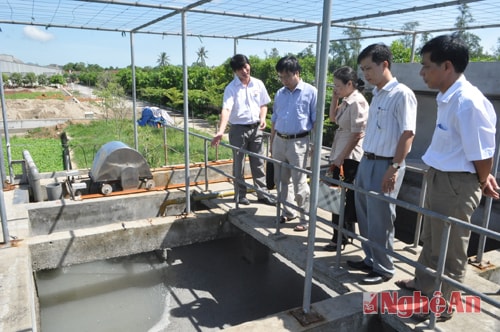 |
| Representatives of the Provincial Fatherland Front participated with the Provincial People's Council in addressing wastewater treatment at Trang An Confectionery Company (Cua Lo). Photo: mh |
In Nghe An province, fulfilling its supervisory function, the Provincial Fatherland Front has recently coordinated with the Nghe An National Assembly Delegation, the Standing Committee and various Committees of the Provincial People's Council to participate in programs monitoring the implementation of laws and resolutions of the Provincial People's Council in many areas of social life; monitoring the selection and appointment of judges and prosecutors; monitoring the process of granting pardons, etc. At the district and commune levels, the Fatherland Front has also coordinated with the Standing Committee of the People's Council at the same level to monitor the implementation of laws and resolutions of the People's Council in the locality. The Fatherland Front and other mass organizations have also independently monitored some specific issues such as monitoring the election of National Assembly deputies and People's Council deputies at all levels; organizing some delegations to monitor the implementation of laws in some agencies and organizations; and some cases of resolving complaints and denunciations from citizens…
It can be affirmed that the supervisory role of the Vietnam Fatherland Front (VFF) and mass organizations has been quite rich and diverse in recent times. The opinions contributed by the VFF through supervisory activities have been accepted by the agencies, organizations, and individuals being supervised, and many issues have been adjusted and rectified, creating practical effectiveness and building trust among the people. However, one difficulty and obstacle affecting the performance of the VFF and mass organizations' supervisory function is the lack of specific guidelines assigning the VFF and mass organizations the responsibility to lead the implementation of this function. This leads to many issues and recommendations made by the VFF through supervision not being promptly and effectively accepted, processed, or rectified by the competent agencies and organizations; furthermore, some issues remain unresolved, and there is no specific, clear mechanism to ensure the VFF and mass organizations can effectively address them.
Regarding social critique activities, in the past, they have mainly been limited to participating in providing feedback, suggestions, and recommendations on draft policies, programs, projects, and resolutions of the People's Council, People's Committee, and state administrative agencies... Due to the lack of specific regulations, the Vietnam Fatherland Front has not been able to independently lead and conduct critiques related to all policy orientation and planning issues..., leading to the role, effectiveness, and efficiency of social critique by the Vietnam Fatherland Front and other mass organizations not reaching their full potential.
Reporter:What is the significance of the two decisions recently issued by the Politburo on regulations for social supervision and criticism, and participation in building the Party and government by the Vietnam Fatherland Front and political and social organizations, in the current political and social life and for the Fatherland Front system at all levels, Comrade?
Comrade Nguyen Van Huy:Since the establishment of the Vietnam Fatherland Front (VFF), the Politburo's Decisions No. 217/QD-TW and No. 218/QD-TW, issued on December 12, 2013, are the first documents to specifically and comprehensively regulate the functions of social supervision and criticism, and participation in building the Party and government by the VFF and political and social organizations. These two Politburo decisions are of special significance, creating a new impetus for promoting people's democracy through the VFF system and political and social organizations in a broader and more effective way; this is also one of the conditions for building people's trust in the Party, the State, and the regime. These two decisions will also help strengthen people's management and supervision in all areas of political and social life, including the supervision of officials and civil servants in the performance of their assigned duties. This contributes to building a stronger Party and government, because supervision helps prevent negative behaviors that may occur among cadres and civil servants. It also creates conditions for fostering the intellect of all segments of society, encouraging their participation and critical feedback on sound, effective, practical, and people-centered socio-economic policies, decisions, plans, and resolutions.
Reporter:Given their significant importance, what do you think needs to be done to ensure these two decisions are implemented promptly?
Comrade Nguyen Van Huy:In order for the Vietnam Fatherland Front and political and social organizations to effectively perform their functions according to Decisions 217 and 218 of the Politburo, in addition to the efforts and progress of the entire system of the Vietnam Fatherland Front and political organizations, it is necessary to leverage the combined strength, including taking advantage of the experience, wisdom, and expertise of managers and leading experts through the establishment of advisory councils.
Initially, the Provincial Fatherland Front plans to establish and strengthen three advisory councils on socio-economic policies; on ethnic and religious issues; and on democracy and law. On the other hand, for effective and high-quality social supervision and criticism, the subjects of supervision and criticism must be strong, possess courage, professional expertise, and the ability to perceive, analyze, and evaluate issues. Therefore, Party committees at all levels need to plan, train, assign, and rotate capable cadres to work in the Fatherland Front and other political and social organizations. Emphasis should be placed on young cadres with competence and qualifications in both professional skills and political theory. Only by correctly identifying the needs for cadres can we proactively create a pool of personnel, avoiding piecemeal or arbitrary personnel transfers.
At the same time, Party committees and government agencies at all levels need to create favorable conditions and be genuinely receptive to listening to the opinions and suggestions of the Fatherland Front and people's organizations. Regulations need to be established and the relationship between the Party and the Fatherland Front clearly defined. The Party must be positioned as both the leader and a member of the Fatherland Front. Only by correctly defining this relationship can the Fatherland Front and people's organizations effectively perform their functions of social supervision and criticism. A specific and comprehensive mechanism should be developed regarding the powers and responsibilities of the Fatherland Front towards its member organizations; and regarding the responsibilities of Party committees and government agencies towards the recommendations and feedback of the Fatherland Front and the people during the supervision and criticism process. Only then can the Fatherland Front truly and fully demonstrate its role as a broad political alliance representing the people's right to self-governance. On the other hand, for the Fatherland Front at all levels to effectively supervise and provide feedback, Party committees and governments at all levels need to create a relatively independent position for the Front, not heavily dependent on the State in terms of organization, personnel, and finance. There should be mechanisms and policies to commend and encourage those who perform well in supervision and feedback, and to protect those who are honest and straightforward in their oversight and feedback efforts.
Reporter:Thank you, comrade!
Mai Hoa


