
Winning bids for drugs: Increased dosage to drive up prices.
According to a survey by Vietnam Social Insurance, the list of drugs awarded to hospitals in 11 provinces and cities under the new regulations applied from June 1, 2012, includes many antibiotics with unusually high concentrations, unlike the commonly used antibiotics today.
 |
Notably, these drugs face very little competition and are priced significantly higher than comparable drugs with the same active ingredient, originating from Vietnam, and with standard dosages on the market.
There is no way to stop it yet.
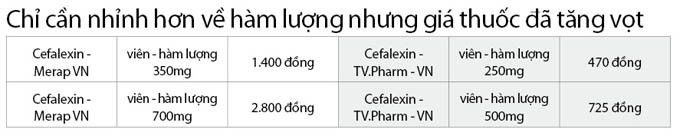
A survey by Vietnam's Social Insurance agency shows that the price of Cefalexin 350mg tablets, produced by Merap Group Joint Stock Company (Vietnam) and awarded a contract in Binh Duong province, is 1,400 VND/tablet. Meanwhile, the same 250mg tablets (the commonly used dosage), also produced in Vietnam and awarded a contract in Binh Duong province by another pharmaceutical company, cost only 470 VND/tablet. Even the Cefalexin 500mg tablets (also the commonly used dosage) from the same pharmaceutical company, awarded a contract in Binh Duong province, cost 725 VND/tablet, nearly half the price of the newer 350mg tablets, also from Vietnam and awarded a contract in Binh Duong province.
Also in this category, the winning bid price for the combination drug Cefoperazol + Sulbactam 1.5g + 750mg, including VAT, was 99,000 VND/bottle, while a product from another pharmaceutical company with the same combination and winning bid in the same category, but with a dosage of 1.5g + 1.5g, was almost half the price, at only 59,000 VND/bottle. Cefotaxim with a dosage of 1.5g (the only one winning the bid in the category) was priced at 35,000 VND/bottle, while a product with the same active ingredient but a dosage of 1g cost only 9,350-25,000 VND/bottle. Ceftazidim with a dosage of 1.25g won the bid at 59,000 VND/bottle, while Ceftazidim with a dosage of 1g, of the same Vietnamese origin and in the same category, won the bid at only 30,000 VND/bottle...
According to Associate Professor Dr. Le Van Truyen, former Deputy Minister of Health and former Chairman of the Vietnam Pharmaceutical Manufacturers Association, the national pharmacopoeia specifies the dosages of Cefalexin tablets and capsules as 250mg, 500mg, and 1g; while Ceftazidim vials contain 250mg, 500mg, 1g, 2g, and 6g. However, recently, Cefalexin tablets of 350mg and 700mg, and Ceftazidim vials of 1.25g have also been observed. A pharmaceutical expert from the Vietnam Social Security believes that theoretically, drugs can be produced with any dosage, but the crucial factor is the price. It is difficult to accept a slightly higher dosage resulting in a price many times higher. "This could be a loophole used by businesses to create a monopoly," this expert assessed.
According to a survey conducted in the first five localities that completed bidding under the new Circular 01, the Drug Administration of Vietnam has just announced that compared to 2012, similar bidding packages in 2013 have reduced drug procurement costs by 28-57 billion VND. However, according to Mr. Vu Xuan Hien, head of the Pharmaceutical and Medical Supplies Department (Vietnam Social Security), there is a trend of drugs with unusually high concentrations, 1-2 times higher than usual, but priced more than three times higher. "We have discussed this phenomenon with the Drug Administration, but currently there are no measures to prevent it," Mr. Hien stated.
Concerns about Chinese medicine.
Authorities are also concerned about the trend of "Chineseization of the pharmaceutical market." Under the new bidding regulations, drugs meeting technical standards will be auctioned individually, but when it comes to price, many Chinese drugs win bids because of their very low prices. For example, the winning bids in Binh Duong province included Ceftriaxone 1g from Qilu (China); the winning bids in Hai Phong included Conxime 0.75g from Shandong Hualu (China), Biloxim 1.5g from Shijiahuang (China), and Cefuroxim powder vials from Shenzhen Zhijum (China); the winning bids in Thua Thien Hue included Tinidazol from Sichuan Kelun (China), and Ampicillin + Sulbactam from Shandong (China)...
"We are very concerned because even motorcycles, clothes, fruits, and even ginger from China have been found to contain toxins, despite their attractive appearance, shiny finish, and low price. If cheap medicine is used and treatment is prolonged, the damage will be far greater than the issue of drug prices," said an expert from Vietnam's Social Insurance agency.
Currently, Vietnam Social Security is compiling a list of recently awarded Chinese medicines, assessing the extent of this trend, and promptly proposing appropriate management measures.
According to Tuoi Tre - TH


