
Finding a direction for shrimp seed production.
As the world's leading shrimp exporter, shrimp brought in $4.1 billion for Vietnam in 2014 (accounting for nearly 52% of the value of seafood exports). However, we only produce 3,000 pairs of black tiger shrimp broodstock annually (meeting only 10% of the demand), while all whiteleg shrimp broodstock must be imported.
$10 million to import shrimp larvae.
According to the General Department of Fisheries (Ministry of Agriculture and Rural Development), in 2014, Vietnam imported approximately 248,000 whiteleg shrimp broodstock. From this broodstock, businesses produce over 100 billion commercial shrimp larvae annually to supply shrimp farmers.
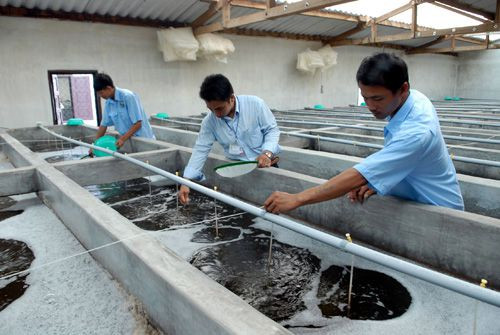 |
| Viet-Australia Co., Ltd. invests in a shrimp hatchery in Ninh Phuoc district (Ninh Thuan province). |
Because Vietnam has not yet been able to produce broodstock shrimp domestically, it has to spend $10 million USD annually importing them from the US, Singapore, Thailand, and Indonesia (each broodstock shrimp costs an average of $40-$50 USD). However, each pair of broodstock shrimp only lasts for 3-4 months before needing replacement, so we are always dependent on imported shrimp larvae.
According to Mr. Pham Anh Tuan, Deputy Director General of the General Department of Fisheries, "Due to our dependence on imports, we face many disadvantages such as: Limited supply, often insufficient to meet production needs; High prices and inconsistent quality."
According to Mr. Phan Tuan Cu, owner of Tuan Cu Private Enterprise (Binh Thuan Shrimp Seed Association): “Because we depend on imported sources, the quality is not guaranteed. We don't get to choose the shrimp seeds; we use whatever they send. Sometimes the shrimp are very big, sometimes very small. Some batches grow very quickly, but unfortunately, some batches grow slowly, and the farmers have to bear the consequences.” Mr. Tuan also stated that due to the unreliable quality of shrimp seeds, two suppliers of broodstock shrimp were recently disqualified.
“We have the potential to research and produce broodstock shrimp, but the coordination mechanism with research institutes is still complicated. The government needs to have preferential policies for businesses regarding taxes, land, etc., then more businesses will be willing to invest in research on broodstock shrimp,” said Mr. Nguyen Hoang Anh, Director of Nam Mien Trung Aquatic Investment Co., Ltd.
According to the General Department of Fisheries (Ministry of Agriculture and Rural Development), Vietnam needs an average of 130 billion commercial shrimp larvae annually for aquaculture, including 100 billion whiteleg shrimp and 30 billion tiger shrimp. Over the years, Vietnam has conducted numerous research projects to create broodstock shrimp for the market, but to date, no unit has officially announced the production of broodstock shrimp. “We are also conducting research and expect to begin testing in 2015, with the possibility of supplying broodstock shrimp by 2016,” said Mr. Nguyen Cong Can, Deputy General Director of Viet Uc Group, a company specializing in supplying shrimp larvae.
Towards proactively securing sources of shrimp larvae.
To proactively secure a supply of whiteleg shrimp broodstock, "the Ministry of Agriculture and Rural Development has directed the Research Institutes for Aquaculture 1 and 2 to conduct research in two phases. The immediate phase focuses on quickly producing high-quality broodstock to replace imports. It is expected that broodstock will be available for production in 2016. The second phase, a long-term project, aims to obtain high-quality broodstock to supply the market by 2020," said Mr. Pham Anh Tuan.
According to Dr. Nguyen Huu Ninh, Deputy Director of the Research Institute for Aquaculture I: "We have imported five different shrimp populations, including a population of natural origin, for research; we have initially selected the first generation (G1)."
In addition, "Vietnamese-Australian businesses are also researching broodstock shrimp, and they have already obtained the third generation (G3). They expect to have broodstock shrimp in 2015. However, this will not be easy," Mr. Ninh said.
Confirming this information, Mr. Nguyen Cong Can, Deputy General Director of Viet-Australia Group, said: “We import broodstock shrimp production technology from Australia, which has over 10 years of research experience. This year, we have not yet launched broodstock shrimp on the market, but we will conduct trial production and market evaluation. We expect to start producing broodstock shrimp in 2016.”
However, according to Mr. Pham Anh Tuan, Deputy Director General of the General Department of Fisheries, obtaining high-quality broodstock shrimp is very difficult because we still conduct research by importing broodstock shrimp from different countries, crossbreeding and selecting over many generations. Therefore, creating top-quality original shrimp is very challenging.
Sharing this view, Mr. Robins, representative of CP Group (Thailand), stated: "The broodstock shrimp exported to Vietnam are only for the production of commercial shrimp larvae and cannot be used for research on broodstock production, because if not careful, it could lead to inbreeding, causing degeneration in subsequent generations."
According to News


