
Finding a new direction for painting.
(Baonghean) - Despite dedicating their passion to painting and creating numerous memorable works in the art world, these artists are unable to make a living solely from their profession. In a new trend, artists are "branching out," taking on side jobs such as graphic design, printing and embroidery, and advertising design.
Passion
When discussing the fine arts of Nghe An, it's impossible not to mention veteran artists such as Tran Minh Chau, Ho Thiet Trinh, Nguyen Dinh Truyen, and Tran Hoang Trung… Most of these renowned artists are active members of the province's fine arts association; they participate in annual exhibitions and have won prestigious awards and commendations. This generation of artists has made a significant contribution to establishing the province's fine arts as a distinct mark on the national art map.
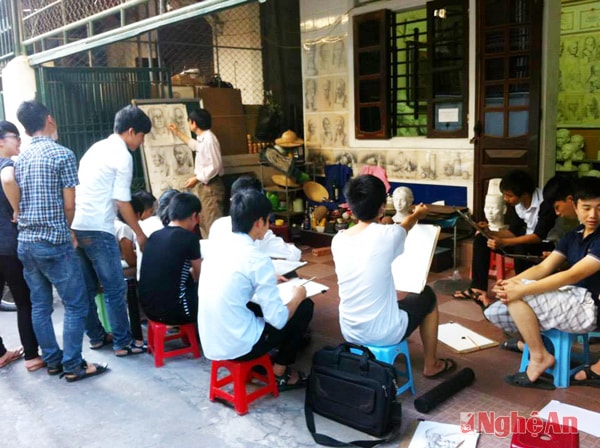 |
| Artist Nguyen Dinh Truyen (Vietnam-Germany Children's Cultural Center - Vinh City) is opening art classes for high school students. |
Stepping into the unassuming little house on Nguyen Sy Sach Street (Vinh City) of painter and sculptor Tran Minh Chau, we felt as if we had entered a miniature art museum. A series of paintings hung on the walls, and large and small sculptures were meticulously arranged from the yard and garden to the living room. He proudly showed us his sculptures, which had won prestigious awards from the Vietnam Fine Arts Association, such as "Border Love," "Diligence," and "The First Farmer"... Regardless of his position, from an employee at a photography and fine arts workshop in the 1980s to a provincial-level cultural management official, painter Tran Minh Chau always held a deep love for painting and sculpture. After work, he dedicated his time to his paintings and sculptures. He recounted that, despite the hardships of the past, he always tried to save every penny of his meager salary to invest in art materials. To cast a 10 kg statue, the cost of materials such as composite, fiberglass, and molds alone can amount to several million dong; some statues weighing 20-30 kg require months of saving up salary to complete. For him, it seems that all his activities related to art are simply about exchanging ideas and fulfilling his creative desires.
To date, numerous works of plaster and terracotta reliefs and monuments bearing the imposing and solid imprint of artist-sculptor Tran Minh Chau are on display at historical sites, government offices, and schools throughout the province. Notable examples include: the Victory Monument at the Truong Bon Historical Site, the Nguyen Tat Thanh Monument in Nguyen Tat Thanh Park (Vinh City), and the Monument to the 72 Soviet-Nghe Tinh Soldiers at the Trang Ke Historical Site (Yen Thanh)... However, he honestly admits that most of his award-winning works from exhibitions are still kept in his "family museum"; only a few have sold for double his salary in the 1980s, which was over 60 dong per month. In recent years, his award-winning works have not found buyers; each year, he only participates in a few commissioned art projects.
Artist Nguyen Dinh Truyen – a member of the next generation of artists, currently the Head of the Fine Arts Department of the Provincial Literature and Arts Association – is considered the author of woodblock and paper-cut works with a fresh and expansive style in lines and forms. His legacy from over 30 years of painting includes more than 70 works in various genres. His artworks have left a special mark, such as the painting "Countryside Afternoon," which won third prize at the Vietnam Union of Literature and Arts Associations (2007), or "Mid-Autumn Festival," which won third prize at the Northern Central Region Exhibition in 2009… And another job closely associated with his profession is passing on his love of art to generations of students. Artist Nguyen Dinh Truyen has been an art teacher at the Vietnam-Germany Children's Cultural Center for over 20 years. His love of art has borne fruit in his students, who have won art awards both domestically and internationally, such as Dau Thanh Huong, Vo Bich Thoa, and Phan Thanh Nhan…
To "nurture" his passion for art, painter Dinh Truyen regularly opens university entrance exam preparation classes for students taking the V and H subject groups each year. In addition, he prints and embroiders advertising signs on order to supplement his income. A large number of his paintings, over 30 in total, have been sold, but only a few have won awards, such as the woodblock print "Countryside Afternoon," which sold for 15 million VND. The rest remain "quietly" in the small corner of the room where the artist usually sits to create.
Artist Dinh Truyen confided that the environment for artistic activities in our province is still poor; the profession of painting has few opportunities to develop. Therefore, although the passion for the profession is great, the "profession" cannot support oneself, so most artists of his time practiced their profession in a makeshift way; therefore, the lives of painters were often difficult.
Turn sideways…
Artists in Nghe An are only allowed to participate in regional exhibitions held once a year, art workshops held every two years, and national exhibitions held every five years. Artistic exchange activities within the province are very limited, almost non-existent. There is a lack of art galleries to showcase, sell paintings, or facilitate professional exchange. Therefore, fewer and fewer young people are pursuing painting. In the Provincial Fine Arts Committee, the youngest member is approximately 40 years old; only a few new members are admitted each year. Most of today's young artists are formally trained at universities and colleges. However, the works of these young artists displayed in regional exhibitions are sparse and appear immature. Thus, the "gap" in Nghe An's artistic scene remains unfilled for an unknown period of time.
To understand the current career development trends of young artists, we visited the Nghe An College of Culture and Arts, the only institution in the province that offers a Fine Arts major. While five years ago the department had nearly 150 students per cohort, the number has steadily decreased in recent years. Currently, each cohort averages only 45-50 students. According to Master Le Vu Anh, the school's Vice Principal, approximately 30% of the Fine Arts department students are studying Applied Fine Arts, while the rest are studying Fine Arts Education. As for painting, the number of applicants has been so low in the last two years that the school hasn't been able to open a separate program, merging it with existing teacher training classes.
In reality, when there isn't much room for development in painting, most students choose applied arts to pursue their careers. After graduating with a degree in graphic design from the Fine Arts Faculty, Class K42, Nghe An College of Culture and Arts (a currently popular field of study), Mr. Doan Van Phu became a graphic artist at Xanh Architectural and Construction Design Company, specializing in interior and exterior decoration, gardens, and landscaping. He shared, "Painting has been my passion since childhood. However, instead of choosing painting, I chose to become a graphic artist to suit current trends. This job allows me to satisfy my passion for painting through murals, reliefs, and statues, while also providing me with an income of 8-10 million VND per month to support my life."
As for Duong Xuan Tung, a student from the Fine Arts Department of Nghe An College of Culture and Arts, after graduating with a degree in Fine Arts Education, he further studied Graphic Design. Thanks to his excellent skills, he is currently collaborating with two companies specializing in advertising design and interior design; therefore, his income from these jobs is quite high (over 10 million VND/month). His busy work schedule leaves little time for artistic creation, so he primarily conveys his aesthetic emotions through each product. For him, every product he creates, whether it's an advertising image for a product or brand, or a mural, is made with the same dedication as a work of art. The success of his "artwork" lies in the recognition of his clients.
Mr. Le Van Hai, a long-time lecturer in Graphic Arts at the Fine Arts Faculty of Nghe An College of Culture and Arts, shared: "Most students now choose applied fine arts because the social demand for these jobs is quite high, and most graduates find employment. They can apply their knowledge in advertising design, product branding, interior and exterior decoration, industrial design, etc."
Pondering for a new direction
The "detour" of artists can be seen as a flexible adjustment to survive and develop the profession. However, one thing we cannot help but wonder is where painting will go when the older generation of artists in our province return to their roots?! Meanwhile, the current generation of young artists participating in art events is very sparse. Only a few young artists strive to seek opportunities to exchange ideas and develop their profession in major cities and even abroad, where the art scene is more developed. Le Vu Anh, a Master's degree holder and Vice Principal of the Provincial College of Culture and Arts, and also a talented young artist, has chosen to develop his career in this direction. He has had the opportunity to exhibit and sell his works at an art gallery in Paris (France). On average, about 15 of Le Vu Anh's works are sold there each year, at prices ranging from 20 to 30 million VND per painting. Most of his paintings are done with oil paint, so the investment cost for each painting only accounts for about 20% of the selling price. Therefore, he continues to create regularly and "nurture" his passion with the income from his artwork. Although that amount is not much, it is still a dream for many young artists in our province today.
According to painter Le Vu Anh, for painting to coexist alongside applied arts, in line with current development trends, artists and those passionate about painting need to connect with each other, organize more art exchanges and exhibitions in the area. Artists themselves need to proactively create opportunities for exchange and connection, build art galleries, and create an environment for young artists to express themselves and interact with each other. At the same time, they should proactively integrate and create demand for appreciation and aesthetics, opening up broader avenues for accessing painting to connect with customers. Because building art galleries requires significant funding, the process needs to be socialized; creating opportunities for young artists to showcase and sell their work, with a percentage of the profits allocated to these galleries to maintain their operations. These art galleries could be set up at tourist destinations, attracting visitors while also showcasing and selling products to domestic and international tourists.
Furthermore, the association of artists needs to establish connections with travel agencies, event organizers, and construction design consulting firms to diversify its art markets. They should proactively approach, introduce, and promote artworks on websites and other interactive platforms that reach potential buyers. This will stimulate demand for artwork and open up new avenues for the art profession in the context of globalization.
Text and photos:Dinh Nguyet


