
Rediscovering performance spaces for folk songs.
(Baonghean) - “Come visit my homeland, the broom-making craft of my village is very famous… reed brooms, bamboo brooms, long brooms, short brooms. Once you’ve used them, you’ll use them forever…”, these simple folk songs seem to have been inextricably linked to the people of Son village, Thanh Linh commune (Thanh Chuong district), in the broom-making craft for generations.
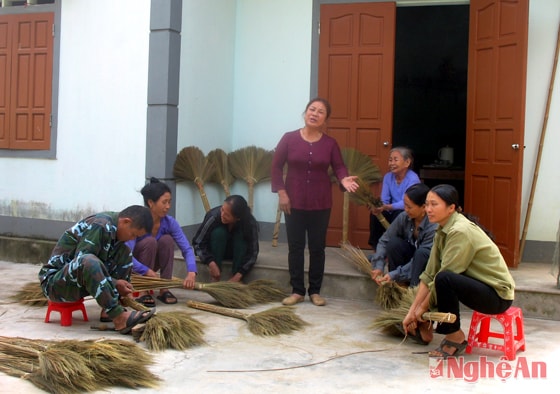 |
| The people of Son village (Thanh Linh - Thanh Chuong), a traditional broom-making village, are recreating a performance space for the folk songs of the Ví and Dặm styles. |
| RELATED NEWS |
|---|
Later, the Thanh Linh broom-making craft developed further. Along with the development of social life, the families in the craft village no longer produce in concentrated groups as before. However, those who love folk songs and melodies still strive to preserve their performance space. Ms. Nguyen Thi Tam, Vice Head of the Thanh Linh Folk Song Club, is the one who teaches folk singing to the people in the village and commune. To this day, in Son village, many folk song enthusiasts such as Mr. Hue – the Party Secretary, Ms. Ha, Ms. Duong, Ms. Tuong… are always actively participating in the movement and passionately practicing folk song performances.
Although in her sixties, Mrs. Nguyen Thi Tam's passion for folk songs remains strong. Born in a traditional craft village, she understands the work and characteristics of the craft. She independently researched ancient melodies from the elders in the village and composed new lyrics. Thanks to this, the folk songs about the broom-making craft have become increasingly diverse. Folk songs about the craft, such as "My Village is Changing," and "My Village's Broom-Making Craft," are often performed by the village's folk song club for the community during festivals and holidays. The performance space, linked to the craft itself, has been restored, with people singing while making brooms, attracting many participants. This strengthens community bonds and fosters pride in the traditions of their homeland.
Leaving Thanh Linh, we visited Ngoc Son carpentry village, a long-standing traditional craft village that the locals used to jokingly say, "Nghi Loc sawmills, Ngoc Son carpenters." Alongside this traditional craft village, the folk songs of the "vi" and "dam" genres exist; a place where the carpenters express their feelings and emotions for their homeland and country. Originating from their daily work, these folk songs bear the unique characteristics of the carpentry village. Mr. Vo Trong Thin, a resident of the village, said: "Since childhood, I've followed my grandfather and father to sing in the carpentry guilds in the village, sometimes in the village square, the warehouse yard, or even within my own home. The carpenters would carve and sing enthusiastically, responding to the rhythm of the chiseling and carving… 'Oh… how many pillars are in a four-pillar house? How many supporting pillars, how many rafters… how many purlins…'" These folk songs about the craft village are always preserved by the villagers with a special sense of pride. Besides collecting ancient lyrics passed down by the village elders, Mr. Thin also researched and composed new lyrics for the melodies; creating "Songs of the Craft Village," "Deep Affection for the Countryside," "Songs of the Craftsman"... simple, rustic lyrics like the witty conversations of the carpenters in the village: "At... your house, what kind of chisel do you use? What kind of animal can you feed it to prepare for when the storm... oh... rages?" These lyrics are still hummed familiarly by the people of Ngoc Son.
However, nowadays, people in traditional craft villages have few opportunities to participate in folk singing exchanges right in their hometowns. This is because the Ngoc Son carpentry village has changed with the development of society; the number of people practicing the craft is decreasing. The melodies and performances about the craft village only take place during festivals and holidays... Mr. Nguyen Nhu Hai, Deputy Director of the Thanh Chuong District Cultural Center, shared that although Thanh Chuong has quite a few traditional craft villages, only three folk singing clubs specializing in the "vi" and "dam" styles are developing: Thanh Linh (with broom and bamboo shoot making), Dong Van (with hat making), and Ngoc Son (with carpentry)...
In those areas, folk music enthusiasts are striving to restore the performance spaces associated with traditional craft villages. However, folk music exchange activities in these craft villages remain infrequent. Restoring the performance environment is considered a direction for preserving and promoting the value of Ví and Dặm folk songs in the overall development of society today; localities wish to organize Ví and Dặm folk music exchange activities within their own communities, especially in craft villages. However, there are currently very few folk singers in craft villages; some craft villages have not yet established folk music clubs to promote the movement; and funding for organizing exchange activities and developing performances locally is limited…
The folk songs and melodies of the past originated from spaces closely associated with traditional crafts, daily life, and the work of the people. Therefore, to preserve these folk songs and keep this cultural form alive in the community, it is necessary to have appropriate policies aimed at restoring traditional crafts and industries so that folk songs are linked to the living spaces and working environments of the community. At the same time, policies are needed to promote the role of artisans to maintain and build folk song groups, teams, and clubs in villages, regularly engaging in singing activities, linking them to village and community cultural activities so that folk songs can develop naturally.
Dinh Nguyet


