
Sophisticated fuel fraud
(Baonghean) - Along with price fluctuations, gasoline and diesel business activities in the province have become complicated. Businesses are taking advantage of price swings by closing down or selling in small quantities, failing to comply with regulated prices… Particularly, violations of regulations on measurement and technical standards are occurring, negatively impacting consumer confidence and demand; and affecting the reputation of legitimate businesses.
On October 22nd, in Tien Phong commune (Que Phong district), the provincial inspection team discovered that Binh Dinh Private Enterprise had altered the technical structure and measurement characteristics of an A92 gasoline measuring device; the actual error was found to be +7.5%. Also in Kim Son town, Que Phong district, Binh Huong Private Enterprise replaced the program IC of a 0.05s diesel measuring device to favor the seller, with an actual error of +7.25%. Each business was fined 70,000,000 VND, had its business license revoked for one month, and had two program ICs confiscated…
Previously, on October 10th, a specialized inspection team from the Department of Science and Technology conducted an inspection of the Yen Thanh gasoline and food store (belonging to the Dong Vinh General Food Trading Enterprise). During the inspection, the team discovered that the establishment had replaced the IC chip in the A92 gasoline measuring device to manipulate the measurement error in favor of the seller; the measurement error at the time of inspection was +4.4%. The Department of Science and Technology's inspection team issued a fine of 70,000,000 VND; revoked the business license for gasoline and oil trading for one month; and confiscated the IC chip.
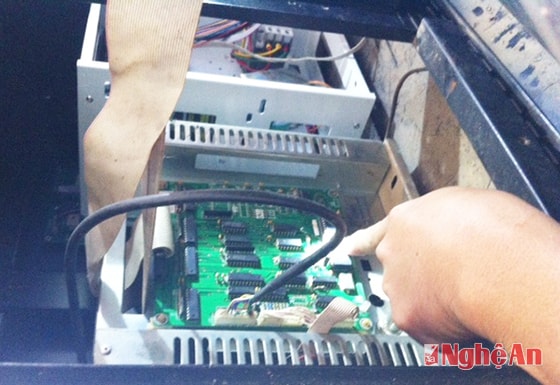 |
| The fraudulent device was discovered by authorities at a business establishment violating the Law on Measurement. |
Despite hearing numerous reports about fuel fraud, consumers are largely unable to protect themselves from the deceptive practices of unethical gas station owners. No other consumer sector forces buyers to turn a blind eye to such fraudulent practices as with fuel. "For consumers, fuel is a product where you only know what you're getting; you just pay and don't know about shortchanging or poor quality. The only support a customer has is the honesty of the business."
"If you do the math, an average motorbike owner spends 300,000 - 400,000 VND per month on gasoline. If a seller cheats by measuring fuel with a 10% margin of error, it means the customer has been ripped off by 30,000 - 40,000 VND per month. These practices are a form of defrauding the people and workers. We hope that when fraud is discovered, the authorities will handle it strictly to create fairness in business and protect the legitimate rights of consumers," shared Mr. Nguyen Dinh Hoa, a teacher at Nghe An College of Education.
As of April 2014, the gasoline and diesel distribution network in Nghe An province comprised 632 dealers and retail outlets with approximately 950 fuel pumps. The main suppliers of gasoline and diesel are the Vietnam National Petroleum Corporation (Petrolimex), the Petroleum Import-Export Company (Petex), the Petroleum Trading and Processing Enterprise (PDC), and the Vietnam Oil Corporation (PVOIL). Most retail outlets have upgraded their facilities, equipping them with modern, high-precision digital electronic fuel pumps to meet business and service demands. However, this technology also creates opportunities for fraudulent activities, as some businesses interfere with the automatic operating systems of the fuel pumps, causing losses to customers. This poses a significant challenge for authorities in managing fuel metering at these stations.
In accordance with Decision No. 1182/QD-KHCN-Thanh Tra of the Department of Science and Technology on specialized inspection of standards, measurement, product quality and industrial property, from October 10, 2014 to November 13, 2014, the provincial inspection team conducted surprise, random inspections of 46 gasoline and oil businesses in 9 districts and towns (including Dien Chau, Yen Thanh, Anh Son, Quynh Luu, Hoang Mai, Que Phong, Tan Ky, Tuong Duong and Ky Son). Through these inspections, authorities discovered 10 businesses violating regulations with fraudulent practices such as replacing program ICs; arbitrarily removing seals from measuring instruments without notifying the authorities; tampering with the power supply (disconnecting the power) to erase errors detected during the inspection; and using faulty measuring instruments with error levels exceeding the permissible limits. They arbitrarily removed the seals on measuring instruments without notifying the competent state agency. In addition to the above-mentioned tactics, some businesses did not carry out the required calibration of measuring instruments… Based on current legal regulations, the inspection team established a file, sealed the infringing items, and collected fines totaling 771,000,000 VND. The inspection team also provided the file to the Nghe An Provincial Police to investigate and clarify the cases of the dealers who violated the law.
According to Mr. Tran Quoc Thanh, Director of the Department of Science and Technology: Previously, fraudulent methods such as installing additional electronic measuring circuits hidden in the CPU slots of fuel dispensers, using SPKEY 2000 keyboards split into two different control panels (circuit modification)... were detected by authorities, so these methods are no longer used by businesses. Currently, there is a more sophisticated and discreet form of fraud to avoid detection by authorities: replacing the program IC to adjust the measurement error of fuel dispensers beyond the permitted level. Of 10 violating stores, 7 were found to be fraudulent using counterfeit ICs. The counterfeit program ICs look similar to genuine program ICs and can run two programs simultaneously, with different accuracy levels.
To operate the device in the wrong mode, a series of default passwords are entered, and the error margin is arbitrarily adjusted by the seller. To resume operation in the correct mode (when the buyer uses cans, bottles, etc., or when an inspection team arrives), simply disconnect the power supply to the measuring device or press any key on the device's keypad. The error margin of each IC is set by the business owner. The highest level of fraud detected during the inspection was 11.6% (buying 10 liters but actually receiving only 8.9 liters), while according to regulations, the allowable error margin for the pump according to the new 2013 measurement standards is only 0.3%. This type of fraud is very difficult to detect because the program IC on the main board of the measuring device still has the seals of the measurement unit and the manufacturer, leaving no evidence to prove that the technical condition and measurement characteristics of the measuring device have been altered.
Gasoline and diesel fuel are commodities that consumers find difficult to monitor visually, making it impossible to detect measurement fraud or quality issues. Furthermore, authorities cannot constantly monitor every business involved in all aspects of their gasoline and diesel fuel operations. Therefore, the core factor determining the quality and quantity of these special commodities depends heavily on the business ethics. This requires gasoline and diesel fuel business owners to possess business ethics and avoid dishonest practices. To avoid fraudulent practices, Mr. Tran Quoc Thanh advises consumers: “You should buy gasoline by volume, not by round amounts of money, because usually when inspecting gasoline pumps, the inspection unit seals the pump with a round number of liters, and all those points adjust the IC correctly. Observe the display of the fuel meter, ask the staff to reset the meter to “0” before pumping; be wary if you see any unusual actions such as cutting off the power or pressing additional buttons before entering the amount. If you suspect the quantity is inaccurate, you can ask the sales staff to verify by pumping gasoline into standard containers available at the store or gas station (as per regulations) for inspection and comparison. In addition, you should boldly report any gas station or dealer that shows signs of violating regulations or intentionally shortchanging customers so that the gasoline business can be more transparent and fair.”
Given the current widespread nature of violations, authorities need to implement thorough preventative measures, comprehensive and sufficiently strong enforcement; publicly disclosing the identities of establishments engaging in fraudulent fuel measurement practices through mass media so that consumers are aware and can avoid them. Based on this, a broad monitoring network of the public and relevant agencies should be established to oversee fuel retail establishments. If violations are discovered, consumers will boycott the businesses, which would be the most effective deterrent against offenders.
Inspectors specializing in measurement, product quality, and industrial property have conducted inspections of gasoline and oil businesses in Nghe An province.
By November 5, 2014, inspections of 43 establishments had uncovered violations in 12 locations, resulting in fines totaling 561 million VND for 11 establishments, the revocation of licenses and business suspension of 7 establishments, and the referral of 1 establishment for exceeding its authority in quality measurement violations to higher levels for further action.- CL
Text and photos:Ngoc Anh