
The French president is struggling to cope with the "yellow vest" crisis.
(Baonghean) - In recent days, the center of Paris, the French capital, has experienced the most serious unrest since 1968. This can be considered the final straw after a series of protests by citizens and factions against President Emmanuel Macron's policies related to fuel prices, pension increases, and the minimum wage.
Observers believe that the protests and violence by the extremist "yellow vest" group are merely the "prelude" to the difficulties and challenges that Macron will face after 18 months in power.
The Arc de Triomphe has fallen.
The Champs Elysees Avenue and the Arc de Triomphe in the French capital of Paris have been the scene of disbelief in recent days. French police have had to use tear gas and smoke grenades to disperse crowds of unruly "yellow vest" protesters attempting to break through security barriers.
 |
| The Arc de Triomphe in Paris has witnessed the most serious unrest in the French capital since 1968 in recent days. Photo: AP |
Right on the Arc de Triomphe were slogans like: "Macron resign" or "The Yellow Vests will win"... Hundreds of people were arrested and more than 100 were injured in the protests and riots.
In fact, the French government's decision to increase fuel taxes had already taken effect last October. However, because it was implemented at the same time as rising global oil prices, it sparked strong protests among the population, especially farmers in the country.
Although the French government claims that the fuel tax increase aims to encourage people to use more fuel-efficient vehicles, thereby reducing environmental pollution, thousands of people still took to the streets to protest. More dangerously, according to observers, far-left, far-right, and non-governmental groups took advantage of the situation to infiltrate the protesters and incite public opinion.
The strategy of incitement appears to have succeeded, as President Macron's approval ratings in polls have plummeted to record lows. Furthermore, Macron's tough, uncompromising response has only fueled the fire, leading to accusations that he is alienated from the masses.
The "yellow vest" movement is a protest movement against rising fuel prices and living costs that is gaining widespread support in France. The movement erupted on November 17th with thousands of protesters setting up roadblocks across France to draw attention and disrupt traffic.
To address the situation, President Macron considered declaring a state of emergency during a meeting with security officials on December 2nd. It is expected that today (December 4th), Interior Minister Christophe Castaner will also present to the Senate's Law Committee an account of the attacks on police and the vandalism by extremist protesters, as well as the countermeasures.
The challenges have only just begun.
The recent breaking point is actually not entirely unexpected for the French public. According to observers, in the first year of his term, while President Macron has been considered successful in foreign policy, he has been quite unsuccessful in handling domestic issues.
Looking back since taking power last year, President Macron has implemented numerous measures to reform the economy and public institutions. Unfortunately, however, the reforms he has introduced have sparked controversy among the public.
In particular, decisions regarding taxes, or decisions allowing the loosening of tax laws and layoffs, have caused the President's approval rating to plummet.
A series of protests and marches took place throughout 2018 against various government policies. For example, in May, tens of thousands of people marched through Bastille Square to protest President Macron's economic reforms.
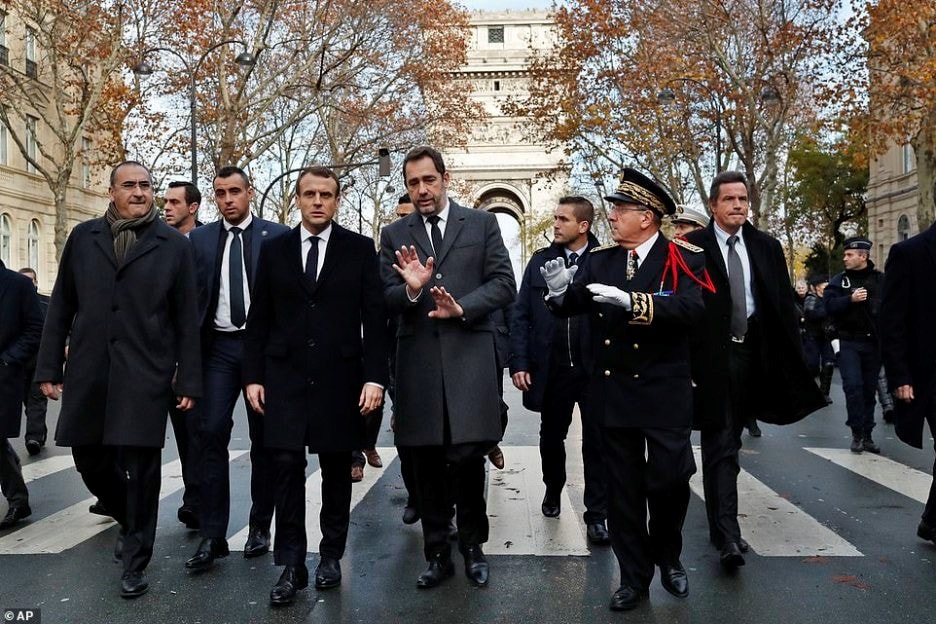 |
| After returning from the G20 summit in Argentina on December 2nd, French President Emmanuel Macron visited the Arc de Triomphe to assess the situation following the unrest there. (Photo: AP) |
According to Macron, these reforms will attract more foreign investors and help the French economy compete in the global market after years of stagnation. However, many argue that Macron is pursuing a profit-driven approach rather than prioritizing the interests of the working class.
As Philippe Martinez, head of the CGT trade union, commented, France needs change, but the government must above all take care of the people's lives. Some even argue that Macron is a president of the wealthy.
These developments are mirroring the grim predictions made when Macron was elected president last May, with a host of challenges that are not new but have existed in France for almost 20 years. These include a sluggish economy and a deeply divided society and political landscape.
Macron's responsibility at the time was clearly defined: not only to reconcile interests and unite the French elite, but also to connect with the entire population, who were deeply disillusioned with the ruling class. In fact, for many years, the French people had been utterly fed up with the infighting between traditional political parties, which had neglected the well-being of the people.
Therefore, voters placed their trust in a "very new" president like Macron. However, after just over a year in power, with numerous controversial policies, the French people seem to be running out of patience. Adding to this are extremist groups constantly seeking opportunities to incite unrest, leading to the serious instability we see today.
Clearly, the protests that turned violent were not merely a test at the start of his term, reflecting a sharp drop in approval ratings for the President. They are posing an enormous challenge to Macron: Will he persist with his current policies or will he make adjustments to appease the people?
However, in a recent statement at the G20 summit in Argentina, President Emmanuel Macron said that while he understands the anger of some people, he affirmed that he will continue to pursue reforms, including in the energy sector.
This statement demonstrates the French President's determination to implement the reform roadmap he has set out, but it also means that a new and difficult period awaits Macron in the coming days.


