
Widespread informal lending schemes and disguised rotating savings and credit associations (ROSCA)
Participating in informal savings schemes (such as rotating savings and credit associations) is understood as a form of fundraising to help people save money within a group with shared interests on a voluntary basis. However, recently, many people in Quy Chau, Dien Chau, and Nam Dan districts have reported via the Nghe An Newspaper hotline that some individuals in their areas are exploiting the gullibility, greed, and lack of knowledge of many people, transforming these schemes into opportunities for illegal profiteering.
(Baonghean)Participating in informal savings schemes (such as rotating savings and credit associations) is understood as a form of fundraising to help people save money within a group with shared interests on a voluntary basis. However, recently, many people in Quy Chau, Dien Chau, and Nam Dan districts have reported via the Nghe An Newspaper hotline that some individuals in their areas are exploiting the gullibility, greed, and lack of knowledge of many people, transforming these schemes into opportunities for illegal profiteering.
We visited the family of Ms. Ngo Thi That in Hamlet 5 along National Highway 48, following a recommendation from the Dien Lam Commune Police (Dien Chau District). Ms. That and her husband, Ngo Sy Thuan, are victims of a scheme run by Ms. Bui Thi Hoa in Hamlet 5. According to the Dien Lam Commune Police records, Ms. Hoa owes Ms. That 860 million VND. However, upon contact, Ms. That denied this, claiming that everything between her and Ms. Hoa was settled. Continuing along National Highway 48, we went to the house of Ms. Chu Thi Trinh in Hamlet 2.
Learning from our previous experience, this time we pretended to inquire about buying a house. And it seemed this tactic worked immediately. “Who told you guys this? Just whispering, there’s no way I’d go bankrupt and sell my house,” Ms. Trinh said angrily. Ms. Trinh was also a member of the lending group run by Bui Thi Hoa. According to her, Ms. Hoa had borrowed cash and owed Ms. Trinh 290 million dong in group loans. But that wasn’t all; Ms. Trinh herself owed nearly 1 billion dong to others, though she had almost paid it all off. “I started trading when I was 12, and just when I had earned a little capital, it was all gone. All my savings were snatched away by the tiger…” Ms. Trinh sighed bitterly.
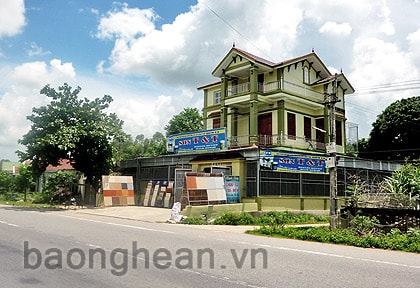
The house used to be owned by the Bui Thi Hoa family.
It has now been used as collateral for a debt.
There have been many sighs and tears of regret every day in the rural area of Dien Lam, home to nearly 15,000 people across 25 hamlets. All because of informal lending schemes. There were times when the people of Dien Lam looked at Mrs. Bui Thi Hoa in Hamlet 5 with respect. Now, that respect has been replaced by resentment. According to the Dien Lam Commune Police records, Mrs. Bui Thi Hoa was the head of an informal lending scheme with about 20 participants. The list of those who contributed to Mrs. Hoa's scheme and were subsequently owed money and absconded includes cases such as: Mrs. Nguyen Thi Hoa residing in Cau Giat Town, who lost 794,800,000 VND; Mr. Nguyen Sy Thuan in Hamlet 5, who lost 860,000,000 VND; Mr. Hoang Van Du in Hamlet 6, who lost 800,000,000 VND; Mrs. Le Thi Bich in Hamlet 1, who lost 173,000,000 VND; Ms. Chu Thi Trinh in Hamlet 2, who lost 213,000,000 VND… and many others. According to incomplete statistics, the total amount of money that Ms. Bui Thi Hoa owes to the local "gangsters" is approximately over 3 billion VND. Her spacious and impressive three-story house, the most prominent in the area, has also been mortgaged to someone else.
According to Mr. Thai Doan Tam, Head of the Dien Lam Commune Police (Dien Chau District), the commune police have only identified 4 informal lending groups (phường/hụi) in the area. These are cases where victims have filed complaints with the authorities. In reality, the number of such groups in Dien Lam commune is much higher. When questioned, Mr. Nguyen Thi Chien and Mr. Vo Van Tuan, residing in Hamlet 6, stated that his wife is the ringleader but has no intention of defaulting on her debts. Because the other members of the group haven't paid, Mr. Tuan and his wife don't have the money to pay others.
Mr. Tuan said that his wife is the boss of 10 wards and also manages 30 other wards. Among the 30 wards that Ms. Nguyen Thi Chien manages, the lowest rate is 600,000 VND per person, and the highest is 10 million VND per person. Mr. Vo Van Tuan also stated that he can't keep track of all the people who owe him money at once. Regarding debts to others, his family has had to sell their car and furniture to cover them. Pointing to the furniture in his living room, he said, "They took my furniture set, worth over 50 million VND, to settle their debt, so I took another set from someone who owed me money!"
Previously, the practice of playing "phường" (a type of informal lending group) was characterized by people pooling money to help each other alleviate poverty and develop the economy. The amount contributed varied according to the capabilities of each group. The order was determined by drawing lots; whoever drew first received the money first. Or, if someone needed money to resolve a family matter, others would gladly allow them to draw lots even if it wasn't their turn. However, nowadays, this form of "phường" has been exploited by some individuals for personal gain, manifesting as illegal misappropriation of funds. Accordingly, while still using the same method of pooling money, anyone wanting to receive "phường" funds must purchase them through an auction process.
Let's say a group of 10 people, with a stipulated contribution of 1 million VND per member. Those wishing to join the group must participate in an auction, buying through sealed bids. The highest bidder wins. This leads to a situation where, out of a total of 10 million VND, the bidders end up paying 5 million VND. This amount is considered profit, divided equally among the 10 people, each receiving 500,000 VND. The actual amount a successful bidder receives is only 4.9 million VND after paying a 100,000 VND commission to the group leader.
In reality, most of the money collected through informal lending schemes ends up in the pockets of a few individuals who exploit this system to raise funds and misappropriate capital. Typically, people participate in these schemes but rarely buy anything; they only contribute money to earn interest. Mr. Pham Van Chung, head of Hamlet 17, Dien Yen commune (Dien Chau district), stated that this interest rate is unbelievable! A lending scheme has 10 participants, each contributing 1 million VND. If the buyer has already paid 5 million VND, then naturally the remaining participants only contribute 500,000 VND each. Who wouldn't want to contribute 1 million VND to earn half the profit? But in reality, it's a case of "using their own money to pay themselves." The scheme's leader takes money from the participants and pays them back. Meanwhile, many people who participate in these schemes don't bid or buy anything; they only contribute money to earn interest and intend to only participate in the final rounds. However, they never get their turn, because once the opportunists have collected all the money, they declare bankruptcy.
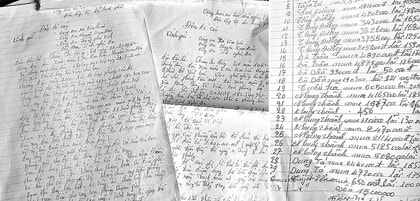
A list of those involved in illegal gambling and the consequences of greed.
The first thing that struck us upon arriving at Mau 4 hamlet, Mau Tai village, Kim Lien commune, Nam Dan district, was the gloomy atmosphere. Men and women were still standing and sitting by the doorsteps and along the pond's edge. Yet, they were silently and thoughtfully watching the houses of the group leaders. Entering the house of Mr. Dang Xuan Tu, the head of Mau 4 hamlet, Mr. Tu said that the hamlet has 19 group leaders, ranging from small to large. The practice of informal lending schemes has existed for a long time, but it has become particularly prevalent in the last two years with various forms of buying, selling, and bidding. Hundreds of households and individuals have participated in these schemes.
Mr. Dang Xuan Tu's wife, Ms. Duong Thi Phuong, is also a ringleader. Following Ms. Phuong's notebook reveals numerous pages and lines recording the names, lists, and amounts of money of many participants. In particular, we paid attention to the name Nhung Thanh – a prominent figure in most of the rotating savings schemes run by Ms. Duong Thi Phuong. Mr. Dang Xuan Tu stated that Ms. Nhung Thanh, also known as Nguyen Thi Nhung, residing in Mau 6 hamlet, Kim Lien – Nam Dan, is one of the active participants in these schemes. Currently, Ms. Nhung owes Ms. Phuong approximately 250 million VND, owes Mr. Ha Huy Minh in Mau 4 hamlet 1.1 billion VND, and owes Mr. Dong (Thang) 570 million VND…
Ms. Nguyen Thi Nhung participated in a rotating savings and credit association (ROSCA) with 3 to 6 members, and she wasn't just involved in one but in many different associations. When she was summoned to work with the Nam Dan District Police, she said she couldn't remember how many ROSCAs she had participated in, how many times she had bought shares, or how much money she owed. Each time the payment deadline for one ROSCA came, Ms. Nhung would buy shares in another to make up the difference. This vicious cycle of "ROSCA supporting ROSCA" has been raging wildly in the community of six hamlets, from Hamlet 1 to Hamlet 6, in Mau Tai village.
In order to raise money for informal lending schemes with the hope of earning unbelievably high interest rates (from 30-50%, and in some cases even 60-70% for a single purchase), many people mortgaged their land titles, borrowed from relatives, and took out high-interest loans... to buy dozens of shares without realizing that those interest rates were just "illusory" and their real debts were growing higher and higher. And because the schemes were virtual, collapse was no longer just a risk. Many residents claim that in Mau Tai village alone, there are 34 scheme leaders. Among them, prominent figures include Chau Thi Hong (Mau 3 hamlet), Nguyen Thi Ngoc Ha (Mau 4 hamlet)... Chau Thi Hong has defaulted on over 11.9 billion VND, and Nguyen Thi Ngoc Ha has defaulted on approximately 6 billion VND. These are the funds that the leaders mobilized from their "members" by any means necessary to transfer to an individual in Vinh City to receive high interest rates. And when this individual "disappeared," everything fell apart, hundreds of families were left penniless, burdened with debt, and a breakdown of public order and security became apparent.
According to Lieutenant Colonel Le Khac Thuyet, since the beginning of 2013, complex issues arising from informal lending schemes in Kim Lien commune have been detected. The district police have organized outreach efforts to the grassroots level to raise awareness, persuade, and explain the situation, but the people have ignored their warnings. Some individuals even informed each other that people shouldn't listen to the police, as doing so would lead to the loss of all their money invested in these schemes. Therefore, they should continue secretly participating to earn profits. Even when the scheme was exposed, many individuals tried to influence the district police, urging them to allow the schemes to continue operating in order to recover their money.
In Mau Tai village, there have been instances of debt collection, aggressive behavior, and a lack of self-control causing a disruption of public order and security. According to Lieutenant Colonel Le Khac Thuyet, the measures being applied by the Nam Dan District Police include continuous public awareness campaigns in the residential area. In recent days, the district police have also summoned dozens of individuals involved to the investigation agency for questioning. In addition, they have demanded that the village headman and those owing money to the villagers rectify the situation. Currently, the Nam Dan District Police, in coordination with the Criminal Police Department of the Provincial Police and the Kim Lien Commune Police, have deployed a special task force permanently stationed in Mau Tai village to ensure security and prevent further violations of the law.
Since November 27, 2006, the Government has issued Decree 144 on mutual aid associations and rotating savings schemes, which clearly stipulates the rights, benefits, and responsibilities of participants and strictly prohibits the exploitation of these organizations for usurious lending, fraud, or the abuse of trust to commit illegal acts. Through the issuance of Decree 144, the Government has recognized this as a form of mutual assistance among the people, and those participating are protected by law.
However, with the incidents that have occurred in Dien Chau, Nam Dan, etc., nowadays, whenever the term "phuong" or "hui" (a type of informal lending group) is mentioned, everyone thinks of it as a serious problem with very negative consequences. Many families have been on the verge of collapse due to financial ruin, and traditional brotherly and neighborly relationships have been fractured. Standing at the gate of Mau 4 village, reading the couplet: "Upholding the laws of the land and the family traditions is like guarding a precious gem / Cherishing village affection and neighborly love is like cherishing gold," it's truly sad to hear Mr. Ngo Canh Toan, a police officer in Mau Tai village, reminisce: "When will my village be peaceful again like it used to be...?"
Dao Tuan - Nhat Lan


