
Growing royal bananas in Piengho
(Baonghean)Upon arriving at Pieng Pho village, Pha Danh commune (Ky Son district), one can easily spot stretches of banana trees covering the steep mountain slopes. These are the royal banana forests planted by the villagers decades ago. Every month, the villagers harvest tens of tons of green bananas, which are then transported by truck to the lowlands.
Stopping by the banana plantation, I chatted with the village head of Piêng Phô, Mr. Lô Văn Xuân, who enthusiastically said: "The village has 52 households, and 50% of them grow bananas. The rest are families of civil servants and employees who don't own forest land. Piêng Phô village was established in 1984, and banana cultivation has been a part of the village since then. We plant a little more each year, and now the total banana area in the village has reached nearly 12 hectares. The variety we grow is the 'royal banana,' which people from the lowlands often use for offerings on the 1st and 15th of each month, as well as during festivals and holidays. Therefore, every month, customers from the lowlands drive up by car to buy large quantities. As a result, everything we produce is sold, and the purchase price varies depending on the time of year."
Currently, the selling price is 3,000-4,000 VND/kg, while during the months leading up to the Lunar New Year, the price drops to a minimum of 20,000 VND/kg. Monthly, traders come to buy the bananas, and the villagers select the ripest bunches to harvest. Because the bananas are used for offerings, harvesters must be careful to prevent the bunches from breaking or getting crushed. Each month, Piêng Phô village harvests nearly 10 tons of bananas, selling them to traders who transport them to the lowlands for consumption. Some families cultivate 1-2 hectares of bananas, earning millions of VND per month. Thanks to the cultivation of the royal banana, the lives of the people of Piêng Phô are stable, and the poverty rate is gradually decreasing.
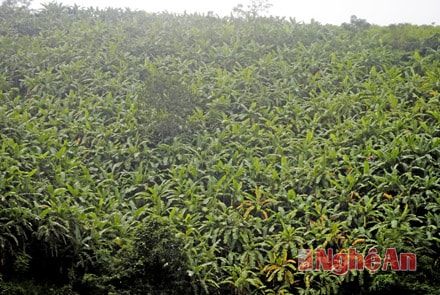 |
| A corner of the royal banana forest in Pieng Pho village. |
The village headman's family cultivates nearly 2 hectares of bananas, earning at least 1 million dong in normal months and 5-6 million dong in the last months of the year. Mr. Xuan said that banana cultivation requires no investment or special care, yet the bananas still grow well. After harvesting the fruit, the banana plants are fed to buffaloes, cows, and pigs, and the leaves are thrown into the pond for fish to eat. Banana blossoms are harvested and sold at the market for 3,000-4,000 dong each. Thus, banana cultivation utilizes all parts of the plant, providing practical economic benefits for farmers.
However, according to Mr. Xuan, to grow bananas effectively, growers must regularly clear weeds and wild plants, and monitor each banana bunch to determine the harvest date. They must also carefully transplant seedlings to other locations. Such meticulous care ensures the banana plants grow large and produce many fruits. Typically, bananas are ready for harvest about three months after flowering. For bananas used for offerings, they must be harvested while still green and not allowed to ripen on the tree. Due to the suitable soil conditions and proper care, the bananas produce large bunches with many hands, some weighing up to 20 kg.
Having a long history of banana cultivation, most households in the village raise pigs and utilize the land for fish ponds, making use of surplus banana products as feed. The people of Piêng Phô have long considered banana cultivation their main source of income; therefore, after harvesting the bananas, they also plant banana trees in the empty spaces, thus expanding their banana plantations.
Text and photos:Xuan Hoang


