
Reforestation in Tuong Duong: A promising new direction…
(Baonghean) - In 2011, based on an assessment of the current state of the forest, the Executive Committee of the Tuong Duong District Party Committee issued Resolution No. 02 on "Continuing to promote forest planting and livestock breeding in the period 2011-2015"; since then, forest planting in Tuong Duong has achieved some noteworthy initial results...
Thanks to the active participation of the people and the timely support and encouragement from the State, after more than 3 and a half years of implementation...
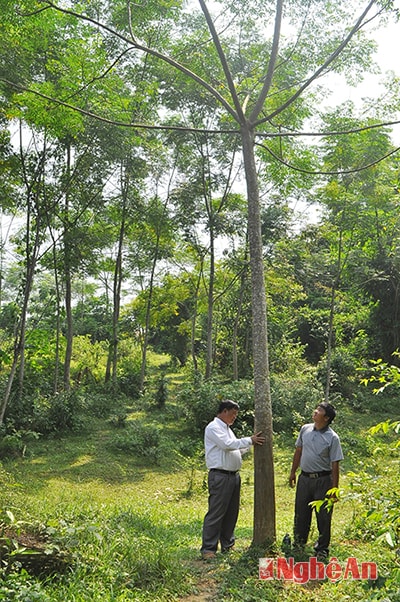 |
| Mr. Lo Xuan Thieu's acacia garden in Phay village is about to be harvested. |
In Xieng My commune, one of the most disadvantaged communes in Tuong Duong district, with nearly 75% of households living in poverty, the forests here are mainly protective forests, making reforestation difficult. Following Resolution 02 of the District Party Committee, the Commune Party Committee issued Action Program No. 06 on October 21, 2011. Based on an assessment of previous reforestation results, the commune set out a new reforestation plan. In addition to the 103 hectares of forest planted before 2010, from 2011 onwards, the goal is to plant 120 hectares each year, reaching a target of approximately 465 hectares by 2015.
The neem tree is a new reforestation target in Xieng My, planted by locals around their houses and in their forest gardens. Meeting Mr. Trinh Van De in Phay village, Xieng My commune – a truck owner buying and collecting neem wood – he explained: Because the amount of mature neem wood ready for harvesting in the village is still small, he only manages to buy one truckload of 5 to 7 cubic meters every few days; if bought directly from the garden, it costs 2.3 million VND/m³, while at the collection point it's 2.4 million VND/m³. Once the truck is full, it's transported down to Dien Chau for sale.
Mr. Lo Xuan Thieu from Phay village, Xieng My commune, while showing us around his acacia garden, said: “My family has planted over 5,000 acacia trees; the acacia trees planted in 2008 have yielded nearly 6 million dong. Acacia trees have the same harvesting cycle as acacia trees, but they are more valuable and easier to sell. If sold individually, they fetch 200-300 thousand dong, or 2.4 million dong per cubic meter.” Mr. Kim Thai Viet, Secretary of the Phay village Party branch, said: “In the early stages of implementing Resolution 02, the Party Committee held an expanded meeting. Besides disseminating the resolution to key Party members, the commune also photocopied the resolution and sent it to each Party branch. In the first year of implementation, we mainly planted acacia trees. Although we received a subsidy of 500 dong per seedling, the low price of acacia meant that people were not really confident and were reluctant to accept the seedlings.” Therefore, based on the Party Committee's directive, the village organized an expanded meeting to disseminate information to Party members and mass organizations, encouraging active participation and promotion. Subsequently, thanks to the exemplary leadership of Party members like Mr. Luong Van Tuyen and active citizens like Mr. Luong Van Than, the village's reforestation movement began to reignite. Besides acacia trees, with the active promotion by the Party Committee and the village's leadership team, the people have gained confidence and boldly switched to planting mahogany, teak, and other similar trees.
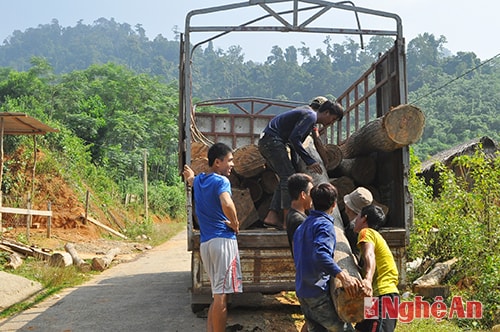 |
| Purchasing mahogany wood in Phay village, Xieng My commune (Tuong Duong district). |
Mr. Luong Thanh Truyen, Secretary of the Party Committee of Xieng My commune, said: In 2012, the reforestation movement under the resolution slowed down due to the drop in acacia prices, but from 2013, people gradually shifted to planting mahogany and cypress trees. By September 2014, the commune had planted 318.18 hectares, including 172 hectares of forest planted in 2014, comprising 50,000 mahogany trees and over 85,000 cypress trees. Some inland communes such as Nga My, Yen Na, Yen Hoa... thanks to the implementation of Resolution 02, the forest area increased quite rapidly. In 2011, the commune planted 123.6 hectares of acacia, in 2012 it planted 137 hectares, and in 2013 it planted 207,000 trees, mainly mahogany and cypress. “At this rate, it won't be long before Nga My and Xieng My communes create a large-scale forest area of mahogany and acacia trees for the district,” said Comrade Luong Hong Son, Secretary of the Party Committee of Nga My commune, excitedly. In communes with favorable transportation conditions such as Tam Thai, Tam Quang, Tam Dinh, Thach Giam... besides developing acacia, mahogany, and eucalyptus trees, people are also strongly developing native trees such as bamboo, reeds, and rattan… Thanks to this, some households have not only eradicated poverty but have also become exemplary forest planting models for others to visit and learn from; such as the households of Mr. Lo Huu Chien in Tam Quang commune, Mr. Lo Van Phai in Tam Thai commune, and Ms. Luong Thi Hue in Yen Hoa commune…
However, reforestation efforts in Tuong Duong district still face challenges. Some communes, such as Luong Minh, Huu Khuong, and Mai Son, lack action programs and plans to implement the resolution, or if they do, they are not specific enough; some communes, like Yen Thang and Luong Minh, still experience damage from buffaloes and cows after planting; and the dissemination of information to raise awareness among officials and Party members about the benefits of reforestation remains weak. Mr. Lo Thanh Hai, Vice Chairman of the People's Committee of Tuong Duong district, shared: "Despite efforts, people in some areas still have a mentality of dependence, not proactively investing in reforestation but waiting for government support. When there is funding support, the number of nurseries for forest tree seedlings develops, but when funding decreases, the number of nurseries also decreases." The process of preparing forest planting records in the communes is still slow and not in accordance with regulations… Although the mahogany tree has clear advantages over the acacia tree and is very popular among the people, for mahogany to become a high-value economic crop, the district needs to provide planning guidance. And one of the limitations of the results of forest planting according to Resolution 02 in Tuong Duong is the very slow progress of allocating land and forests to the people; people are not yet truly confident in investing in forest planting; if this is not resolved soon, complex disputes may easily arise when it comes time for harvesting…
Thus, Resolution 02 of the Tuong Duong Party Committee has met the aspirations of the majority of ethnic people in the area, unleashing the potential of forest land, creating proactive and voluntary forest planting, care, and protection in many places, and finding their own markets, bringing in promising income; the issue is that local authorities at all levels must soon resolve the obstacles in land and forest allocation; support people in finding markets for their products… After evaluating the effectiveness of successful forest planting models, the district needs good solutions to replicate them; on the other hand, continue to evaluate the effectiveness of programs and projects providing plant and animal breeds and clearly define the direction: for forest planting, the upper communes should prioritize planting native trees such as mahogany and bamboo; the outer and inner areas should plant mahogany, teak, bamboo, and rattan. In the short term, focus on reviewing and compiling statistics on the area of planted forests ready for harvesting to have a basis for building forest planting plans for the following years; Assigning members to go down to the grassroots level to guide and mobilize the people to actively plant forests; organizing practical and regular inspections of the implementation of Resolution 02 of the District Party Committee…
Text and photos:Nguyen Hai


