
China is incorporating AI into its curriculum starting from primary school.
Chinese education is witnessing a significant leap forward as artificial intelligence (AI) is being integrated into the curriculum starting from primary school.
Starting in September, primary and secondary schools in Beijing will officially integrate AI courses and AI teaching methods into their curricula. This move aims to cultivate a new generation of talent and promote the development of the AI field in China.
In an announcement posted on its official website on March 7th, Chinese education authorities emphasized that schools will “explore and develop” AI courses and integrate AI into after-school services, club activities, scientific research, and other educational systems starting from the fall semester.
.jpg)
In addition, schools will also collaborate with businesses, universities, research institutes, and leading industry associations to develop in-depth AI training programs.
AI tools will be used to shape the classroom of the future, where AI will play a supporting role in teaching, research, and personalizing the learning experience.
According to the new regulations, schools are required to provide at least 8 hours of AI instruction each year, either through specialized courses or integrated into existing subjects such as information technology (IT) and science.
Promoting AI amidst global technological competition.
The expansion of AI education is taking place against the backdrop of China's growing ambitions to develop AI amidst global technological competition.
With the rapid development of AI applications and companies domestically, the Chinese government is increasing investment and support for this sector.
According to the plan, AI will be integrated into the curriculum at each educational level. Specifically, at the primary school level, the focus will be on developing AI thinking skills in students, helping them become familiar with the concept and potential of this technology.
For secondary school students, practical courses will be implemented to help them enhance their AI application skills and access innovative technological methods.
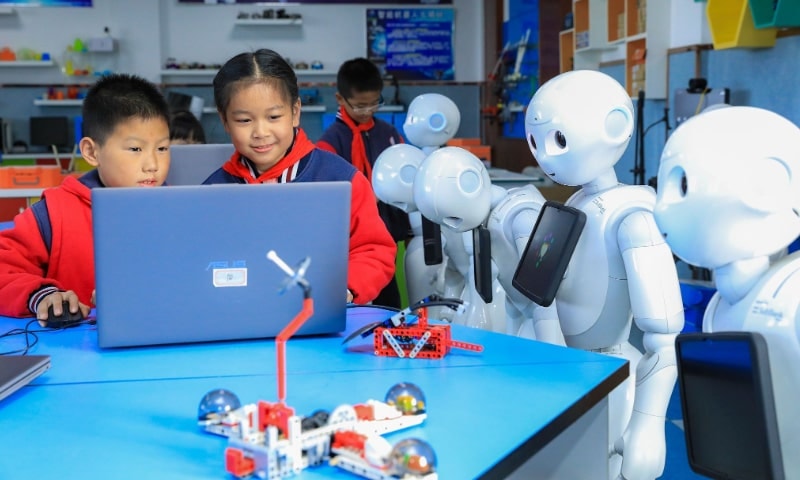
Photo: Internet.
Specifically, students will be guided on how to use AI generation tools scientifically, rationally, and responsibly, in order to minimize potential risks.
In addition, the teaching staff will be carefully selected, prioritizing teachers with STEM (science, technology, engineering, and mathematics) backgrounds to enhance the quality of AI instruction in Beijing.
Challenges in controlling deepfakes and protecting data privacy.
The increasing prevalence of AI, particularly deepfake technology and AI-generated tools, has sparked much debate about the safety and ethics of students using AI.
Chinese lawmakers have warned of the risk of misuse of AI technology without strict regulatory mechanisms.
In a statement quoted in state media, Zhang Yi, a member of the National Committee of the Chinese People's Political Consultative Conference (CPPCC), emphasized that the rapid development of AI could bring about problems such as algorithmic bias, privacy violations, and data security vulnerabilities.
He also warned that the risks and uncertainties from AI would pose a long-term challenge to governance, requiring China to have an effective management strategy to ensure that this technology is developed and used safely and ethically.


