
Short story: The Flowing Stream
Taking off her sandals and letting her bare feet touch the cool earth, feeling the earthy scent of green grass permeate her skin and spread through her bloodstream, Hân felt a momentary sense of calm.
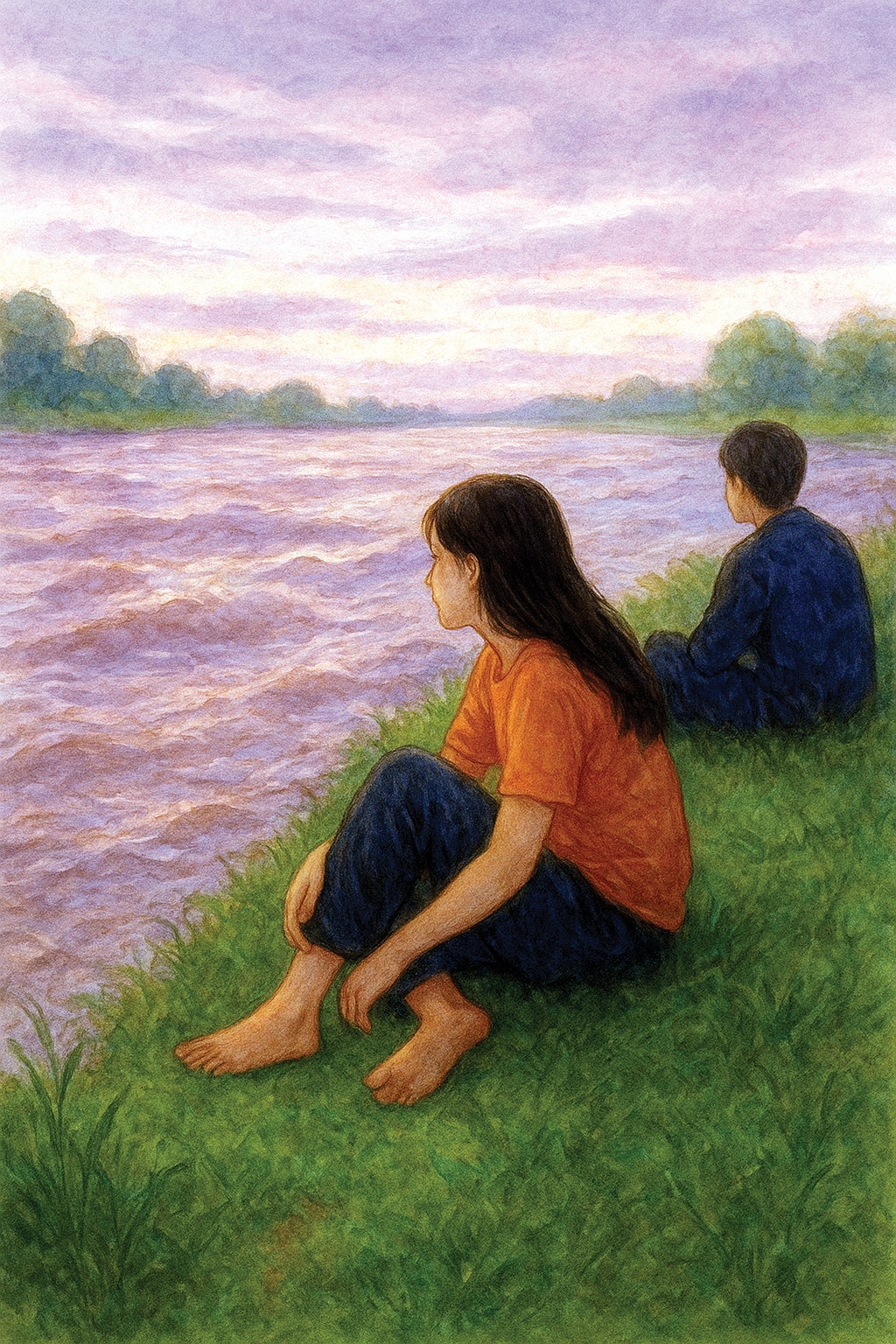
Taking off her sandals, letting her bare feet touch the cool earth, feeling the earthy scent of green grass permeate her skin and spread through her veins, Hân felt a momentary sense of calm. For countless days in a foreign land, Hân had spent nights comforting herself, trying to close the wounds of the past, burying herself in studying and working. She had even told herself not to return, that she could ask friends here to help and send money back. But gratitude wouldn't allow her to do that.
It was late autumn. The Lam River had just passed its flood season, its banks still bearing the fierce, swirling, and muddy marks of Mother Nature's wrath. As evening fell, pale purple clouds drifted lazily along the river, the water not yet returning to the calm, clear blue of peaceful days. Waves lapped against the boat, one after another, creating a rhythmic, rumbling sound. Deeply buried memories resurfaced, a painful ache. Han pulled Kien down to sit on the grass, watching the deep purple twilight descend upon the Lam River, tirelessly healing its wounds inflicted by the raging floodwaters with its silt. Ten years had passed since Han had finally mustered the courage to return to this place.
Back then, Hân had just turned twenty, innocent, naive, and full of life. Her family's poverty couldn't stop her from dreaming of a better life. Her father died early in a sudden traffic accident, and her mother was constantly ill. Hân grew up under the care of neighbors, villagers, and relatives. As she got older, she learned how to plant rice in straight rows, weed properly, and harvest rice by sickle, bundling it into small bundles to carry home. She would attend school in the mornings and then ask neighbors for help finding odd jobs to earn money for rice, pens, and notebooks. Tuition and other fees were partly waived and partly paid by kind teachers. After the planting and harvesting seasons, when there were no more jobs, she would go foraging for crabs and snails. Yet, every year she was the top student in her class and the school. Perhaps that's why Hân's mother also persevered, taking all kinds of herbal remedies to save money, trying whatever anyone suggested. She didn't completely cure her illnesses, but she could still stay at home, cooking rice, boiling water, and most importantly, she had her daughter so Hân wouldn't be left alone in the world.
After graduating from high school and passing the entrance exams to prestigious universities, Han chose to study education near home, saving on expenses and allowing her to care for her mother. Her young heart was stirred during those years. Han entered her first love, sincere and passionate. When she learned he was the son of a wealthy family, Han hesitated to open her heart. But he didn't look down on Han's family circumstances; instead, he always supported and encouraged her, being there for her when she needed him most. Several times when her mother was hospitalized for emergency treatment, he was there, taking care of everything without complaint. He said that since he was the only son, his parents would support whoever he loved and married. Moreover, Han was beautiful, talented, and capable from a young age, so her parents would surely love her. Han thought that God had seen her efforts and rewarded her and her mother with happiness after so much bitterness and humiliation, but little did she know that another storm would strike.
Her mother's frail body could no longer withstand the ever-increasing pain. She passed away one night in the pouring rain. The villagers, pitying the widowed mother and her orphaned child, each lent a hand to help Hân arrange a proper funeral for her mother. Hân's loved one was absent during those days. A distant premonition arose in Hân's heart, but she had to suppress it to focus on her mother's arrangements. Her mother, since her father's death, had hardly had a happy life. Hân didn't want her mother to feel ashamed even in her final moments.
On her return to school, the news that her boyfriend had gone abroad for his studies came as a shock, leaving Hân devastated. His family, upon learning of the situation, pressured him to go overseas. His grandmother and mother threatened suicide. Though heartbroken for Hân, he didn't want to be seen as unfilial. He left hastily, leaving behind only a few short lines, less than a page long, as a farewell message, which he asked a classmate to deliver to Hân.
Hân wandered aimlessly all night, then stopped in the middle of the Ben Thuy Bridge, feeling the icy wind blowing up from the river. She neither cried nor laughed. Only bitterness filled her chest. Her mother was gone, her first love had vanished like a bubble. There was nothing left to hold her back, nothing to anchor her to this life anymore. As her feet crossed the railing, a single thought flashed through Hân's mind: She could disappear without anyone knowing, without thinking about tomorrow or the days to come, without caring about the judgmental, pitying glances of others. And then darkness enveloped Hân, the water sweeping her away into the vast, icy expanse.
Tears streamed down her cheeks without her realizing it. Memories pierced her heart like needles, chilling her to the bone. Hân felt as if she were suffocating in a swirling vortex, with no way out. Kiên's warm hand brought her back to reality. Gently and patiently, he wiped away her tears and comforted her. It was all over. Yes. Hân told herself as she stood up, taking his hand and heading back to Hậu. It was all over.
Ms. Hau pulled Han back to life. Just as the icy water engulfed Han, the engine roared, tearing through the water, and the strong hands of the woman who made her living as a fisherwoman pulled Han out of the whirlpool. A heartfelt call. Words of encouragement. Life is long. Don't take your own life because of a moment of recklessness.
Hân stayed with the couple for a full month. Their house was perched precariously on a small sandbar, just a few steps from the water's edge. Inside, there was nothing valuable except an old boat, a few tattered fishing nets, and the laughter of their two children and their mother. Phúc was a man of few words but very kind; he never spoke harshly to his wife or children, not even once. Hậu was cheerful, quick-witted, and cheerful. She was like an older sister, whispering to Hân about everything, encouraging her to keep living. Even if the sky fell, she had to live.
Hân, unaware of the impending death, lost the unborn child she was carrying. Hậu cared for Hân like a mother caring for her daughter. One miscarriage was like seven births. She was young, so she had to be careful. Hậu picked betel leaves, heated them, and applied them to Hân's stomach. She crushed ginger, squeezed out the juice, mixed it with white wine, and rubbed it on Hân's hands and feet. Seeing Hân sad, Hậu told her, "Just consider it that we weren't meant to be together, as long as you're alive, there's hope." Hậu didn't ask Hân why she had such suicidal thoughts. Because those who reach this point have already suffered immensely; why bring up the painful past? Hân cried. Her tears weren't as bitter as the night she wanted to end it all. They were tears bidding farewell to her unborn child, saying goodbye to the years gone by to begin a new life.
Hân stayed at her sister's house, taking the opportunity to teach her two children. Her parents were illiterate, spending their lives by the river, scavenging for fish and shrimp to make ends meet. But no matter how hard things were, her sister hoped her two children would receive a proper education so they wouldn't have to wander aimlessly like them. When she talked about her children, a bright smile lit up her weathered face. She thought, "It must be God's blessing that they are so bright, learning everything they learn, winning awards in handwriting competitions and school and provincial-level competitions."
On the day of farewell, she slipped a wad of small bills she had saved from selling shrimp and fish into Han's hand. Seeing her teaching the children, she knew Han was a good student. "Don't give up for any reason. We're not rich, but we have health and our hands; we'll make a living again… Go, Han. Remember our words: all hardships will pass; heaven never closes all doors for anyone…"
Hân led Kiên to the strip of land where she had spent a short time, a place filled with so much love. This was their house. After the rainy season, only the dilapidated walls and a few crooked sheets of corrugated iron remained. Phúc was busily measuring and calculating. Hearing footsteps, they stopped what they were doing and looked up. They were older, tanned, and weathered, but their eyes were still bright and kind. They didn't recognize Hân. That was understandable; throughout their lives, they had saved so many lives, how could they remember them all? But their youngest child recognized Hân. The child exclaimed, gently chiding them for their bewildered expressions:
- Ms. Han, Ms. Han used to stay at our house and teach us, and you don't remember her, Mom and Dad?
Ms. Hau recognized Han, her emotions a mix of joy and sadness. She gently stroked Han's arm, gazing at her, exclaiming how beautiful she looked, almost unrecognizable. "Ten years have passed, and seeing you like this, I know you're doing well. I'm so happy. Stay here and have dinner with us and our child today. Our house had its roof blown off, and I'm measuring the area to build a temporary mezzanine to protect us from the flood. I was also planning to rebuild properly, but the eldest is graduating from university, and the youngest is about to start university – there are so many things to worry about. We can manage on our own, but we have to prioritize our children's education first," she said.
She avoided bringing up the past, probably to protect Hân in front of Kiên. Hân introduced him as her husband. "He knows everything; I don't hide anything from him. Back then, I went back to school to continue my studies. Then I won a scholarship, went abroad to study, and settled down. We met there, fell in love, shared the same orphan status, and the same struggle to escape poverty through education, and we got married. I didn't dare return because of many things, but he encouraged me, saying, 'You still have your roots, your parents' graves, and the kindness of your siblings. Besides, you should return so your children know their ancestral homeland.'" Hân placed her hand on her stomach and smiled softly. Hậu brushed it aside, saying, "Returning to visit your hometown is right, but you've never remembered or thought about the kindness of your siblings. Don't worry about that. I'm happy for you." Her voice choked up, perhaps from the wind blowing from the Lam River.
The two sisters chattered excitedly. Phuc and Kien listened silently, patiently and understandingly. Han wanted to save the joy for them until tomorrow. Tomorrow, Han and her husband would give them a gift: a small house built right here. Warm and sturdy, selfless and compassionate, just like the hearts of these two people who dedicated their lives, regardless of danger, to saving lost and desperate souls. This gift from Han and her husband was a heartfelt present, given on behalf of all those they had saved.


