
Applying scientific and technological advancements to develop products and goods.
According to preliminary statistics from the Technology Management Department (Department of Science and Technology), there are currently 37 products bearing the reputation of Nghe An province; of which 25 are specialty products, some of which already have established "brands" in the market and have great commercial potential such as Nam Dan soy sauce, Quy Chau incense, Van Phan fish sauce, etc.
(Baonghean)According to preliminary statistics from the Technology Management Department (Department of Science and Technology), there are currently 37 products bearing the reputation of Nghe An province; of which 25 are specialty products, some of which already have established "brands" in the market and have great commercial potential such as Nam Dan soy sauce, Quy Chau incense, Van Phan fish sauce, etc.
These products are linked to the natural conditions, traditional crafts, and rich cultural characteristics of the regions, thus having significant importance in the socio-economic development of the localities. However, for a long time, these specialties and traditional products have received almost no investment in research, preservation, and development, and are therefore less competitive in the market. Recognizing this problem, in recent years, the Department of Science and Technology has prioritized the application of scientific and technological advancements to preserve and develop traditional products and local specialties, gradually transforming them into marketable goods. This is a correct approach and has initially yielded positive results.
Among the specialties and traditional products of Nghe An, fruit trees are known for their wide variety. Numerous scientific and technological projects have been implemented in this area, such as: Research on the conservation and development of Tuong Duong mango varieties; Research on the application of micrografting technology to restore Xa Doai orange varieties; Support for building, promoting, and developing the Vinh orange brand; Building a model for restoring native orange varieties in Minh Thanh commune, Yen Thanh district; Applying scientific and technological advancements to build a model for rehabilitating degraded lemon orchards in Nam Dan district; Applying scientific and technological advancements to build a model for restoring and developing Quang Tien pink pomelo varieties; Applying scientific and technological advancements to create and develop black ebony trees in Thanh Chuong district. The goal of these projects is to classify plant varieties, evaluate characteristic biological features (mainly morphology and product quality); and build models for propagation, restoration, and development of traditional products.
In addition, traditional raw material crops are also receiving attention and becoming targets for restoration and development through science and technology projects: supporting the construction of models for breeding and planting raw material bamboo in Quy Chau; establishing breeding gardens for red lac insects in Ky Son and Que Phong districts. Livestock products are also emphasized (project: Applying scientific and technological advancements to develop the local yellow cattle breed (Mong cattle) in Ky Son district). The development of goods and brand building is being addressed through projects such as: supporting the construction of a model for processing ready-to-eat jellyfish in Dien Chau district; building a collective trademark for the traditional rice cracker and peanut candy making village of Vinh Duc - Do Luong; and building a collective trademark for Hai Giang fish sauce - Cua Lo, with the goal of diversifying products, enhancing competitiveness, and improving the economic efficiency of the products.
The results of applying scientific and technological advancements to develop products based on traditional products show that: Although not all topics and projects were successful and achieved their set goals, the research has classified and evaluated the outstanding characteristics and uniqueness of traditional products, thus being very significant in preserving valuable genetic resources. Given that research and application of scientific and technological advancements have not yet comprehensively addressed the issues, proposing solutions for the protection and sustainable exploitation of traditional products for conservation and development is essential.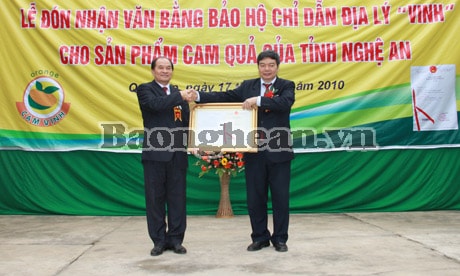
Granting geographical indication protection certificate to Vinh oranges. Photo: Duong Van
Strategic investments in traditional products (Quy Chau incense, Nam Dan soy sauce, Vinh oranges), from expanding production areas through breeding and trial production using new technologies to building and developing brands, have yielded significant results in many aspects, creating sustainable development for these traditional products. In addition, some traditional products such as Thanh Chuong black olives, Ky Son Mong cattle, Minh Thanh oranges, Nam Dan lemons, etc., have also shown promising results in initial investment and research, contributing to the recovery and improvement of productivity, creating large quantities of high-quality products to become marketable commodities.
The above results confirm that applying scientific and technological advancements to develop products based on local traditional products is a crucial and necessary priority. To combine the preservation and conservation of genetic resources and the promotion of cultural values with the commercialization of traditional products, the following issues need to be considered:
- Further investigation, survey, and evaluation of local specialties and traditional products are needed to determine directions for exploitation and development. The investigation should not only classify and identify endemic characteristics, genetic value, and traditional "technological" processes that need to be preserved as scientific and cultural values, but also assess the commercial potential and the ability of these products to become marketable goods. Based on this assessment, appropriate solutions can be developed for each product.
- It is necessary to accurately and appropriately select the stages of science and technology impact on products. Investing in science and technology to develop traditional products is essential. However, which stage in the product's value chain the science and technology impact requires thorough research to ensure that the impact guarantees two objectives: preserving or improving the inherent quality of the specialty or traditional product, while simultaneously expanding production and increasing product volume. In practice, depending on the product, the impact can be on stages such as: breeding, cultivation and farming processes (specialty plants and animals); raw materials, equipment, technological processes, new products (processing); human resource training, brand building, and market development… Some products require simultaneous impact on all stages, but for most, impacting only a few key stages can create positive change.
- It is necessary to mobilize and integrate resources for the development of specialties and traditional products. Specifically, science and technology resources should be primarily used for basic research on products and production processes, technology transfer, human resource training support, and the development and establishment of trademarks and geographical indications for products. Other resources should be mobilized to expand production and business, build infrastructure and equipment, and expand markets…
- Policies are needed to encourage and support the development of local specialties and traditional products, considering this as an important direction for product development, with not only economic significance but also profound cultural meaning.
Le Van Khanh (Nghe An Department of Science and Technology)


