
King Uy Minh Ly Nhat Quang and Nghe An and Dai Viet
Prince Uy Minh Ly Nhat Quang was the eighth son of King Ly Thai To, born in Thang Long (Hanoi), and the younger brother of King Ly Thai Tong (same mother). In 1039, Ly Nhat Quang was appointed to Nghe An to oversee tax collection. During his tenure, he was renowned for his integrity. King Ly Thai Tong admired him and bestowed upon him the title of Uy Minh Crown Prince.
(Baonghean)Prince Uy Minh Ly Nhat Quang was the eighth son of King Ly Thai To, born in Thang Long (Hanoi), and the younger brother of King Ly Thai Tong (same mother). In 1039, Ly Nhat Quang was appointed to Nghe An to oversee tax collection. During his tenure, he was renowned for his integrity. King Ly Thai Tong admired him and bestowed upon him the title of Uy Minh Crown Prince.
Great contribution
During the Ly Dynasty, Nghe An was a crucial southern frontier region of Dai Viet. Deeply aware of the region's position and its crucial importance to the nation's prosperity and decline, from the beginning of the 11th century, the Ly Dynasty paid close attention to building, consolidating, and developing Nghe An in many aspects, aiming to make it a "fortress and stronghold," a key strategic point for the dynasty. Therefore, the first person entrusted by King Ly Thai Tong (the second king of the Ly Dynasty) with the task of governing Nghe An province was Uy Minh Hou Ly Nhat Quang.
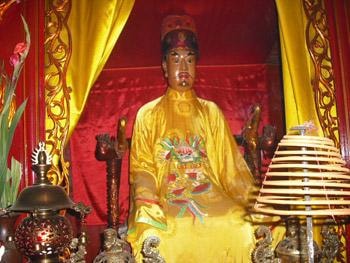
Statue of Ly Nhat Quang.
In 1041, Ly Nhat Quang was officially appointed as the Prefect of Nghe An (this also marks the time when Nghe An chose to establish its province). It can be said that during that period, Nghe An was a border region of the country with many local uprisings of a "rebellious" nature, forcing the imperial court to suppress them on numerous occasions. Entrusted with the responsibility of Prefect (the head of the administrative apparatus in Nghe An), he always prioritized virtue and was resolute against corrupt officials and bandits, determined to protect every inch of Dai Viet's land. Therefore, throughout his tenure and for many decades afterward, this land was very peaceful. The stable political and social situation provided a favorable foundation for Ly Nhat Quang to organize and perfect the grassroots government apparatus, mobilize the people to reclaim and expand land, establish villages, care for agricultural production, teach people farming and silkworm breeding, and develop the economy...
In 1044, King Ly Thai Tong personally led an expedition against Champa. During this campaign, Uy Minh Marquis Ly Nhat Quang was tasked with supplying and transporting provisions from Nghe An, the main source of supplies for the army. After returning victorious from the Champa campaign, Ly Thai Tong promoted Ly Nhat Quang from Marquis to Prince and granted him the title of Tiet Viet, giving him the authority to decide all political affairs in Nghe An. During his 16 years as Governor of Nghe An, from 1041 to around mid-1057, with his talent for governance, strategic vision, and bold and correct policies, Ly Nhat Quang implemented progressive policies to develop production, maintain law and order, and secure the borders. In particular, he advocated for leniency and comfort for the people, prioritizing their well-being and happiness as the foundation of his governance.
Ly Nhat Quang played a crucial role in building and developing Nghe An from a remote and turbulent region during the Ly Dynasty into a prosperous province in all aspects, providing solid support for subsequent dynasties and creating a turning point in the history of Nghe An's development. As a prince and governor of Nghe An, Uy Minh Vuong Ly Nhat Quang has been highly regarded by historians, ranking him as one of the nine most distinguished figures of Dai Viet. In Ly The Xuyen's "Viet Dien U Linh," Ly Nhat Quang is described with great respect as "a great benevolent deity who reformed the province, upright and honest." Notably, according to Ly The Xuyen's concept, deities with greater merit are ranked above kings and high-ranking officials, rather than chronologically, with Uy Minh Vuong Ly Nhat Quang being mentioned first.
Scientists also acknowledge that Ly Nhat Quang deserves to be recognized as a historical figure, having made immense contributions to the stability and development of the country, primarily the Nghe An region, during the early decades of the Ly Dynasty.
Forever living in the hearts of the nation.
Because of his immense and comprehensive contributions, leaving a deep and lasting impression on the people, after the death of Uy Minh King Ly Nhat Quang, the people erected temples to worship him. In the Bach Ngoc area alone (now Boi Son commune, Do Luong district), where he once served as his administrative center, there are eight temples dedicated to Uy Minh King Ly Nhat Quang.
Legend has it that in 1057 – 953 years ago – Ly Nhat Quang attained sainthood at the southeastern part of Qua Mountain (now Boi Son commune, Do Luong district). The people then erected a main temple in his honor, making it one of the three oldest temples in the Central region, alongside the An Duong Vuong Temple (Cuong Temple) and the Mai Hac De Temple (King Mai Temple). After 1072, Grand Tutor Ly Dau Thanh, upon becoming the Governor of Nghe An, honored Uy Minh Vuong Ly Nhat Quang and began constructing a larger temple. During the Tran Dynasty, King Tran Nhan Tong bestowed the title "Uy Minh Dung Liet Tao Thanh Pho De Vuong" upon Ly Nhat Quang and built an even larger temple, considering it a spiritual anchor. During the Le Dynasty, there was a policy to reorganize the hierarchy of deities, and Ly Nhat Quang was ranked as the highest-ranking deity of Dai Viet. From then on, a vast area of land was dedicated to the temple of Qua Son, where the people were exempt from taxes, military service, and corvée labor, solely for the purpose of organizing festivals and ceremonies (currently, no other temple has such a large area and a large population as Qua Son Temple). During the Nguyen Dynasty, restoration and renovation were also undertaken.
Having weathered the ups and downs of history and the vicissitudes of time, and after numerous restorations and renovations throughout different periods, Quả Sơn Temple has now become a sacred temple overlooking the Lam River, ranked among the scenic spots of Nghe An province and a national historical and cultural relic. The temple consists of an upper, middle, and lower hall connected in the shape of the Chinese character "gong," dedicated to Uy Minh Vương Lý Nhật Quang; a left wing dedicated to Đông Chinh Vương Lý Lực and a right wing dedicated to Dục Thánh Vương (two famous generals, half-brothers of Lý Nhật Quang, who served him in Nghe An). In addition, there is the tomb of the revered Uy Minh Vương Lý Nhật Quang, a stele house, a horse stable and horse statue, a three-arched gate, and thousands of ancient artifacts made of silver, bronze, and wood. Particularly noteworthy are the unique ancient statue of Uy Minh Vương Lý Nhật Quang, dragon thrones, and ceremonial vessels from the Ly Dynasty.
The Quả Sơn Temple Festival, dating back to the Lý Dynasty, is considered one of the oldest, most majestic, and grandest festivals in Nghệ An, taking place in a vast area. Every year, in the middle of the first lunar month, the people of Bồi Sơn, Ngọc Sơn, Lam Sơn, Tràng Sơn, Đặng Sơn communes and surrounding areas organize the Quả Sơn Temple Festival. Attending the Quả Sơn Temple Festival, one will experience unique characteristics both on land and on water, with the rituals and festivities combined. On land, there is a procession of three sacred palanquins and many sacred objects, including horses, chariots, and offerings to honor the merits of Lý Nhật Quang, such as coins, sacred rice grains, incense, offerings, and soldiers. The water procession consists of six boats, proceeding parallel to the land procession to Bà Bụt Pagoda (Lam Sơn commune, 3 km from Quả Sơn Temple) to offer thanks and gratitude to the Goddess of Mercy. Along the way, there are five points where people pay their respects and express their gratitude to the Saint. Before the procession, there is a "military parade," which simulates battles both on land and water according to the "eight trigrams formation"; a ceremony to pray to the water god for safe passage of boats on the river; a ceremony of announcement; a bathing ceremony; and a ceremony of spirit possession. The festival space is expanded with many cultural and sporting activities, including volleyball matches, tug-of-war, stick pushing, wrestling, chess, boat racing, etc.
The festival is held annually to help revive the fine tradition of "drinking water, remembering the source," honoring the great contributions of King Uy Minh Ly Nhat Quang, honoring the Buddha; encouraging the martial spirit to defend and build the nation, strengthening unity among all strata of the people, and contributing to the preservation and promotion of traditional folk cultural values.
For nearly 1,000 years, the merits of King Uy Minh Ly Nhat Quang have been deeply remembered by the people of Nghe An and the entire nation. His achievements and contributions will forever be honored in history books and revered in the hearts of the people nationwide as the most sacred symbol.
Mai Hoa -Collected and compiled


