
The role of village elders in the border regions of the Fatherland
(Baonghean)To contribute to preserving the border and boundary markers, and to build and strengthen the friendship and solidarity between Vietnam and Laos, over the years, Que Phong district has implemented many effective methods, especially by promoting the role of influential and exemplary individuals in disseminating information and mobilizing the people…
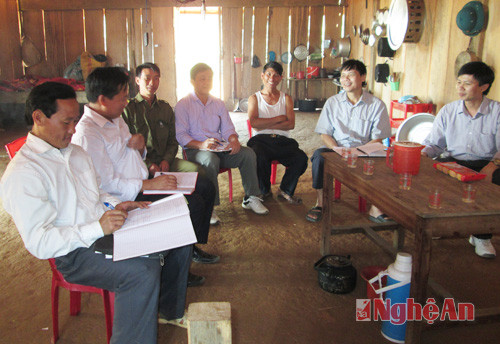 |
| Frontline officials and village elders and clan leaders in Pà Khổm village are campaigning to prevent illegal migration and relocation among the people. |
Pa Khom is one of the ten Hmong villages in Tri Le commune, Que Phong district. Many years ago, due to hunger and poverty, the people of Pa Khom, influenced by unscrupulous individuals, sold their homes, abandoned their land and villages, and migrated to Laos, hoping to get rich in a new land. However, life in Laos was no better, and the Hmong people of Pa Khom returned to their old village.
Like deer and fawns that have strayed from their herd and now return to their old home, the villagers experienced mixed feelings of joy and sadness. The joy was clear, but the sadness stemmed from the fact that their gardens and houses had all been sold, leaving them penniless and unsure how to rebuild their lives. At that time, fortunately, thanks to the dedicated assistance of the Party, various agencies, organizations, and local authorities – providing food, clothing, housing, land, and guidance on farming – Pa Khom was able to be rebuilt. That was in 2008… – recounted Elder Tho Chu Ho, a respected and exemplary member of the Tho family in Pa Khom. The Mong people are inherently hardworking, and with the guidance of officials on how to make a living, life here gradually stabilized. The village has nearly 100 households, many of which have become well-off thanks to farming, cultivating wet rice, upland rice, and livestock raising. Notably, Mr. Tho Giong Nu's family raises over 80 buffaloes and cows, while Mr. Tho No Po's family raises 65 buffaloes and cows. In the village, 39 households have implemented a model of cultivating bitter bamboo shoots – enclosing and protecting them – which has proven highly effective, generating 10-15 million VND per year. Many other households have also achieved similar results in planting peach trees.
Following Mr. Lang Manh Hung, Vice Chairman of the Fatherland Front Committee, to Pa Khom today, we saw a peaceful Pa Khom: Adults had all gone to the forest and fields, leaving only children playing and kind-hearted elderly people around the fire. The fires in each family's hearth were still smoldering, and large cast-iron pans hung above them. According to officials from Que Phong district: The sign that people are still living in their homes or have left is that cast-iron pan. In the Hmong people's belief, the pan is their most valuable possession… Pa Khom today is so prosperous, but just a few months ago it was still full of turmoil.
Mr. Lang Manh Hung recounted: Between the fourth quarter of 2013 and the first quarter of 2014, 17 households with 138 people in Pa Khom wanted to relocate to the Nhot Huoi Ton area in Quang Phong commune, Que Phong district. The Nhot Huoi Ton area, located within the Pu Huong Nature Reserve, has fertile land suitable for cultivation, old-growth forests suitable for hunting, and is far from the jurisdiction of Quang Phong commune. Significantly, all 17 households wishing to establish a new village were relatively well-off, owning rice paddies capable of producing two crops a year, and therefore not lacking food. Understanding their intentions, Tri Le commune and Que Phong district approached them to explain the advantages and disadvantages, and to help them thoroughly understand the nature of the area within the nature reserve.
Only when the border region is peaceful can the interior develop. Recognizing the existing problems in Pa Khom, in mid-February 2014, the Que Phong District Party Committee and the District Fatherland Front Committee conducted a survey and implemented a model titled "Promoting the role of village elders, heads of hamlets, and exemplary influential people to mobilize the Mong ethnic people to prevent illegal migration, stop replanting opium poppies, stabilize their lives, develop the economy, and eradicate hunger and poverty in Pa Khom village." The approach was as follows: District and commune officials lived, ate, and worked alongside the villagers, talking to the elders and influential people in the clans about the policies and guidelines of the Party, State, and locality. Once the elders and influential people understood, they would share the information with their descendants. In Mong customs, when the elders speak, everyone must listen. Based on this, the Standing Committee of the District Fatherland Front Committee has included Mr. Tho Chu Ho - a prominent and respected figure of the Tho family, Mr. Va Chia Nenh - a prominent and respected figure of the Va family, Mr. Ly Lia Cha - Head of the Ly family, Mr. Tho No Po - a prominent and respected figure of the Tho family, and Mr. Va Dua Lau - Head of the Va family into the model implementation committee.
As an initial result, the exemplary and reputable individuals, as recognized by the Fatherland Front at the district and commune levels, have effectively played their leading roles and responsibilities in mobilizing their fellow clan members to comply with the National Border Law, the Law on Drug Prevention and Control, and the Law on Marriage and Family... to stabilize their lives. Mr. Va Dua Lau, from Pa Khom village, happily shared: "The advice was reasonable and compassionate; these 17 households listened and are now settled and stable in Pa Khom." Recently, the leaders of the Ly and Va clans successfully mediated a land dispute between Mr. Ly Say Denh and Mr. Va Ba Cau.
With the advice and persuasion of the two clan leaders and respected elders, in the spirit of brotherhood and neighborly solidarity—"A spilled bowl of rice can never be full again"—Mr. Dếnh's family yielded the land to Mr. Câu's family. Mr. Và Bá Câu also offered some material gifts and thanks to Mr. Lý Sấy Dếnh. The dispute was resolved amicably and peacefully. In the future, with the State continuing to invest in plant and animal breeds, creating land for the people to reclaim and cultivate two rice crops a year, along with the effective operation of the model implementation committee as it is now, Pà Khổm will surely become more stable and prosperous.
In fact, in the mountainous and particularly disadvantaged district of Que Phong, incidents similar to those that occurred in Pa Khom are not uncommon. The people still cling to some outdated customs and farming practices. The material and spiritual lives of ethnic minorities remain difficult and lacking, especially in the four border communes, significantly impacting the dissemination of Party policies and State laws to the people. As a result, many problems have arisen along the district's 73 km border, such as illegal migration, the re-cultivation of opium poppies, drug possession and trafficking, and illegal proselytization.
In 2008, 113 households of Hmong people, nearly 1,000 in number, returned from Laos. These families had sold all their fields and gardens before leaving, and now they have no houses or land for production. To help these households, the Fatherland Front, in coordination with Border Guard Post 519, through respected and exemplary individuals and clan leaders, went to each house in 10 Hmong villages to encourage people to welcome the returning people. They also encouraged people to donate land for housing and production, provided hundreds of days of labor for house construction, and collected hundreds of kilograms of rice to help the people. To date, with the support of the State, the returning households have stabilized their lives," said Mr. Lo Van Bao, Chairman of the Fatherland Front Committee of Que Phong district.
Over the past year, the District Fatherland Front Committee, in coordination with various departments and agencies, and the three border guard posts in the area, has successfully implemented Directive No. 06/2008 of the Prime Minister on promoting the role of influential figures among ethnic minorities in the cause of national construction and defense. The District Fatherland Front Committee has successfully enlisted the support of 191 village elders, clan leaders, and other exemplary influential figures in the community. Having built rapport with these influential figures, the Fatherland Front has proceeded to enhance their knowledge in all aspects so that they can pass this knowledge on to their descendants and fellow villagers. From this, where people have been educated and equipped with knowledge to proactively raise their vigilance against various types of crime, the Fatherland Front has encouraged households and clan leaders to commit to not violating the law, such as not engaging in illegal migration, not cultivating opium poppies, not transporting drugs, and strictly adhering to border regulations and rules. Promoting labor productivity and livestock farming, replicating economic development models, creating income sources for families, and eradicating hunger and poverty. The results show that coordinating and leveraging the role of village elders, clan leaders, and exemplary influential figures has helped resolve many prominent incidents occurring in the area, contributing to the stability of border security…
Mr. Lo Van Bao, Chairman of the Fatherland Front Committee of Que Phong district, said: Thanks to information from the head of the Tho clan in Huoi Xai 2 village, the authorities were able to promptly deport Gia Ba Denh, 40 years old, of the Mong ethnic group, residing in Thuong Xuan, Thanh Hoa, who had come to seek immigration and showed signs of illegal proselytizing. Leveraging the role of village elders and heads of the Ly, Tho, and Va clans in Muong Long, Nam Toc, and Pa Khom villages, the Fatherland Front successfully persuaded several households to abandon their intention of freely migrating within the district to Quang Phong and Hanh Dich communes. To date, the situation of free migration in Tri Le commune has ceased…
Along with the Hmong people, influential figures from other ethnic groups such as the Thai and Khmu have regularly coordinated efforts to encourage their children to promote the transformation of outdated production practices, improve healthcare and environmental hygiene, and enhance education. In particular, the exemplary elders in Thong Thu commune, Dong Van district, have set a good example by mobilizing 1,400 households of their descendants, relatives, and villagers to relocate to the new resettlement area in time for the Hua Na Hydropower Plant project. Furthermore, these elders have actively encouraged their descendants to participate in patrolling and protecting the border and boundary markers, maintaining unity among clans, ethnic groups, and villages along the Vietnam-Laos border.
In particular, last year, through the role of exemplary and reputable individuals, the Fatherland Front Committee successfully coordinated the establishment of fraternal ties between Muong Piet village in Thong Thu commune and Nam Tay village, Vieng Phan cluster, Sam Tay district, Hua Phan province (Laos), and between Huoi Moi 2 village in Tri Le commune and Den Din village, Phan Thong cluster, Muong Quan district, Hua Phan province, Laos. This connection is very significant, creating opportunities for people of both countries to visit relatives and exchange goods. Through this, a regular exchange of information between Vietnam and Laos is maintained, promptly resolving issues related to the governments and people of both countries… “A prosperous nation is built by its elders. A nation survives thanks to the elders' support. When a nation is lost, its elders save it. When a nation declines, its elders support it.” – Perhaps more than anyone else, the village elders, clan leaders, and respected figures in Que Phong have truly lived up to the teachings of beloved President Ho Chi Minh. They have made significant contributions to the socio-economic development of the locality, improving the lives of the people, and strengthening the people's trust in the Party's leadership.
Thanh Son


