
Regarding the two tombstones of the renowned figure Dang Thai Than
In the Bau Non field, in Nam Thanh commune, Nam Dan district (Nghe An province), stands a brick-built tomb. Two stone tablets are affixed to the tomb's roof, clearly inscribed with the name, birthplace, and achievements of the deceased – the patriot Dang Thai Than. The bottom of the tablets also clearly states the name of the person who composed the inscription – Phan Boi Chau. The inscription, written in Chinese characters, can be roughly translated as follows:
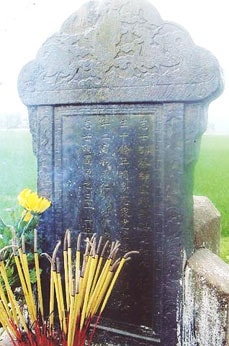 |
Tablet No. 2 |
Summer, the year of Quy Dau (1933)
(Compiled by Phan Boi Chau).
Memorial No. 2: Patriot Dang Thai Than, from Hai Con commune, Nghi Loc district, nicknamed Mr. Ngu Hai Tien Sinh. For more than ten years, he selflessly devoted himself to the cause of modernization and national salvation, far from home. He heroically sacrificed himself on February 1st, 1910 (the year of Canh Tuat).
Alas! How great! After 31 years since this patriotic hero sacrificed himself for his country, who will follow in his footsteps?
Date... month... year Canh Thin (1940)
Written by Phan Bội Châu.
Patriot Dang Thai Than, whose pen name was Ngu Hai, was born in 1873 and died in 1910 in Hai Con commune, now Nghi Thai commune, Nghi Loc district, Nghe An province. He was the nephew of Dang Tu Kinh. He was intelligent and, even at a young age, was renowned for his literary talent. He was Phan Sao Nam's best student. At the age of 32, he composed a pair of couplets titled "Thu Trai" (Posted at home for reading).
Translated by Mr. Huynh Thuc Khang:
- At thirty-two years old, still not mature enough, sighing and lamenting, my heart burning with the desire to consume the world;
- Having read countless books, yet still being illiterate, I sit silently contemplating, my fervent devotion illuminating the path of the sages.
Although academically gifted, his ambition was not to seek wealth and power through scholarship. Born during a time of national subjugation and family ruin, when the Vietnamese people suffered under the brutal rule of the French colonialists and their feudal collaborators, he harbored the ambition to save the country and its people. He joined Phan Boi Chau and Cuong De in establishing the Duy Tan Society from its inception, becoming one of its most important figures. He specialized in fundraising, mobilizing young people, and organizing a network for them to emigrate to Japan under Phan Boi Chau's leadership.
Enraged by the Duy Tan and Dong Du movements, the French were determined to capture Ngu Hai, a key organizer. They constantly monitored him with spies, and upon discovering him holding a secret meeting with his comrades in Phan Thon (now Nghi Kim commune, Vinh City), they mobilized 500 soldiers to surround him. He ordered his comrades to retreat, while he himself held a pistol, waiting for the enemy. He shot and killed the dangerous collaborator Mot Do, then shot himself to avoid falling into enemy hands. He sacrificed himself heroically, setting a shining example of patriotism and love for his people!
After his death, the French brutally dragged his body through the streets of Vinh and his hometown, hoping to intimidate and crush the patriotism of the people of Nghe An. His comrades and the people, deeply saddened, did everything they could to retrieve his body and secretly brought it back for burial in the Bau Non field, Thanh Tuyen commune (now Nam Thanh commune), his wife's hometown and also where he had once run a school.
Phan Boi Chau was deeply saddened to hear of Ngu Hai's sacrifice, feeling as if his right arm had been severed. In the year of Quy Dau (1933), Phan Boi Chau composed an inscription for a memorial stele and sent it to his hometown, asking someone to engrave it on stone and place it on Ngu Hai's grave (Stele No. 1). He was also constantly troubled by the loss of his beloved student, his closest and most trusted comrade, until one day, before his death, he composed another, more complete inscription about the patriot Dang Thai Than, clearly stating the name of the composer (Stele No. 2). Stele No. 1 only recorded "Chau Chi," perhaps out of fear of enemy interference and destruction. The later stele, with its more complete content, was solemnly placed on the front of the grave.
The two inscriptions on the tombstone of Dang Thai Than, composed by Phan Boi Chau, have honored a shining example of a Nghe An native in the South. This tomb and these two inscriptions are rare relics of our homeland and country, and need to be protected and honored to contribute to educating future generations about the tradition of patriotism!
Dao Tam Tinh


