
Regarding the imperial decrees collected in Nghe An
Royal decrees are a precious heritage of our country, serving as historical and cultural documents issued by the feudal state to recognize deities and famous figures who contributed to the protection and development of their homeland. The people of Nghe An province have successfully preserved thousands of these royal decrees to this day.
Royal decrees are a precious heritage of our country, serving as historical and cultural documents issued by the feudal state to recognize deities and famous figures who contributed to the protection and development of their homeland. The people of Nghe An province have successfully preserved thousands of these royal decrees to this day.
On the occasion of the scientific seminar on imperial decrees in Nghe An, we would like to undertake the task of compiling a preliminary statistical overview of the number of existing and discovered imperial decrees in historical sites and ancestral temples in various localities of Nghe An province...
Currently, we have tentatively listed 1,351 imperial decrees that have been photographed directly, photocopied, documented, or collected from historical records and family genealogies. The district with the most statistics is Yen Thanh with 304 decrees, of which 148 have been collected; Hung Nguyen has over 150; Thanh Chuong 126; Do Luong nearly 100; Vinh 70; Quynh Luu 51; Quy Chau 35; Dien Chau 60; Nam Dan 140; Nghi Loc 27; Nghi Xuan 57; Anh Son 10... And nearly 300 decrees are in USB drives and computers that have not yet been categorized by district.
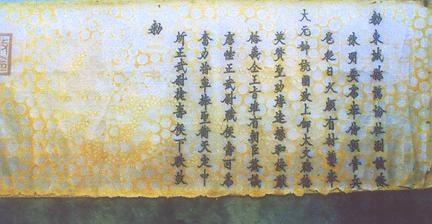 |
Royal decree granting the Tran Minh family, in Van Phan, in the fifth year of the Vinh Huu dynasty (1739).Photo: D.TT |
There are relics with hundreds of imperial decrees, such as Linh Kiem Temple in Do Luong, which has about 80 decrees. Unfortunately, more than a dozen of them have deteriorated or torn. The Dinh family in Hung Trung commune, Hung Nguyen district (which includes Doctor Dinh Bat Tuy) has 38 decrees, including the oldest ones, such as 2 Thuan Binh decrees (1554), 2 Chinh Tri decrees (1559), 12 Quang Hung decrees (1589), 1 Gia Thai decree (1575)...
In particular, the royal decrees of the Tay Son dynasty that have survived to this day in Nghe An province are extremely rare, because after King Gia Long overthrew this dynasty and established the Nguyen dynasty, he ordered the destruction and burning of all relics, documents, and papers related to the Tay Son dynasty. Currently, Nghe An province still preserves 3 decrees from the Thai Duc era, 5 from the Quang Trung era, and 27 from the Canh Thinh era...
The following districts and places possess special imperial decrees: the Dinh family in Hung Trung, the Hoang Nghia family in Hung Linh commune, the Hoang Dang family in Hung Chau commune in Hung Nguyen; the Phan Hoang family in Vinh Thanh, Yen Thanh; the Nguyen Canh family in Trung Son, Do Luong; the Vo family in Yen Tap, Yen Thanh; the Thai Ba family in Yen Son, Do Luong... many of which are ancient decrees from the Le dynasty. The Dinh family has an imperial decree for Mr. Dinh Bat Tuy, who passed the Imperial Examination and was awarded many titles up to the rank of Duke, Minister, and Grand Academician of the Eastern Pavilion.
His parents and wives were also granted titles and honorary titles, including state-granted land for ancestral worship... The Hoang Nghia family bestowed a title upon one of his aunts, Princess Que Hoa. The Ho family in Hung Phu, Hung Nguyen, had a title for Ho Doan Hai, a Doctor of the Tran Dynasty, whose name was not recorded in the state's official list of successful candidates.
The Phan family in Vo Liet, Thanh Chuong, possesses numerous imperial decrees from the Nguyen dynasty, as well as royal edicts bestowed upon Doctor Phan Si Thuc concerning his appointment as chief envoy to the Qing dynasty. The Phan Nhan Tuong family ancestral temple also holds an imperial decree conferring upon him the title of Doctor of Philosophy in a special examination not recorded in history books, the examination during the reign of Le Trang Tong (1546).
This examination had 10 people from Nghe An who passed and received imperial decrees from the past, including members of the Phan family (Phan Tien Tho, Hung Tay commune, Hung Nguyen district)... The Ho family in Tho Thanh, Yen Thanh district, has imperial decrees clearly stating that Ho Tong Thoc, Ho Tong Don, and Ho Tong Thanh were top scholars of the Tran dynasty, and several doctors whose names are not yet found in the state's official examination records.
In particular, the Tran Ke Lu family in Dien Chau has imperial decrees bestowing titles upon family members who were famous Ca Tru singers in Nghe An province and in the capital city... Some families have individuals who received hundreds of imperial decrees from multiple dynasties, such as the Doctor and High Official Tong Tat Thang in Nam Dan, whose decrees lasted from the Le dynasty to the end of the Nguyen dynasty.
According to imperial decrees from various dynasties, some individuals held many important positions in the feudal court, such as Nguyen Trung Mau in Dien Binh, Dien Chau, who served as Minister in all six ministries. Many individuals with titles and official positions received imperial decrees, clearly defining their ranks and positions.
In Nghe An province, there are many types of imperial decrees for deities, most notably Cao Son Cao Cac, which are found in almost every district. These include mountain deities (often accompanied by the name and the word "Son," such as Tran Son...); water deities, such as Long Vuong, Ha Ba, Thuy Tinh, Doc Cuoc...; decrees for human deities, such as Sat Hai Dai Vuong Hoang Ta Thon, Hoang Muoi...; decrees for village tutelary deities, which are found in many places...; and decrees for female deities, such as Mau Lieu Hanh, Que Hoa Cong Chua, Que Nuong Cong Chua, Bach Y Cong Chua, Tu Vi Thanh Nuong... In addition, there are also royal edicts or decrees from high-ranking officials such as commanders and governors, granting individuals selected for necessary tasks, and bestowing titles and positions to carry out those tasks.
The content of imperial decrees in Nghe An province is extremely rich and diverse, containing many mysteries that are difficult to fully describe and explain. Therefore, the task of the members of the Nghe An Han-Nom Club is to carefully research and examine each type to select the most distinctive and representative ones, as well as select representative decrees within the same category, to describe, translate, and compile into a comprehensive work. This will help to best utilize the values of imperial decrees for research, dissemination, and promotion of the fine traditions of our ancestors as expressed in imperial decrees, and to highlight the most distinctive features of the rich national identity of this type of decree.
Dao Tam Tinh


