
About the 'gateway to heaven' of Tay Son
(Baonghean) - The mountainous district of Ky Son has two places known as 'heaven's gates' located on the north and south sides of National Highway 7. These are the Muong Long Heaven's Gate and the Tay Son Heaven's Gate.
One early winter day, we traveled 12 kilometers from Muong Xen town to Tay Son. The paved road was smooth, but the only difficulty was the steep uphill climb. Before we left, my friend told me that even though it was hot up here, we should remember to dress warmly because it would be freezing cold once we passed through the "Heaven's Gate." I didn't quite believe him, thinking that I had been to colder places like Na Ngoi, Nam Can, and Muong Long, and that Tay Son couldn't possibly be as cold as those places.
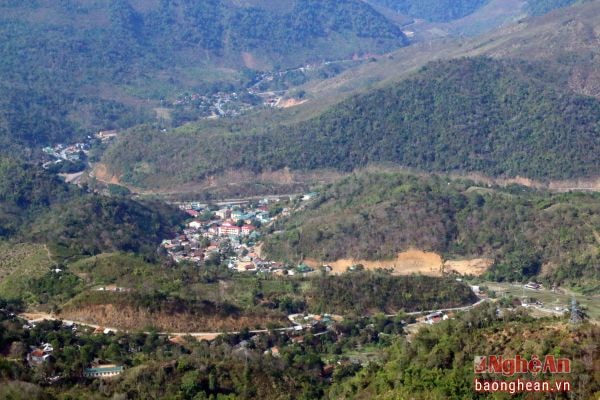 |
| The Tây Sơn Sky Gate overlooks the area below. |
The road to Tay Son this season is covered in white reeds on both sides of the hills, blending in with the white clouds drifting lazily by. Finally, we reached the summit of the southern "Heaven's Gate" of Ky Son. Indeed, only upon reaching this point did I truly feel the bone-chilling cold of early winter. The biting wind blew fiercely. Mist, carried by the wind, settled on my body like a thin veil of rain.
Looking down from the "Heaven's Gate," the town of Muong Xen appears tiny, nestled in the palm of our hand, with the Nam Mo River flowing like a winding silk ribbon. Quickly putting on another jacket, we walked a few more kilometers to reach the center of Tay Son commune, located in Huoi Giang 3 village. It was past 10 a.m., but the weather was still bitterly cold. People out on the streets were bundled up to protect themselves from the winter chill. Children, wrapped in warm scarves, slept soundly. The commune chairman, Vu Ra Tenh, told us, "The cold is a specialty of Tay Son."
"Thanks to this unique climate, the people here produce many specialties such as raising black chickens, growing cauliflower, taro, and peaches... But there have also been years when it was so cold that livestock and crops died in droves." Then he recounted the severe cold spell at the beginning of the year that caused great damage, with the mountains and hills covered in a blanket of ice and snow. Many households were left penniless after the snow melted. Mr. Vu Ra Tenh's voice softened: "Hopefully, this year the weather will be more favorable so that the people can feel at ease."
Tay Son in the cold season is truly beautiful. The remaining early-blooming peach blossoms still cling fresh to the branches. We must say, we haven't seen anywhere else with so many beautiful peach blossoms as this region. Tay Son peach blossoms are a delicate pink, with six petals, their moss-covered trunks enveloping the ancient houses. And there are also trees that have shed all their leaves, leaving only branches laden with ripe, red fruit. In Huoi Giang 1 village, an entire forest of vibrant red persimmons lies in the middle of the village, their fallen fruit covering the paths. The villagers say there are so many persimmons that they couldn't possibly eat them all, so they just leave them there. The fading peach blossoms and the red-pink hues blend with the green mountains and forests, making the scenery of Tay Son irresistibly beautiful.
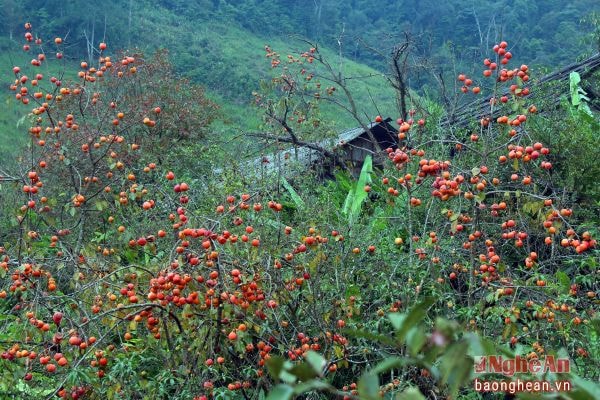 |
| The rose bushes in Tay Son are laden with fruit. |
After wandering around the village for a while, the young commune official, Vu Ba Lenh, told us: "Tay Son also has one of the largest and most beautiful forests in Nghe An province. Do you see it? Behind the villages, there are dense thickets of cypress trees!" Only then did I observe the forest stretching across the backs of Huoi Giang 1, 2, and 3 villages. In just a few steps, Vu Ba Lenh led us to the edge of the cypress forest.
As Ba Lenh had said, the "most beautiful forest in Nghe An" was now before our eyes, open and flat like a resort. Every tree was perfectly straight, as if regularly pruned. "Last year's cold weather killed all the trees in the neighboring forests, but this cypress forest remained unaffected and even grew greener," Vu Ba Lenh said.
Then Bá Lềnh recounted that before 1996, people went into the forest to exploit natural Pơ Mu wood extensively. Large trees, so big that it would take 7-8 people to encircle them, took a whole week to cut down, and were felled haphazardly. Mr. Vừ Pà Rê (from Huồi Giảng 3 village) was deeply saddened by this. Despite his old age, he discussed with his children, including the current Chairman of Vừa Rả Tênh commune, that planting Pơ Mu trees was the only way to ensure a long-term livelihood.
So, he single-handedly trekked through the forest, searching for saplings of the Pơ Mu tree to clear the land and plant, much to everyone's astonishment. Initially, his family planted them on a small area of less than 10 hectares, and now those trees are 20 years old. In 2007, Mr. Vừ Pà Rê passed away, but before closing his eyes, he instructed his children and grandchildren to preserve the Pơ Mu forest; if he didn't get to enjoy it, his children and grandchildren would, and so on, would.
Remembering their father's advice, Vu Xai Chu, Vu Va Lenh, Vu Nhia Hua, and Vu Ra Tenh's sons always considered it a precious treasure that needed further development. They mobilized the villagers to work together to cultivate seedlings and expand this forest to over 50 hectares. "Now we have over 30,000 cypress trees. If we harvest them when they reach maturity, it will surely be worth hundreds of billions of dong," Mr. Vu Ra Tenh told us proudly.
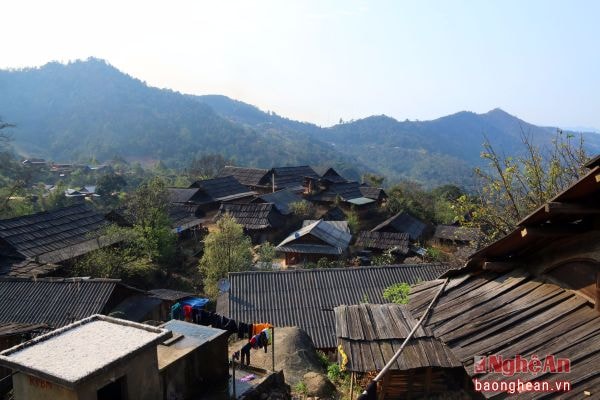 |
| Sermon 1. |
We were truly astonished to find such far-sighted people in this remote, misty land. "We're talking about the future, but right now, life in Tay Son is still very difficult. Electricity and phone service have only recently reached the commune, but in remote villages like Dong Tren, Dong Duoi, and Lu Thanh, life is still incredibly hard, with many households struggling to make ends meet," Vu Ba Lenh told us, standing beside us.
After saying that, he led us up the steep slope of the high mountain on the summit of Huồi Giảng 2 to the house of Ms. Xồng Y Hùa. The highland air was bitterly cold and misty, but we were still sweating profusely by the time we reached where she and her children lived. Hearing the village official introduce the house, we were startled, as we hadn't imagined it to be a proper home. The four sides were a makeshift structure of bare planks. There was nothing of value inside except a bed made of a few logs covered with bamboo. A few chayote squash, which she had gathered from her fields to make the main meal for the family, lay scattered on the damp earthen floor, still wet from the rain.
Through Vu Ba Lenh's translation, we learned that in 2014, her husband, Vu Ba So, died after eating poisonous mushrooms while in the forest. She is now raising two young, disabled children, Vu Y Di and Vu Ba Nenh. Xong Y Hua, with tears in her eyes, said that her family is so poor that they often don't even have enough rice to eat; if they do, it's only enough to save for when they're hungry. Their main food consists of rice with wild vegetables or plain water. Hearing her story, we couldn't help but feel heartbroken seeing the biting wind still blowing into the house where she and her children live…
We bid farewell to Tay Son as the sun began to set. The sun peeked out from behind the misty clouds on the high mountain peaks. The villagers returned from their fields with baskets full of vegetables, taro, pumpkins, and more. The village was already beginning to light up with lamps.
Dao Tho
| RELATED NEWS |
|---|