
The first Tay ethnic general of the Vietnam People's Army.
At the end of January 1941, President Ho Chi Minh returned to Vietnam via the Cao Bang border, exactly 30 years after leaving his homeland. Upon setting foot on the Vietnamese border, he bent down and kissed the Vietnamese soil, his eyes welling up with emotion. The person who brought President Ho Chi Minh back to the country on that trip was the young Tay ethnic man Dam Van Mong – who later became Major General Le Quang Ba, the first commander of the Viet Bac military region and also the first Tay ethnic general of the Vietnam People's Army.
At the end of January 1941, President Ho Chi Minh returned to Vietnam via the Cao Bang border, exactly 30 years after leaving his homeland. Upon setting foot on the Vietnamese border, he bent down and kissed the Vietnamese soil, his eyes welling up with emotion. The person who brought President Ho Chi Minh back to the country on that trip was the young Tay ethnic man Dam Van Mong – who later became Major General Le Quang Ba, the first commander of the Viet Bac military region and also the first Tay ethnic general of the Vietnam People's Army.
The house of Major General Le Quang Ba and his wife is located in the Trung Tu residential area and is very simple and modest.
In the small attic room that Mrs. Le Quang Ba (whose maiden name was Hoang Thi Dao) used as a living room, there are portraits of the late Major General Le Quang Ba, photographs of him with President Ho Chi Minh, and the prestigious Ho Chi Minh Order personally signed by the late Chairman of the State Council Vo Chi Cong, all of which Mrs. Hoang Thi Dao proudly displays in that small living room.
Twenty-four years after Major General Le Quang Ba passed away, the living room and the mementos he left behind are still carefully preserved and cherished by Mrs. Hoang Thi Dao.
At 90 years old, Mrs. Hoang Thi Dao's memory is no longer as sharp as it once was, but she still enthusiastically told me stories about Major General Le Quang Ba. She said that occasionally reminiscing about him is a great source of happiness for her.
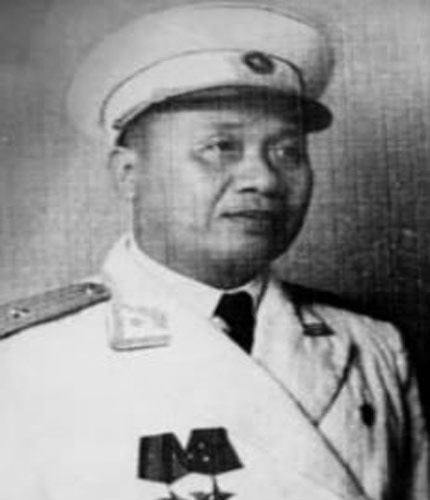
Major General Le Quang Ba
Major General Le Quang Ba and his wife were both born in Ha Quang district, Cao Bang province, in different communes. In the late 1930s, when the revolutionary movement was still facing many difficulties and many Tay people in Cao Bang were still unaware of what revolution was, both of them had already joined the revolution.
Ms. Hoang Thi Dao recounted that her hometown was Soc Ha commune, Ha Quang district. Her mother passed away early, and she lived with her father, brothers, and sister-in-law. As a young woman, after hearing her cousin talk about the revolution for the first time, she ran away from home to join the revolution and was assigned to work in women's affairs.
Major General Lê Quảng Ba was then a friend and comrade of her cousin. He, along with Comrade Hoàng Sâm (later Major General Hoàng Sâm) and Lê Thiết Hùng (the first Major General of the Vietnam People's Army), was tasked with propagating revolutionary ideas and raising revolutionary awareness among the Tay ethnic minority people in Cao Bằng province.
Through Major Generals Le Quang Ba, Hoang Sam, and Le Thiet Hung, Ms. Hoang Thi Dao gained a much deeper understanding of the revolution and became even more determined to follow the path she had chosen.
Thanks to this, a short time later, in 1942, she was admitted and became a member of the Communist Party of Vietnam.
Through frequent business trips and joint propaganda missions, Major General Le Quang Ba began to develop feelings for Hoang Thi Dao, a young Tay woman 10 years his junior, who was petite, gentle, yet very charming and resilient.
Ms. Hoang Thi Dao's cousin and Messrs. Hoang Sam and Le Thiet Hung also strongly supported Major General Le Quang Ba, constantly urging and encouraging the couple to get to know each other.
Ms. Hoang Thi Dao recounted that Major General Le Quang Ba was a gentle, quiet man who rarely expressed his feelings through words. When they were getting to know each other, he would occasionally visit her in Soc Ha commune.
But every time he visited her house, he only talked to her father and the other adults in the family, never trying to have a private conversation with her. Seeing how serious and proper he always was, her father liked him very much, but she occasionally felt a little sad because she didn't get to talk to him.
Although he rarely expressed his feelings, he was very indulgent and caring towards her. Back then, he often traveled to China for work, and each time before leaving, he would ask her, "What would you like to buy there, Dao, so I can bring it back?"
Back then, goods were scarce in Vietnam, and she cherished every piece of cloth, comb, or mirror that he brought back.
After dating for a year, they got married. The wedding was witnessed by many officials and colleagues from both of their workplaces. Everyone enjoyed a celebratory meal featuring a pig weighing over 70kg that her brother had raised as a "wedding gift" for his sister's wedding.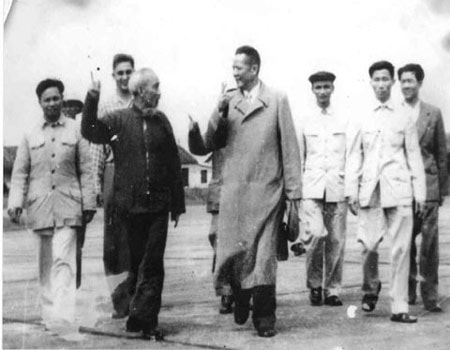
Major General Le Quang Ba with President Ho Chi Minh in the working delegation.
After the official marriage ceremony witnessed by the organization, the couple lived in a hut in Pac Bo, along with many other cadres from Viet Minh agencies. Mrs. Hoang Thi Dao recounted that her time in Pac Bo was a very beautiful period in her life. Although life was difficult and lacking in resources, it was warm and happy.
Back then, Uncle Ho stayed in the inner huts and frequently visited the huts where the couple and other Viet Minh cadres lived. He inquired about everyone's well-being very kindly, advising them to eat and drink moderately, to wake up early to exercise, and to maintain their health so they would have the strength to continue the revolution for a long time.
Among the officials who were with Uncle Ho at Pac Bo at that time, Uncle Ho held Major General Le Quang Ba in particularly high regard, because he was one of the people who overcame many dangers to go to China to bring Uncle Ho back to Vietnam safely.
The name Le Quang Ba was also given by Uncle Ho to the first Tay ethnic general of the Vietnam People's Army (the real name of Major General Le Quang Ba was Dam Van Mong).
Later, during his revolutionary activities, Major General Le Quang Ba adopted this name. For him, being named by President Ho Chi Minh was both a source of happiness and pride, both for him personally and for the Tay people of Cao Bang in general.
In 1959, Le Quang Ba was promoted to Major General. He became the first Tay ethnic general of the Vietnam People's Army and the first Commander of the Viet Bac Military Region (now Military Region I – based in Thai Nguyen).
Mrs. Hoang Thi Dao said that her husband's promotion to General was a source of pride for her entire family and for the Tay people of Viet Bac. On the day he officially received the rank of Major General, when he came to see her, his eyes sparkled with joy.
He said, "My dear, if we live simply, humbly, and strive to contribute our best, we will be respected by our comrades and loved by our people." Indeed, throughout his life, Major General Le Quang Ba always lived by that principle.
Regardless of his position, he lived a simple, honest, and approachable life. The people of Cao Bang in particular, and the people of Viet Bac in general, all loved him for his sociable, simple, and kind nature.
During his lifetime, Major General Le Quang Ba was a very kind and loving husband and father. He never hit or scolded his children. When teaching them, he often said:
"I'm not forcing you to do anything. Live the way you want, do what you like, just remember that whatever you do, don't violate family traditions."
When the children of Major General Le Quang Ba and Mrs. Hoang Thi Dao reached marriageable age, he would often advise them that whoever they loved, they must be committed to that person and wholeheartedly care for and nurture that relationship.
Ms. Hoang Thi Dao recounted that in the decades they lived together, she had never once heard her husband speak harshly to her.
While he was in Viet Bac, she worked in the Women's Association of Cao Bang province. Later, when he returned to Thai Nguyen to become the Commander of the Viet Bac Military Region, and then to Hanoi to hold other important positions in the government, she followed him, sometimes working in the children's affairs department of Thai Nguyen province, and sometimes as an official in the Ministry of Transport.
He always told her that he was grateful for the sacrifices she made for her husband and children during the arduous years of the resistance against the French and the Americans.
Throughout their lives, Major General Le Quang Ba and his wife lived simply and honestly. Compared to the homes of other generals, the house where Mrs. Hoang Thi Dao currently lives can be said to be very simple and modest.
Although Major General Le Quang Ba held important government positions, at home, he and his wife remained just an ordinary Tay ethnic couple, speaking the Tay language and living simply according to Tay customs and traditions.
The neighbors around their house still remember him as a simple, approachable General who, after work in the evenings, would often stop by their neighbor's house to chat and share a few pleasant stories.
In 1988, Major General Le Quang Ba passed away at the age of 74. Many Party and State leaders, generals, and veteran revolutionaries came to bid him farewell. But the person who suffered the most and experienced the greatest loss was Mrs. Hoang Thi Dao.
More than 20 years have passed, and even now, for her, the image of him, the first Tay General of the Vietnamese Army, remains as vivid and endearing as ever.
According to Phunutoday - nt


