
Mass shootings in the US: Due to legal loopholes?
(Baonghean) - Although mass shootings represent only a small fraction of overall gun violence, they appear to be becoming increasingly common in the United States. This reality exposes a problem facing the country: loopholes in gun control.
On the evening of July 23rd, US time, a gunman opened fire at a movie theater in Lafayette, Louisiana, killing two people and injuring seven others before taking his own life. The attacker is believed to be a 58-year-old white man armed with a handgun, and according to witnesses, he fired for about 20 minutes during the movie screening. Police have identified him but have not released any further details, only stating that the perpetrator had a prior criminal record. The Louisiana governor told reporters, "This is a terrible night for Lafayette, for Louisiana, and for the entire United States."
The incident occurred just three days after the third anniversary of the Aurora, Colorado movie theater shooting that killed 12 people and injured 70; and shortly after two previous tragedies in Charleston and Chattanooga that claimed the lives of 9 and 5 innocent people, respectively, sending shockwaves through communities and across the United States. Just hours earlier, US President Barack Obama had told the BBC that gun reform was his “biggest failure” of his presidency. He said: “If you look at the number of American citizens killed by terrorism since 9/11, it’s less than 100. But if you look at the number of people killed by gun violence, it’s in the tens of thousands. For us, it’s heartbreaking that we can’t solve this problem.” This is indeed a thorny question for Obama in particular and America in general, as throughout his term, the president has repeatedly pushed for stricter gun control but has yet to bring about any significant changes to the laws.
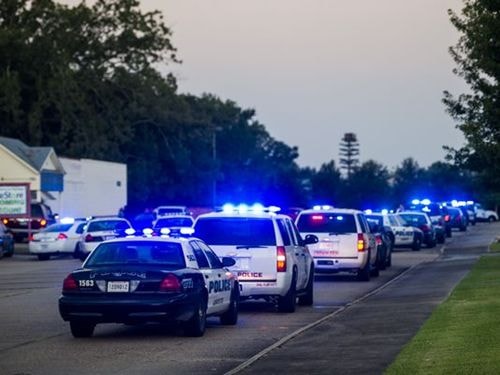 |
| Police in Lafayette and Louisiana have sealed off a street after reports of a shooting at the Grand Theater. (Photo: Advertiser) |
According to CNN, an average of 88 American citizens die each day due to gun violence. Not every incident makes headlines, but clearly, each life is precious, and the loss of each person is a devastating blow to this developed nation. Therefore, every American citizen, including political leaders, is grappling with the question: What can be done to prevent similar mass shootings in the future? How can gun violence no longer be a constant feature in daily news?
The Louisiana shooting occurred while Americans were still unclear about the origins of the Chattanooga incident on July 16th. However, recent media reports indicate that the gunman who killed the Marines exploited loopholes in online gun sales and purchased at least one of the weapons through this channel, knowing it was easy to buy firearms in this way without background checks or answering any questions. A month earlier, the tragic Charleston incident was also a consequence of incomplete background checks at a federally licensed gun dealership where the killer purchased his weapon.
To understand these inconsistencies, it's necessary to grasp the history behind background check laws. The Brady Background Check Act of 1993 required gun dealerships to conduct background checks on all buyers through the Federal Bureau of Investigation (FBI). However, as Congress debated the bill, the National Rifle Association proposed and successfully pushed through an amendment allowing gun dealerships to issue permits to sell firearms within three business days, even if the FBI hadn't yet confirmed that the buyer was legally permitted to possess the weapon.
Most background checks are completed in just a few minutes, but in a few cases, this process can take more than three days. In those rare instances, there is usually uncertainty about the buyer's background, requiring further verification. The key point here is that the FBI only has three days to complete the background check before the seller is allowed to proceed with the transaction. According to CNN, between 2010 and 2014 alone, this time limit for background checks inadvertently allowed over 15,000 guns to be sold to individuals who could potentially pose a danger to society.
Let's try some simple hypothetical comparisons with other professions to see the problem with the above regulation. In the banking sector, when the credit verification process is not yet complete, credit officers will not rush to grant loans to customers after only 3 days. Similarly, doctors will not hastily conclude a patient's condition just because test results are not yet available after 3 days. The American Rifle Association's lobbying to amend the Brady Act more than two decades ago undoubtedly made buying and selling guns simpler and easier, consequently putting the lives of American citizens at greater risk. The reality proves that Congress made a serious mistake, because background checks should only have one of two outcomes: approved or rejected, preventing people from buying guns with the label indicating "incomplete" verification. American citizens need to speak out and demand that Congress quickly fix this dangerous loophole so that no criminals can buy guns in this way.
Of course, waiting for Congress isn't the only thing that can be done; America needs to urge retailers selling these specific items to only conduct transactions after a complete background check, demonstrating their right and responsibility to ensure that those buying guns are not criminals, abusers, or people with mental illnesses.
Following these tragic events, as the veil behind the tragedy is lifted, it's easy to fall into the trap of speculation: What if they had acted differently? The reality is that America cannot change what has happened, but it can certainly ensure a more secure future. This depends on each American citizen, from leaders to gun dealers and ordinary citizens, to raise awareness about gun control and use, close the current loopholes, and remove America from the list of developed nations grappling with gun violence.
Thu Giang
| RELATED NEWS |
|---|


