
Addressing oversized and overloaded vehicles requires a comprehensive and systematic approach.
(Baonghean)Most of the key national highways in our province have long been in need of repair due to the rapid deterioration caused by oversized and overloaded vehicles. The provincial police have also organized intensive campaigns to strictly and decisively handle these types of vehicles, initially restoring order. However, to effectively address oversized and overloaded vehicles, a comprehensive and thorough solution is needed.
National Highway 1 has long had a high volume of oversized and overweight vehicles. Many sections, despite upgrades, still suffer from structural damage, subsidence, and uneven surfaces. For example, nearly 2 km of the route in Dien An (Dien Chau district) is uneven and bumpy, a consequence of the tire tracks left by overloaded vehicles. Many sections are riddled with potholes, causing water to accumulate during rain, seriously affecting traffic.
Traveling along National Highway 48C from the Sang Le intersection, one often sees "menaces" carrying massive blocks of white stone without any tarpaulins, speeding along and leaving behind clouds of dust. These trucks typically carry over 100 tons, more than three times the permitted load. Most frightening are the "reo" trucks, the "four no's": no mirrors, no windows, no license plates, and no registration, carrying huge blocks of stone swaying from the quarry to the processing plant. Traffic accidents can happen at any time. It is known that these trucks are mostly modified, of unknown origin, and have numerous defects, yet they continue to operate brazenly in Quy Hop. Ms. Vi Thi L from Tam Hop expressed her frustration: "These trucks damage the roads wherever they go, cause air pollution, and are prohibited from circulating, yet they brazenly occupy the road and sidewalks…"
In response to this situation, under the direction of the Provincial People's Committee, since 2012, the Director of the Provincial Police Department issued Official Letter No. 1755 dated August 29, 2012, "on handling overloaded and oversized vehicles in Nghe An province." Following this, implementing Prime Minister's Directive 95 on rectifying the situation of road vehicles carrying overloaded goods and exceeding the prescribed number of passengers, the Nghe An Provincial People's Committee issued Official Letter No. 1557/UBND dated April 1, 2013, assigning the Provincial Police force and local police forces to coordinate with other functional forces to "strengthen the handling of overloaded and oversized vehicles."
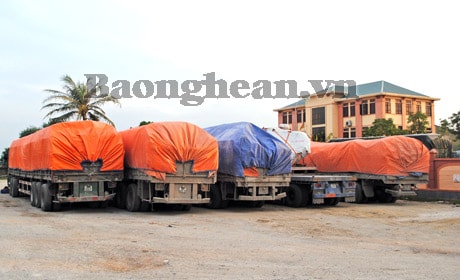
Overloaded and oversized vehicles are waiting to be unloaded at Traffic Police Team 1-5.
Lieutenant Colonel Tran Dinh Khuong, Head of Traffic Police Team 1-5, stated: "The volume of large trucks traveling daily on National Highway 1 is quite high, including over 10 businesses in Nghe An and Ha Tinh provinces specializing in transporting cement. Following the directive from the People's Committee and the Nghe An Provincial Police regarding the handling of oversized and overloaded vehicles, Traffic Police Team 1-5 has increased mobile inspections and set up checkpoints on the roads, resolutely enforcing regulations and forcing the reduction of load weights for vehicles transporting cement and construction materials."
From April 1st to the present, the team has handled nearly 200 oversized and overloaded vehicles, mainly trucks and semi-trailers, recovering over 500 million VND for the State budget. According to Mr. Khuong, the penalties for oversized and overloaded vehicles are not strong enough to deter offenders. Government Decree 71/CP/2012 only stipulates penalties for drivers who violate the regulations, but does not penalize those involved in loading goods exceeding the road and bridge load limits. Furthermore, there are currently no penalties for repeated violations of load limit regulations. In reality, each oversized or overloaded vehicle is only fined between 2 and 2.5 million VND.
Many drivers are aware that overloading and oversized vehicles are violations; however, drivers are merely "hired drivers" for businesses, so they have to obey their bosses. The heavier the cargo and the more trips they make, the more profit they make. Mr. Khuong added: The process of enforcing regulations against oversized and overloaded vehicles is facing difficulties. National Highway 1 is nearly 100 km long, with 25 km of bypass around Vinh City, but the Traffic Police Team 1-5 has a limited workforce. When they detect a violating vehicle, they have to take it to private weighing stations tens of kilometers away to weigh its load. Furthermore, the team lacks unloading areas and warehouses for storing goods…
National Highway 48 is also struggling to cope with trucks carrying sugarcane, white stone, and raw acacia wood. Currently, Traffic Control Team 1-48 is inspecting and requiring many trucks carrying white stone and acacia wood to unload their cargo. These trucks are designed to carry 20 tons of stone, but most are loaded with 80-90 tons.
Major Le Thanh Nghi, Team Leader of Traffic Control Team 1-48, said: To effectively handle oversized and overloaded vehicles, the team has deployed forces to set up checkpoints at the Sang Le intersection in Tam Hop commune (Quy Hop district), a route frequently used by trucks carrying white stone. To evade traffic police, these vehicles often travel between 1 and 2 AM to avoid detection, taking advantage of shifts when officers are changing shifts to transport their goods. Since April 1st, the team has intensified inspections and issued citations to 143 oversized and overloaded vehicles, mainly those carrying white stone and acacia wood.
The Vietnam Road Administration issued Official Letter No. 1429/TCĐBVN-TTr dated April 12, 2013, regarding the "simultaneous deployment of mobile vehicle weight inspections on roads nationwide." The General Department requested strict handling of violations involving oversized and overloaded cargo on national and local roads. Vehicles found violating regulations by carrying oversized or overloaded cargo will be resolutely forced to unload their excess cargo and will only be allowed to continue their journey if they meet the prescribed weight and size limits. Any difficulties encountered during implementation should be reported to the Vietnam Road Administration and General Department VII. |
Overloaded and oversized trucks carrying timber from Laos have been rampant on National Highway 7 for a long time. It is known that these trucks often travel at night, avoiding shortcuts and the Ho Chi Minh Highway. Traffic Police Team 1-7 has been actively setting up checkpoints at key locations to bring the vehicles to the team's office for processing and weight reduction. To date, the team has processed over 100 oversized and overloaded vehicles, mainly carrying timber from Laos. Currently, the team is stationed to handle cement tankers and trucks carrying equipment for hydropower projects that violate oversized and overloaded regulations.
Recently, traffic police forces across the province have launched a coordinated campaign to strictly handle violations of transporting oversized and overloaded goods; forcing vehicles to unload their cargo and only allowing them to continue their journey if the load meets the weight and size limits as stipulated. From April 1st to the present, authorities have issued citations to 782 cases of oversized and overloaded vehicles, temporarily seized 31 vehicles, and collected over 1.1 billion VND for the state budget. Other penalties, such as revoking driving licenses for 30 to 60 days, have been applied to 650 cases.
Lieutenant Colonel Cao Minh Phuong, Deputy Head of the Provincial Traffic Police Department, stated: The current difficulty is that the traffic control teams in the province lack designated unloading points. For example, Traffic Control Team 1-7 has to borrow the Do Luong bus station as a place to unload cargo. In particular, there are no weigh stations on national highways, requiring drivers to travel tens of kilometers to rent private weigh stations. Furthermore, during the process of handling oversized and overloaded vehicles, many transport businesses face resistance. When vehicles are impounded, many drivers do not cooperate with the police. Local vehicle inspection agencies only control the vehicles' condition upon arrival, not their operational status. Most vehicles, after inspection, are modified by owners to carry more cargo than designed.
Meanwhile, vehicle inspection agencies lack sufficient personnel to conduct surprise inspections during the inspection period. Oversized and overweight vehicles, and most other trucks currently circulating in Vietnam, are imported from abroad. However, in recent times, technical barriers controlling the total weight of imported vehicles have been inadequate and lax. Currently, there are no specific regulations regarding the dimensions of the cargo bed, or the cargo capacity limits for trailers, container trucks, tanker trucks, etc.
To effectively address oversized and overloaded vehicles, coordinated efforts are needed between localities and relevant sectors. The government should build more weighing stations and depots. In particular, a comprehensive approach to dealing with oversized and overloaded vehicles is crucial, because while Nghe An province is resolutely cracking down, other provinces have not yet implemented similar measures, resulting in many overloaded vehicles still passing through our province.
Van Truong


