
An inevitable trend in production.
(Baonghean)High-quality, delicious rice varieties are increasingly being chosen by consumers, even if they have to pay a higher price. Selecting and using high-quality rice varieties is considered an inevitable trend in commercial agricultural production; therefore, the area of high-quality rice cultivation in our province is growing…
As the province's rice granary, Yen Thanh produces a large amount of food annually. However, like many others, farmers in this rice-growing region have faced the common problem of "bumper harvests, falling prices," with their hard-earned rice going unsold. In recent years, with the market increasingly favoring high-quality rice, the government and people of Yen Thanh have been quick and bold in transforming their crop structure to find a new, more favorable and effective direction. Mr. Nguyen Sy Hung (Vice Chairman of the District People's Committee) said: "For the past three years, we have focused quite strongly on transformation, introducing high-quality seed production models and creating favorable 'outlets' so that farmers can see, believe, and follow them." In particular, emphasis is placed on high-quality, purebred rice varieties such as AC5, Bac Thom No. 7, glutinous rice varieties 89, 87, Bio 404, F1 hybrid rice, L25, and gradually introducing the popular glutinous rice variety "Nếp Cái Hoa Vàng". This spring, Yen Thanh planted 13,209 hectares of rice, of which only 5,600 hectares were hybrid rice, the rest being purebred varieties. "The yield of high-quality rice varieties reached about 65 quintals/hectare, while hybrid rice averaged 72 quintals/hectare, but the economic efficiency of high-quality rice varieties is still 1.5 times higher due to higher prices and favorable market outlets, with most products being purchased by businesses."
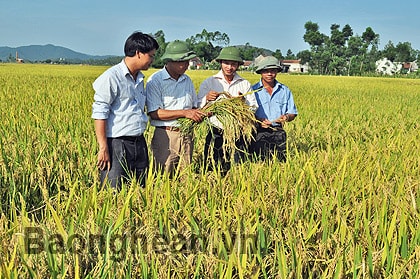
The high-quality rice variety VTNA2 is being introduced into production in the fields of Nghi Loc. Photo: V.D.
Mr. Vo Xuan Hong (Hamlet 6, Hung Xa Commune, Hung Nguyen District) owns 5 sao (approximately 0.5 hectares) of rice land within the district's model rice field. This past spring, he received full support in terms of rice seeds. Besides keeping some for his family's use, Mr. Hong recently sold nearly 1 ton of Nang Xuan rice. He happily shared: "This spring, the rice yield wasn't as high as last year – only 2.5-2.7 quintals per sao – but the profit is still high because the price of rice has increased from 8,000 to 9,000 VND per kilogram since the beginning of the harvest season, and now it's reached 9,500-10,000 VND per kilogram, considered a 'record' price." Having previously cultivated Chinese hybrid rice varieties like AC5, Mr. Hong only learned about Nang Xuan rice two years ago, but he's very fond of this variety. According to him, although the yield of Nang Xuan rice is lower than that of hybrid rice varieties, the rice is very delicious, fetches a high price, and he still can't sell enough to traders. This year, more than 1 ton of his Nang Xuan rice was still easily sold at a high price.
In recent years, the area of high-quality rice cultivation in Hung Nguyen has been increasing. Hoang Duc An, Deputy Head of the District Agriculture Department, shared: Many high-quality rice varieties such as AC5, Nang Xuan, HT1, XT28, VTNA2… are being introduced in increasing numbers; thanks to the good application of scientific and technological advancements, their yields are only slightly lower than hybrid rice varieties. For example, in the past spring crop, hybrid rice yields reached approximately 66 quintals/hectare, while high-quality purebred rice varieties averaged 59-61 quintals/hectare. Meanwhile, according to our survey, the price of Khang Dan rice and other hybrid rice varieties at the beginning of the harvest season was purchased by traders in Hung Nguyen at 5,400-5,700 VND/kg and has now increased to about 6,200 VND/kg. Purebred rice varieties, and even fairly high-quality hybrid rice such as AC5, Nang Xuan, HT1, XT28, NA2… are being purchased at current prices of 8,000 - 10,000 VND/kg. Notably, while in previous years, high-quality glutinous rice varieties like 87 and DT52 were difficult to sell, this year traders have been buying them even while the rice is still fresh, at a relatively high price of 6,800 - 7,000 VND/kg.
In terms of production structure, hybrid rice still consistently accounts for around 70%. For example, in the spring of 2012, out of a total area of nearly 90,000 hectares of rice in the province, only about 10,000 hectares were planted with high-quality purebred rice varieties, plus nearly 1,000 hectares of hybrid rice varieties with decent rice quality such as GS9, Bio 404, Nghi Huong 2308, etc. Therefore, the quality of Nghe An rice is generally much lower than that of other provinces, especially Southern rice and Thai rice. Nghe An rice is mainly sold to some establishments processing beer, spirits, and animal feed, and is rarely sold to urban consumers.
While high-quality rice varieties are easy to sell and command high prices, hybrid rice varieties are increasingly facing the opposite situation. Currently, varieties like the purebred Khang Dan 18 and the hybrid Khai Phong 1 are difficult to sell; farmers mainly produce them for livestock feed, noodle making, and animal feed production. The prices of these rice varieties are also very low. For example, this spring, at the peak of the harvest, the price of rice was only approximately 5,000 VND/kg, while purebred and even fairly high-quality hybrid varieties like AC5, DT68, GS9, BTE1, DT52, HT1, and Bac Thom No. 7 were always 3,000-4,000 VND/kg higher, and some varieties like Nang Xuan were even 1.5 times higher. Based on that reality, during the past spring crop season, while the province's plan was to plant 10,000 hectares of high-quality rice, the number in the districts increased to over 20,000 hectares, including: Nam Dan 2,500 hectares, Do Luong 1,500 hectares, and Nghi Loc over 1,000 hectares. According to Mr. Tu Trong Kim (Head of the Crop Production Department - Department of Agriculture and Rural Development), this is a positive sign in the trend of gradually shifting towards commodity production, increasing the value of agricultural production, especially when input costs in production are increasingly high. Increasing the economic value per unit area for farmers is an essential requirement. In fact, this transformation has been enthusiastically received by farmers, as the introduced varieties all have outstanding advantages, high yields, good quality, and high commodity value, thus convincing them. Rice varieties of decent quality but low yield, only slightly inferior to hybrid rice such as BTE1, Nghi Huong 2308, Quy So Uu, and GS9, are gaining dominance. It can be said that this is an inevitable trend in the commercial agricultural production of our province.
Phu Huong


