
Pepper exports: Supply shortages
According to the Ministry of Agriculture and Rural Development, pepper exports in the first seven months of the year increased by 22.8% compared to the same period last year. However, in the remaining five months of 2013, the supply of pepper is expected to be very strained.
The average export price of pepper from the beginning of the year to date has decreased by 4% compared to the same period in 2012. Vietnam's pepper export market in the past 7 months has been concentrated mainly in Europe (34%), Asia (35%), America (22%), and Africa (9%).
Alarming decline in production.
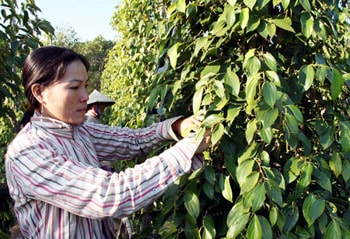
According to a survey by the Department of Crop Production, the average pepper yield has now decreased to 2.4 tons/ha.
According to the Vietnam Pepper Association (VPA), the country's pepper production in the 2013 crop year reached approximately 95,000 tons, a decrease of about 15% compared to the 2012 crop year. To date, only 15,000 tons remain available for export. For many years, Vietnam has been the world's largest pepper exporter, yet the pepper industry faces a paradox: increased acreage while declining production.
In 2011, the whole country had 53,000 hectares of pepper plantations, yielding 125,000 tons; in 2012, this reached 57,500 hectares, with a yield of 115,000 tons; in 2013, the pepper plantation area increased to 60,000 hectares, but the yield decreased to only 94,000 tons. Pepper currently accounts for only 2.5% of the total area of nearly 2 million hectares of five industrial crops in our country, but it accounts for over 8% of export value. The economic value of pepper is currently about 6,800 USD/ha/year, four times higher than rubber, eight times higher than cashew nuts, 2.6 times higher than coffee, and six times higher than tea. Each hectare of pepper plantation can yield a profit of 200-250 million VND/year.
Because pepper cultivation yields super profits, many farmers in the Central Highlands have recently been cutting down coffee and cashew trees en masse to switch to pepper cultivation. The worrying aspect is that many farmers are planting pepper varieties of unknown origin, leading to the risk of disease spread and causing losses.
A survey by the Department of Crop Production shows that the average pepper yield has now decreased to only 2.4 tons/ha (compared to 3-3.5 tons/ha in 2010). Dong Nai province has the largest increase in planted area, adding about 1,000 hectares compared to 2011, but the yield has decreased from over 2 tons/ha in 2011 to 1.4 tons/ha in 2013. In Ba Ria-Vung Tau, the average yield has also decreased, to only 1.72 tons/ha...
What strategies should be implemented for exports?
According to VPA, pepper prices on Indian exchanges and import prices in European and American markets are rising again. This is due to the dwindling supply from major pepper-producing countries like Vietnam and India. Meanwhile, countries like Malaysia and Indonesia, which are currently harvesting pepper, are also producing modest yields.
Currently, foreign traders are increasing their pepper purchases for speculation. Vietnamese businesses should not rush to sign export contracts without securing the goods, as there is a risk that pepper prices will later rise beyond the price agreed upon.”
VPA recommends
The Vietnam Pepper Association (VPA) believes that pepper prices will continue to rise sharply in the near future, as there are only about 15,000 tons of pepper in stock domestically, and foreign traders are currently flocking to Vietnam to buy pepper.
While supply in many major producing countries is declining, global demand for pepper continues to rise, which is expected to create unpredictable developments in the export market, and pepper prices in the final months of the year may still be surprising.
The Vietnam Export Promotion Agency (VPA) advises that businesses need to exercise extreme caution when signing export contracts regarding quantity, delivery time, price, and payment methods… in order to avoid contract breaches and payment defaults, which can lead to lawsuits where the risks and losses usually fall on Vietnamese businesses.
According to danviet -PH


