
Yen Thanh: Developing a sustainable forest business model
(Baonghean.vn) - As a semi-mountainous district, Yen Thanh has 21,993.87 hectares of forest land. Implementing the policy on socio-economic development in hilly areas, the district has built a sustainable forest business model with high economic value, aiming to help people develop high-yield crops on hilly land. This model involves agroforestry, intercropping long-term and short-term crops to sustainably generate income while simultaneously introducing some new crops for trial planting before expanding to a larger area.
(Baonghean.vn) - As a semi-mountainous district, Yen Thanh has 21,993.87 hectares of forest land. Implementing the policy on socio-economic development in hilly areas, the district has built a sustainable forest business model with high economic value, aiming to help people develop high-yield crops on hilly land. This model involves agroforestry, intercropping long-term and short-term crops to sustainably generate income while simultaneously introducing some new crops for trial planting before expanding to a larger area.
Mr. Dang Ngoc Thu, Deputy Head of the District Agricultural Extension Station, said: "In the initial period, the implementation of the model faced many difficulties because the new crops had long harvesting cycles, and many households participating in the model were hesitant during the implementation process due to uncertainty about the actual effectiveness. Given this situation, the Station conducted a survey throughout the district and selected six households in hamlets 7 and 8 (Bac Thanh) to implement the model."
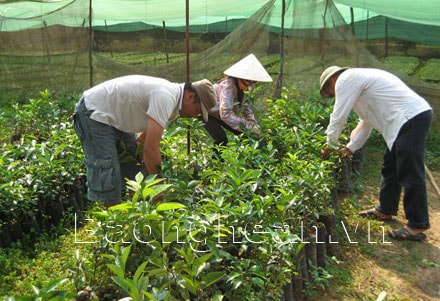
Preparing acacia seedlings for reforestation.
Initially, 15 hectares of hilly land were selected for planting trees such as bamboo, Mexican teak, agarwood, and hybrid acacia, along with intercropping rattan, vetiver, and elephant grass. The villagers also took advantage of the land to raise bees for honey. Regular training sessions were conducted for the households, helping them grasp the technical procedures for planting and caring for the trees.
Mr. Thu stated: "Through monitoring, we have found that the crops are suitable for the natural conditions. The acacia hybrid trees, propagated from cuttings, grow and develop quickly, have a short harvesting cycle, and are resistant to pests and diseases. As for the Mexican teak trees, they grow and develop very quickly in the initial stages, and although they are susceptible to stem borers that break off the tops, they are still suitable for the Yen Thanh ecological zone. In particular, the honeybee colonies have a high multiplication rate, increasing from 10 colonies in the first year to 8, yielding high honey production, with each colony producing 8-9 kg of honey per year, generating an income of 1-1.2 million VND per year."
According to assessments, the model has helped local people change their traditional planting practices, which involved planting without investment and at high densities, resulting in slow growth and development. People have learned to apply new scientific and technological advancements, introducing new crops to the area, creating jobs, and increasing income. In particular, the sustainable forest management model, with its high economic value, has created an agroforestry system that rationally integrates different crops, resulting in a sustainable forestry ecosystem. This has reduced soil erosion, improved degraded soil after eucalyptus planting, and increased soil fertility. This is considered a new and effective direction for developing the hill and garden economy in Yen Thanh.
Phu Huong


