
5 signs from moles that should immediately raise suspicion of cancer.
Cancer originating from moles is very dangerous, developing rapidly, metastasizing quickly, and easily causing secondary cancers in the lungs, brain, liver, bones, etc.
According to statistics from the Central Dermatology Hospital, the hospital treats more than 300 cases of skin cancer each year, and the number of patients increases by 10-15% annually.
However, very few people pay attention to this disease. When they notice strange marks on their skin, patients often mistake them for normal moles or birthmarks and therefore do not seek early medical attention, leading to many serious complications.
For example, two male patients in Hanoi noticed unusual dark spots on their faces several years ago but didn't seek treatment because they thought they were moles. When they went to the hospital for cosmetic laser treatment, doctors discovered that the skin cancer had progressed to a late stage and required chemotherapy and radiation therapy.
|
| Many people mistakenly think that a large black spot on the face is just a normal mole. |
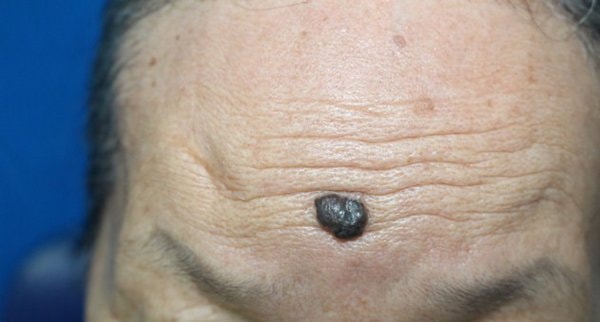
Dr. Hoang Thi Phuong Lan, Head of the Department of Plastic and Reconstructive Surgery at a hospital in Hanoi, said that cancer originating from moles is very dangerous, develops rapidly, is often malignant, metastasizes quickly, and causes secondary cancers in the liver, bones, lungs, brain, lymph nodes, etc.
Cancer originating from moles often begins as a small, non-itchy, and painless tumor, which is why people often overlook it. However, during its development, this type of tumor can cause inflammation, ulceration, necrosis, and destruction of local tissue. In severe cases, the tumor can "eat away" at fingers, toes, mouth, eyes, nose, etc., depending on its location.
However, if the patient is diagnosed early and treated promptly when the mole first becomes malignant, the cure rate is quite high.
According to Dr. Lan, to identify cancerous moles, people can easily check with the naked eye through 5 signs:
ButSymmetry:Benign moles usually have two symmetrical halves. When a mole or freckle has an unusually asymmetrical shape, it should be checked by drawing an imaginary line dividing the mole vertically and comparing the two halves to see if they are symmetrical. If it is asymmetrical, it could very well be cancerous.
ButBorder:If the outer border of a mole is blurred, the boundary between the skin and the mole is indistinct, and it looks unusual compared to other moles, it could be a warning sign of cancer. Malignant tumors often cause the borders of unusual moles on the skin to become blurred.
|
| Many abnormalities in malignant moles can be easily detected with the naked eye. |
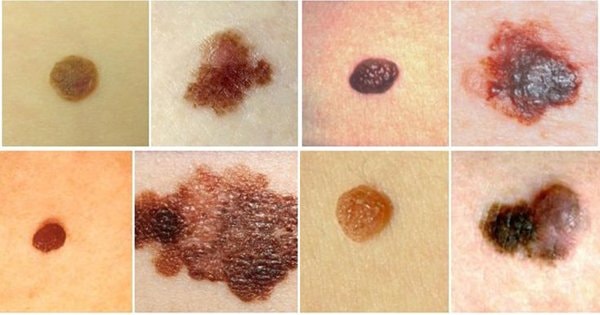
ButColor:A mole that is not the same color as other moles on the skin, regardless of whether it is brown, black, dark blue, white, or red, is suspicious.
Normal moles have a consistent color and are uniform across the skin, but if there are many moles of different colors and shapes, with some darker and some lighter, the risk of cancer is very high.
ButDiameter:One suspicious sign when observing unusual spots on the skin is that their diameter is significantly larger than that of typical moles. Moles are usually smaller than or equal to 0.6 cm.
ButConvexity:If a noticeable, raised bump appears on the skin, it's necessary to have it checked. This is because malignant tumors often grow rapidly in size or diameter. A mole that keeps growing, changes color, becomes itchy, uncomfortable, or bleeds is a real cause for alarm.
Therefore, doctors advise that if you notice lumps or bumps on your skin that look like moles, or unusual patches of skin color that are spreading, growing over time, feel hard to the touch, or are painful to the touch, you should consider the possibility of cancer and get checked as soon as possible.


