
The 'retention' challenge?
(Baonghean) - After attracting tourists, the next challenge is retaining them, a question that still awaits answers from those involved in tourism in Nghe An.
ButYesterday, my daughter Bim was taken out by her parents to celebrate Children's Day. When we got home in the evening, I asked her:
- Did Bim have fun playing?
- It was fun, but we had to go home after only a short while.
- You saw the parents and their two children going out from early morning until late at night, they spent the whole day together and you still think it wasn't enough?
- No, the road was so crowded that we didn't get to the park until noon. Bim's dad said we should come home early this afternoon so we wouldn't have to wait as long as we did this morning...
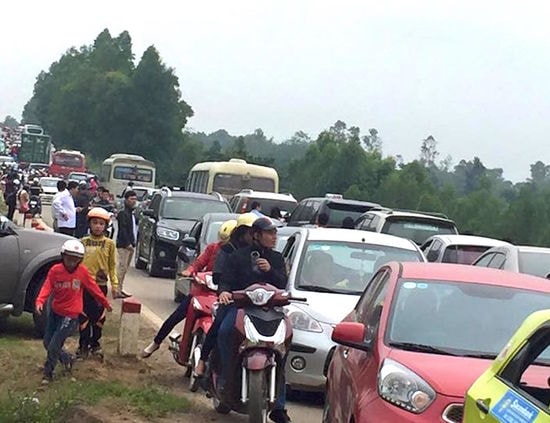
I was surprised and asked the girl's father, and he confirmed that there was indeed a traffic jam. This surprised me a little because Nghe An province has never had traffic jams outside the city before (except in case of a serious accident). However, I was even more surprised when Bim's father said, "I've never experienced such a traffic jam while traveling within the province before, so I'm glad!" I was surprised, but not entirely confused.
Nghe An is a large province with diverse topography and culture. Long recognized for its immense tourism potential with numerous natural and man-made resources, Nghe An has yet to truly shine on the Vietnamese tourism map. When visitors from outside Nghe An think of Nghe An, they often immediately think of Cua Lo and President Ho Chi Minh's birthplace. Recently, other options have emerged, such as Hoang Muoi Temple, visiting Thai ethnic minority villages in the western districts of Nghe An, and sunflower fields. Meanwhile, local visitors tend to seek out neighboring provinces like Ha Tinh and Quang Binh – a regrettable situation considering they may never have visited many of the province's own attractions.
 |
| Tourists visit the sunflower field. Photo: Internet |
Traffic congestion due to the large number of tourists in Nghe An may be welcome news for those interested in the province's tourism, as it's a positive sign indicating certain changes in a potentially promising but underutilized sector. On the other hand, this also suggests that Nghe An's tourism will soon face significant challenges regarding transportation. This will involve issues across multiple aspects: infrastructure, services, and even the behavior of the local population. In reality, shortcomings in services and traffic culture have already emerged, rather than being a prediction of the future.
Let me use Bim's family trip as an example. In countries with strong tourism industries in the region, such as Thailand or Singapore, people rarely travel to tourist destinations far from the city center by private car; instead, they usually use public transportation like trains and buses. The quality of public transportation service is excellent: the buses are clean and new, the seats are spacious, passengers sit neatly and speak softly, and there is no crowding or noise. Compared to our bus routes, it's a world apart; whenever we see a bus on the road, our first reaction is to... get out of the way to avoid any trouble.
Our traffic culture is still quite limited. Motorcyclists brazenly ride in car lanes, and car drivers readily speed, splashing water on motorcyclists whenever it rains. Occasionally, people riding next to buses even get a "bonus" – a bag of trash falling right on them… These are just a few examples of the uncivilized behavior of road users in Nghe An in particular and the whole country in general.
Tourism is a unique economic sector. First and foremost, it's considered a non-polluting industry, but ultimately, it's a service. And in any service, human experience is crucial. If a tourist's impression of a destination is marred by frustration, fatigue, and the feeling of excessively long travel times, will they want to return? After attracting tourists comes the challenge of retaining them, a question that awaits answers from those involved in tourism in Nghe An.
Hai Trieu
| RELATED NEWS |
|---|


