
Parent-teacher association or school representative?
(Baonghean.vn) - In reality, the activities of the Parent-Teacher Association (PTA) have long been based on oral tradition and experience, leading to a lack of full understanding of their functions, powers, and responsibilities. This lack of understanding often results in neglecting their duties.
At the beginning of each school year, the community raises the issue of tutoring, extra classes, "additional fees," and the role of the Parents' Association. Many even suggest dissolving the Parents' Association. As someone who has served as the head of the Parents' Association for many years in both elementary and high school, the author wishes to offer a different perspective.
First of all, real-life experience shows that if there are only 3 people, we need to appoint one representative. Therefore, for a school with hundreds, even thousands, of parents, having a parent representative board is essential. The public and community's much criticism and strong condemnation of the Parent Representative Board is, in my opinion, largely due to the Board's failure to operate in accordance with the spirit of Circular 55/2011/TT-BGDĐT dated November 22, 2011, promulgating the Charter of the Parent-Teacher Association.
This stems from the fact that although this Circular was issued 6 years ago, many parents serving on the Parent-Teacher Association at the class and school levels are unaware of or have not read its regulations. Many teachers have also never read this Circular, leading to a "mismatch" in the coordination of activities between parents and the school.
The Parent-Teacher Association (PTA) operates on an oral, experience-based basis, leading to a lack of full understanding of its functions, powers, and responsibilities. This lack of understanding and grasp of its position, role, and duties results in improper conduct, causing negative reactions from parents and inadvertently "abetting" wrongdoing within the school.
Who do they represent?
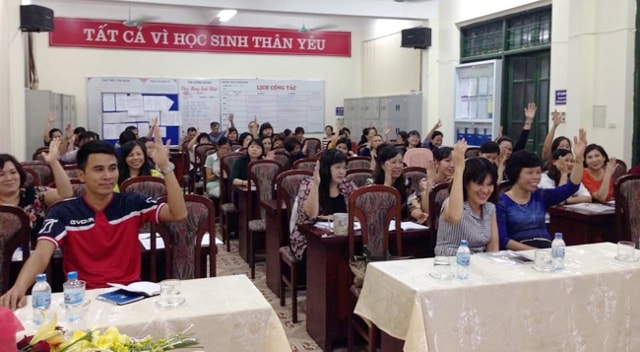 |
| The Parent-Teacher Association (PTA) usually needs to have a firm stance on how to collect fees for the school. (Image: Internet) |
In reality, my many years as head of the school's Parent-Teacher Association (PTA) have shown me that when a "Parent-Teacher Association is organized each school year and elected by parents or guardians of students (hereinafter referred to as parents) currently studying in each class and school," it truly functions for the class. However, if it is elected by the homeroom teacher or the principal, it tends to represent the class or the school.
Monitoring feedback from parents nationwide, we found that 99% mentioned unreasonable fees collected by schools under the guise of the Parent-Teacher Association (PTA). In reality, Clause 4b, Article 10 of Circular 55 stipulates that PTAs are prohibited from collecting donations that: “Documents not directly serving the activities of the PTA: protecting school facilities, ensuring school security; supervising students' transportation; cleaning classrooms and the school; rewarding school administrators, teachers, and staff; purchasing machinery, equipment, and teaching materials for the school, classrooms, or for school administrators, teachers, and staff; supporting management, teaching organization, and educational activities; repairing, upgrading, or constructing new school facilities.”
If the Parent-Teacher Associations at the class and school levels understand this, they can politely decline to participate in fundraising campaigns. In reality, many parents readily contribute their time and money to activities directly benefiting their children, but react strongly against contributions that are "pointless" or without purpose.
Some common problems
Many parents question the "playing both sides" role of the Parent-Teacher Association (PTA), meaning only one parent is in charge of managing the finances, without a semester-by-semester spending plan or transparent financial statements. Many principals prefer to keep the "school parent fund," preventing the PTA from independently managing its operating budget. The role of "post-auditing" after parents' contributions is often not effectively carried out.
Despite the regulation stating "There is no fixed average amount of financial support for parents," many Parent-Teacher Associations (PTAs) fail to understand the circumstances of each family and simply distribute the funds equally, leading to public backlash. Many PTAs also exceed their authority, making decisions on issues in an undemocratic and non-transparent manner, causing resentment among parents.
Some class and school representative boards lack independent input in discussions and consultations with homeroom teachers and principals, operating on a "whatever is said, they do" basis. They fail to effectively solicit and gather collective opinions on school proposals, especially those related to contributions, leading to unnecessary negative reactions. Furthermore, when parents face backlash, the representative boards often lack the credibility and reasoning to explain and apologize, potentially causing a chain reaction and damaging family-school relations.
Having served as the head of the Parent-Teacher Association (PTA) at two fairly large schools for many years, I believe that the legal framework for the PTA already exists; the issue lies in its flexible and effective application. If parents are truly given the opportunity to democratically discuss and approve matters through the PTA, then the coordination between the school and the family will clearly be enhanced.
An Thanh
| RELATED NEWS |
|---|


