
Ingenious methods used by farmers in Nghe An to protect cattle from the cold.
(Baonghean.vn) - Mr. Son has a total herd of 37,793 buffaloes and cows. To protect their "livelihood assets" this winter, in addition to traditional methods such as reinforcing and sheltering barns and proactively stockpiling feed, farmers have also adopted a new approach.
In October 2016, the Anh Son District Agricultural Extension Station conducted training on the model of silage fermentation in livestock farming in Cam Son and Hung Son communes, with over 100 households participating. To date, after nearly four months of implementation, the model has proven effective, especially during cold weather.
Mr. Cao Xuan The, from Hoi Lam village, Cam Son commune, said: "My family raises 15 buffaloes and cows. In previous years, we often used things like straw, corn stalks, and sugarcane tops as feed for them. However, with this conventional method, the aforementioned feed doesn't last long and is lacking in nutrients."
This year, he applied the method of fermenting animal feed and found it to be exceptionally effective. This method allows him to store feed for his buffaloes and cows for a long period of 3-5 months, reducing the labor involved in grazing and solving the problem of feed scarcity during cold, rainy days.
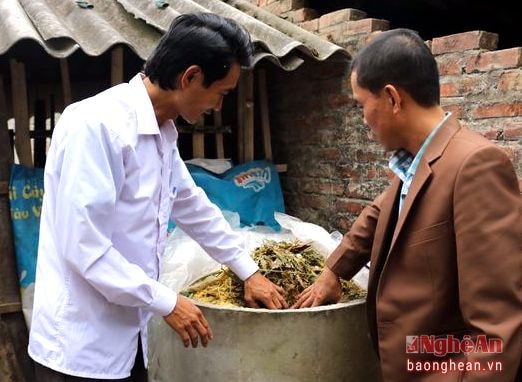 |
| With a ratio of 100 kg of grass or colored stems mixed with 5 kg of corn bran or rice bran, 0.5 kg of coarse salt, and 1 kg of molasses, then sealed in a tank, it can be fed to cattle and buffaloes after about a week. |
Nguyen Van Hung from Hamlet 2, Cam Son Commune, shared: "The silage method creates a feed source with high nutritional content, and my family's cattle gain weight 30% faster than with normal farming, while the cost is low, each time we make silage it only costs about 80,000 - 100,000 VND."
According to Mr. Nguyen Quang Phung, an officer at the Anh Son District Agricultural Extension Station: In addition to utilizing agricultural by-products to help clean the environment, raising cattle and buffaloes using the silage method also has other advantages such as: allowing for long-term feed storage; fermented silage feed helps livestock digest food better, stimulates cattle and buffaloes to eat more, grow faster, and increase their resistance to disease.
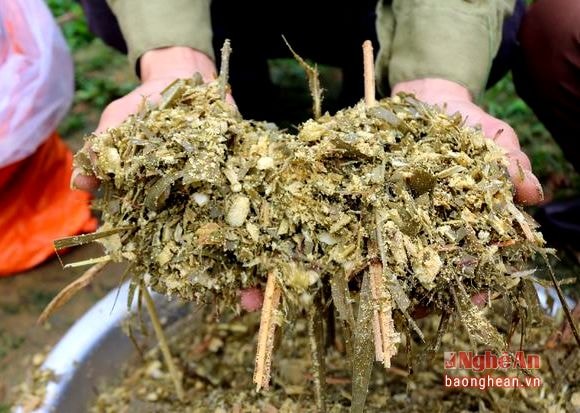 |
| After fermentation, the feed turns yellow and has a slightly sour aroma, making it very attractive to cattle. |
Accordingly, to implement this method, people need to prepare materials such as grass, straw, corn stalks, cassava plants, etc., which are chopped into pieces about 5-7 cm, dried for one day, and then fermented. The ratio is 100 kg of grass or stalks mixed with 5 kg of corn bran or rice bran, 0.5 kg of salt, and 1 kg of molasses. After one week of fermentation, it can be fed to buffaloes and cows; it can be stored for up to 6 months. Each adult buffalo or cow consumes 10-15 kg of fermented feed per day in combination with grass, or 15-20 kg/day if kept in confinement.
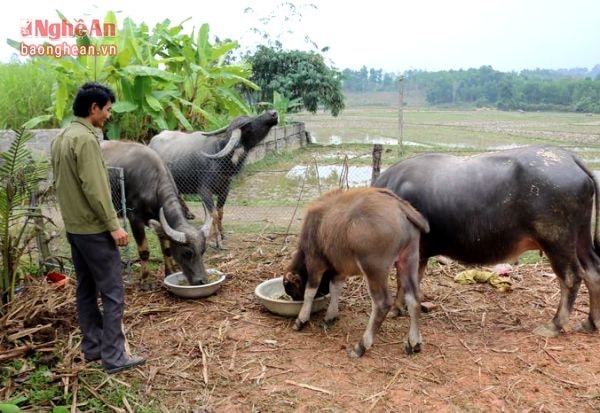 |
| Cattle fed fermented feed (made using the silage method) will digest it better, grow faster, and have increased resistance to disease in cold weather. |
To encourage people to raise livestock commercially, Anh Son district has implemented a mechanism to support 50% of the cost of purchasing feed cutting machines and silage starters for households raising 5 or more buffaloes and cows. Currently, not only in Hung Son and Cam Son communes, but also in other communes such as Tuong Son, Tao Son, Thach Son, etc., hundreds of households are actively applying this silage method. The effectiveness of this model has contributed to the policy of developing commercial livestock farming throughout the district.
Huyen Trang


