
The August Revolution - a great event in the history of the Vietnamese nation.
(Baonghean.vn) - The August Revolution of 1945 was the first great victory of our people since the Party's leadership, opening a great turning point in the history of the Vietnamese nation. From here, the country, society, nation, and people of Vietnam entered a new era, an era of national independence linked with socialism.
Historical context and developments of the August 1945 Revolution
In early 1945, World War II entered its final stages. The Soviet Red Army achieved a series of decisive victories on the European battlefield, liberating a number of countries and advancing directly into the heart of Nazi Germany in Berlin.
On May 9, 1945, Nazi Germany surrendered unconditionally, ending the war in Europe. On August 8, 1945, the Soviet Red Army launched a fierce offensive against the Japanese army. On August 14, 1945, the Japanese fascists surrendered unconditionally, ending World War II.
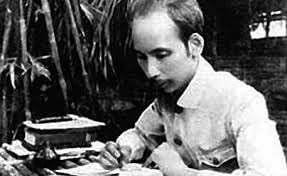 |
| President Ho Chi Minh working in Pac Bo (Cao Bang) after a 30-year journey to find a way to save the country. (Archival photo) |
According to the Allied agreement, after the surrender of the Japanese fascists, British and Chiang Kai-shek's troops would enter Indochina to disarm the Japanese army. Meanwhile, the French colonialists were eager to rely on the Allies to restore their dominant position; the American imperialists, backing these forces, were also ready to intervene in Indochina; and reactionary, stubborn elements within the Japanese puppet government were plotting to overthrow their masters and oppose the revolution.
Domestically, following rehearsals, the revolutionary movement intensified by 1945. On March 9, 1945, the Japanese fascists staged a coup, ousting the French. That same night, the expanded meeting of the Central Standing Committee decided to launch a revolutionary upsurge as a prelude to a general uprising, adapting the forms of propaganda, mobilization, organization, and struggle accordingly.
In March 1945, the Central Committee of the Party issued the Directive "The Japanese-French Conflict and Our Actions." In April 1945, the Central Committee convened the Revolutionary Military Conference of Northern Vietnam, deciding on many important issues and unifying the armed forces into the Vietnam Liberation Army. On April 16, 1945, the General Headquarters of the Viet Minh issued a Directive to organize National Liberation Committees at all levels and prepare for the establishment of the Vietnam National Liberation Committee, which was the Provisional Revolutionary Government of Vietnam.
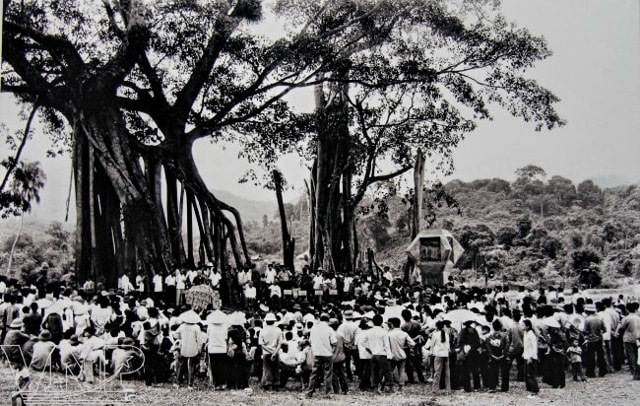 |
| General Võ Nguyên Giáp speaking with the people of Tuyên Quang under the banyan tree in Tân Trào. Archival photo. |
From April 1945 onwards, the anti-Japanese national salvation movement intensified, becoming rich in content and form. In early May 1945, President Ho Chi Minh returned from Cao Bang to Tuyen Quang, choosing Tan Trao as the base to direct the nationwide revolution and prepare for the National Congress.
On June 4, 1945, the Viet Bac Liberation Zone was established, placed under the leadership of the Provisional Command Committee, becoming the base area for the entire country. In August 1945, the National Congress of the Party, meeting in Tan Trao (Tuyen Quang), affirmed: "A very good opportunity for us to gain independence has arrived" and decided to launch a nationwide uprising to seize power from the Japanese fascists and their collaborators before the Allied forces entered Indochina; it also set forth three principles to ensure the success of the general uprising: concentration, unity, and timeliness.
At 11 PM on August 13, 1945, the Uprising Committee issued Military Order No. 1, calling on the entire nation to launch a general uprising. On August 16, 1945, the National Congress met in Tan Trao and adopted the "Ten Major Policies of the Viet Minh"; approved the "Order for a General Uprising"; stipulated the national flag and national anthem; and established the Central National Liberation Committee, which was the Provisional Government, with Comrade Ho Chi Minh as Chairman.
President Ho Chi Minh sent a letter calling on the people of the whole country to rise up in a general uprising, in which he clearly stated: "The decisive moment for the destiny of our nation has arrived. All compatriots throughout the country, rise up and use your own strength to liberate yourselves."
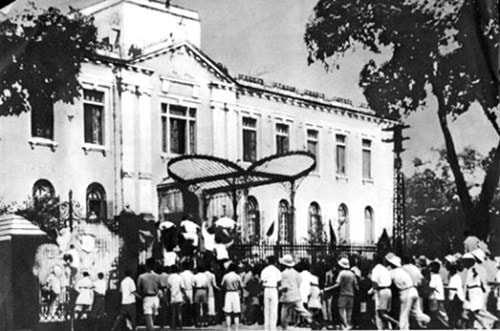 |
| On August 19, 1945, tens of thousands of people in Hanoi took to the streets to demonstrate and launch an armed uprising to seize power. (Archival photo) |
Under the leadership of the Party and President Ho Chi Minh, the people throughout the country rose up simultaneously, launching a general uprising to seize power. From August 14th to 18th, the general uprising broke out and achieved victory in the rural areas of the Northern Delta, the majority of Central Vietnam, parts of Southern Vietnam, and in the towns of Bac Giang, Hai Duong, Ha Tinh, Hoi An, Quang Nam, etc.
On August 19th, the uprising to seize power was successful in Hanoi. On August 23rd, the uprising was successful in Hue and in Bac Can, Hoa Binh, Hai Phong, Ha Dong, Quang Binh, Quang Tri, Binh Dinh, Gia Lai, Bac Lieu...
On August 25th, the uprising was victorious in Saigon - Gia Dinh, Kon Tum, Soc Trang, Vinh Long, Tra Vinh, Bien Hoa, Tay Ninh, Ben Tre... In Con Dao, the Con Dao prison Party Committee led the imprisoned revolutionary fighters in an uprising to seize power.
In just 15 days at the end of August 1945, the general uprising achieved complete victory, and power throughout the country fell into the hands of the people.
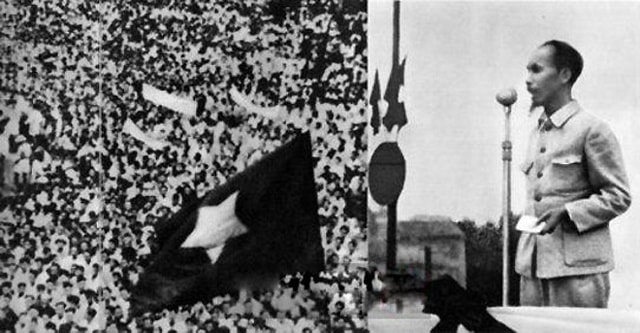 |
| President Ho Chi Minh reading the Declaration of Independence, giving birth to the Democratic Republic of Vietnam. (Archival photo) |
On September 2, 1945, at the historic Ba Dinh Square (Hanoi), before a rally of nearly one million people, President Ho Chi Minh, on behalf of the Provisional Government, solemnly read the Declaration of Independence, declaring to the nation and the world: The Democratic Republic of Vietnam was born (now the Socialist Republic of Vietnam).
Causes and historical significance of the August Revolution
- The success of the August Revolution of 1945 was due to the correct, wise, and skillful leadership of the Party; and the correct, independent, self-reliant, and creative application and development of Marxism-Leninism in the specific conditions of our country.
- The August Revolution succeeded precisely because of the patriotism, unity, and indomitable will of all strata of our people, who refused to live forever in the slavery of a nation that had lost its independence; wholeheartedly following the Party and being led by the Party through general rehearsals, they were determined to rise up and win independence for the nation.
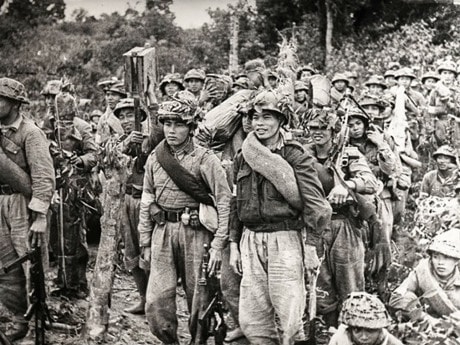 |
| Vietnamese youth during the resistance war. Archival photo. |
- The August Revolution was carried out in a context of certain favorable international conditions. German, Italian, and Japanese fascism had been defeated, and the liberation movements of oppressed nations and progressive forces around the world were developing strongly.
- The August Revolution of 1945 was the first great victory of our people since the Party's leadership, marking a great turning point in the history of the Vietnamese nation. Power was transferred to the people, and the Democratic Republic of Vietnam was established - the first workers' and peasants' state in Southeast Asia; ending the feudal monarchy in Vietnam; and concluding more than 80 years of our people's subjugation under colonial and fascist rule.
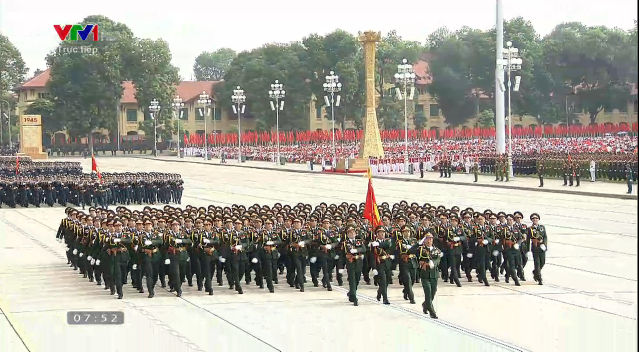 |
| Images of the parade and march at the celebration of the 70th anniversary of the August Revolution and National Day on September 2nd, 2015. |
- This is also the inevitable development process of the nation's history, spanning thousands of years of struggle, the culmination of indomitable will, the strength of community cohesion, and the intellectual height of the nation, blended with Marxism-Leninism, Ho Chi Minh Thought, and the trends of the times, for peace, democracy, and social progress, for national independence and socialism.
Commemorating the 72nd anniversary of the victorious August Revolution, the entire Party, people, army, and nation of Vietnam continue to strive to study, research, internalize, and implement the policy of great national unity and the historical lesson that "The eternal principle of morality lies in the hearts of the people"; to better and more effectively implement President Ho Chi Minh's lesson of grasping the laws of the people's will, in order to awaken the spirit of national pride and self-respect, and to affirm that genuine patriotism is the great driving force in the process of successfully implementing the reform./.
Peace
(Synthetic)
| RELATED NEWS |
|---|


