
Strengthening the political system in special regions: New developments
(Baonghean) - Over the years, Party committees and authorities at all levels in Nghe An province have developed, promulgated, and implemented many policies and guidelines aimed at building, consolidating, and improving the quality of the political system in special areas. This includes focusing on strengthening Party branches and developing Party members in hamlets, villages, and communities with large numbers of religious followers and ethnic minorities…
Based on practical surveys of the political system in areas with ethnic minorities and religious communities, from the 15th Provincial Party Congress (2000-2005) to the 18th Congress (2015-2020), the Nghe An Provincial Party Committee has continuously issued resolutions, projects, conclusions, and directives related to building the political system in these special regions.
Notably, Resolution No. 18/NQ-TU of 2004 on consolidating and building the grassroots political system in ethnic minority and religious areas; Conclusion No. 10/KL-TU of 2006 on building the grassroots political system in ethnic minority areas; Conclusion No. 09/KL-TU of 2006 on building the grassroots political system in religious areas; and Directive No. 20 on continuing to promote the implementation of Conclusion No. 09/KL-TU.
And more recently, there is Project No. 01/DA-TU, dated August 10, 2016, on building Party branches and developing Party members in hamlets, villages, and communities that do not yet have Party branches or Party members, and in hamlets, villages, and communities at risk of no longer having Party branches, for the period 2016-2020. Implementing the directives of the Provincial Party Committee, Party committees, governments, and mass organizations from the provincial to the grassroots level have developed action programs and specific plans, bringing about positive changes.
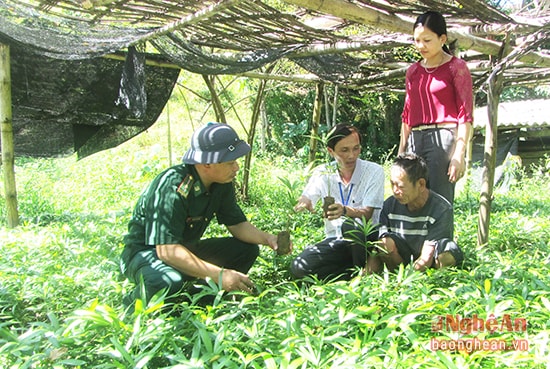 |
| Leaders of Hanh Dich commune (Que Phong district) are guiding local people on the benefits of participating in a rattan cultivation project for export. |
Efforts to eliminate weaknesses and reduce "blanks"
Nghe An province has approximately 270,000 Catholic parishioners and 325 parishes in 211 out of 480 communes, wards, and towns; 15 districts, cities, and towns have religious organizations. In previous years, the percentage of villages and hamlets without Party members or Party branches in areas with religious communities in the province was quite high. Based on this reality, localities have proactively implemented many comprehensive solutions to eliminate villages and hamlets without Party members and Party organizations.
Yen Thanh district has a population of 13% who follow a religion, distributed across 27 out of 39 communes and towns, accounting for 69.23% of the total number of communes in the district. The Yen Thanh District Party Committee has identified the construction and strengthening of the political system in religious areas as an extremely important task. The focus is on developing Party members, building and strengthening Party branches, associations, and youth union branches at the village level – the level closest to the people and directly implementing the policies and guidelines of the Party and State into daily life.
Long Tien hamlet (Cong Thanh commune) has 418 inhabitants, of which 95.69% are Catholic. This hamlet has a fairly comprehensive movement in economic development, improving cultural life, and building new rural areas. Speaking about the leading role of the hamlet's Party branch, Party branch secretary Tran Khac Mai – an exemplary Party member – said: "To have strength, first and foremost, there must be unity. From the head of the Party committee to each Party member, there must be a unified will. In everything the hamlet does, Party members must set an example and lead the way so that the people follow. For example, the implementation of the land consolidation and exchange policy initially faced difficulties, with many people not agreeing. However, thanks to persistent propaganda and mobilization efforts, and the pioneering spirit of cadres and Party members, Long Tien became the only hamlet among the seven predominantly Catholic hamlets in Cong Thanh commune to successfully implement land consolidation and exchange."
During the 2010-2015 term, the Long Tien Party branch admitted 5 Catholic party members, bringing the total number of party members to 20, not including 4 members transferred from other merged party branches. This was also the only party branch in the Catholic area of Cong Thanh to admit new party members during the past term.
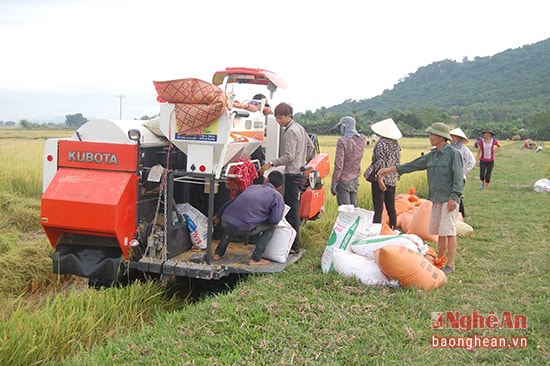 |
| Promoting the introduction of mechanization into agricultural production in Tang Thanh commune, Yen Thanh district. |
Meanwhile, in Hamlet 13 – a predominantly Catholic hamlet in Bao Thanh commune, where five Party members are non-specialized commune officials assigned to the area – the Party branch has decided to focus its leadership through the Fatherland Front and mass organizations. Based on the resolution issued by the Party branch on improving the quality of activities of the Fatherland Front and mass organizations, each mass organization has developed specific regulations, plans, and programs of activity linked to effective mass mobilization work.
Comrade Nguyen Trong Cuong, Secretary of the Party Branch of Hamlet 13, Bao Thanh Commune, said: "When the mass organizations are in motion, and cadres and Party members think and act for the common good, the Catholic community also strongly supports it. Proof of this is that previously, the collection of various funds was often 'stalled,' but by 2016, all funds have been 100% collected; the people have also actively and voluntarily contributed over 1.5 billion VND to build roads, cultural centers, etc."
Comrade Nguyen Viet Hung, Permanent Deputy Secretary of the Yen Thanh District Party Committee, said: Thanks to effective methods, from 30 hamlets that did not meet the conditions to establish Party branches, through solutions such as developing local Party members; strengthening Party members who are full-time and part-time officials and commune-level civil servants to participate in activities at hamlet Party branches, Yen Thanh has now eliminated the situation of having no Party branches in the Catholic areas.
As for Quynh Luu district, where Catholics account for 16% of the total population, spread across 15 out of 33 communes and towns, and 52 out of 406 hamlets, including one commune with a predominantly Catholic population and two communes with 50-60% Catholic residents, the 26th Congress of the Quynh Luu District Party Committee outlined five key programs. Program 4, focusing on "Continuing to build and strengthen the political system in special areas," encompasses regions with religious and ethnic minority communities, with a comprehensive set of solutions. Following this, the new term of the District Party Committee (2015-2020, 27th Congress), continued to issue Resolution No. 04 dated April 22, 2016, on "building and strengthening the political system in religious and ethnic minority areas for the period 2016-2020 and beyond."
Up to this point, generally speaking, the grassroots political system in areas with religious communities is basically well-organized, from the Party organization, government, Fatherland Front, and other mass organizations from the commune to the hamlet level. Before 2010, the entire Quynh Luu district had 32 hamlets that did not meet the conditions to establish Party branches. However, with decisive measures and various solutions, 22 hamlets have now established Party branches...
| In implementing Conclusion 09-KL/TU dated December 5, 2006, of the Provincial Party Committee (16th term) on building the grassroots political system in religious areas, localities in the province are currently strengthening 498 Party members in 125/168 hamlets to establish Party branches, including 62 hamlets with 100% Party members; and 13 hamlets with combined Party activities. |
Cultivating positive factors
For ethnic minority areas, especially the 27 border communes adjacent to Laos, located in 6 districts (Thanh Chuong, Anh Son, Con Cuong, Tuong Duong, Ky Son, and Que Phong), the Party committees and authorities pay special attention to the work of developing Party members, consolidating Party branches, training and utilizing grassroots cadres, and promoting the role of influential individuals as centers of unity and bridges connecting the Party's will with the people's hearts, bringing the Party's guidelines and policies into life.
In Nam Can, a border commune located in the southern part of Ky Son district, home to 371 households and 2,100 Mong ethnic minority people, the commune's Party Committee consistently focused on recruiting and training new Party members from among young people, demobilized soldiers, teachers, and outstanding individuals in various mass organizations. During the 2010-2015 term, the commune's Party Committee admitted 55 new Party members, exceeding the resolution's target by 83%.
In the first six months of 2016 alone, the commune introduced six comrades to attend Party membership training courses, and granted full membership to three probationary Party members, bringing the total number of Party members to 148. In addition, in appointing leaders, the commune prioritizes selecting Party branch secretaries who are experienced and reputable among the people, while village heads are chosen from among young, dynamic, and proactive individuals.
Mr. Xau Ba Lau, Deputy Secretary of the Party Committee of Nam Can commune, said: "The experience and prestige of the elderly, combined with the dynamism and creativity of the young, will strengthen the village movement."
We went to Son Thanh village to meet the Party branch secretary, Mua Va Xenh, a veteran who has been awarded the 30-year Party membership badge with decades of active service. Under the leadership of this exemplary "leader," despite having only 7 Party members, the Son Thanh Party branch has consistently achieved outstanding performance for many years. Mr. Mua Va Xenh himself has received numerous commendations from various departments and agencies at all levels; the village's front committee and various associations also operate quite effectively.
Sharing his approach, Party Secretary Mua Va Xenh said: "If cadres and Party members truly practice 'saying and doing,' then the people will listen, trust, and follow."
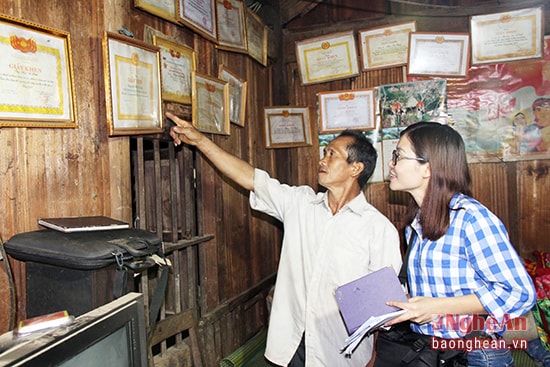 |
| The Party branch secretary of Son Thanh village, Nam Can commune (Ky Son district) introduces the achievements of the Party branch. |
Discussing Party development work in remote areas, Comrade Lu Quang Hung, Deputy Head of the Organization Department of Ky Son District Party Committee, said: The team of ethnic minority cadres and Party members is considered a solid foundation for the development of the locality. In recent times, the Ky Son District Party Committee has strengthened the responsibility and awareness of grassroots Party committees regarding the training and recruitment of Party members from outstanding individuals living and working in remote areas, ethnic minority regions, and students from ethnic minority groups. On average, Ky Son district admits 250 new Party members each year...
In Que Phong district, to strengthen the political system, especially in the four border communes that still harbor complex issues such as social evils like drug abuse, illegal migration, and Protestant proselytization, the District Party Committee's Standing Committee has resolutely directed the implementation of projects such as "Improving the quality of Party branch activities" and "Eliminating weak Party organizations"; issued numerous guiding documents for grassroots organizations; and assigned tasks to Party committee members to directly monitor grassroots Party organizations.
Comrade Lu Dinh Thi, Secretary of the Que Phong District Party Committee, said: "Officials entrusted with important responsibilities from the commune to the hamlet and village level must meet the standards of being reputable individuals trusted by the people..."
To help border areas strengthen their political systems, the Provincial Party Committee directed mountainous districts to do a good job in personnel work, proactively train and plan for cadres, and pay attention to planning for cadres from ethnic minorities. At the same time, it issued Directive No. 32-CT/TU in 1999 stipulating the duties and working relationships of border guard officers assigned to border communes and wards; and Announcement No. 1002-TB/TU in 2005 on "Transferring Border Guard Party members to temporarily participate in Party activities in villages along the western border of Nghe An province".
As a result, 25 border guard officers were assigned to the position of Deputy Secretary of the Party Committee of border communes, one officer became the Secretary of the Party Committee in Thanh Son resettlement commune (Thanh Chuong district), and 77 border guard officers were assigned to temporarily participate in Party activities in village and hamlet Party branches in vulnerable areas.
The team of cadres and Party members deployed to the grassroots level serves as a solid and reliable support, helping people develop their economy and improve their spiritual lives; they live and work according to the law, and do not trust or listen to evil elements. This is also a source of human resources that strengthens the "core" role and fighting capacity of village Party branches.
As a result, while in 2006, the ethnic minority areas of Nghe An province had 52 villages without Party branches and 8 villages without Party members, by the end of 2014, 100% of villages had Party branches and members; the quality of Party members improved significantly, and the percentage of Party members classified as having successfully completed their tasks increased year by year...
| From 2011 to the first six months of 2016, the entire province admitted 22,765 new Party members from ethnic minority groups, of which the district level admitted 4,968 people: Tuong Duong district 1,035 people, Ky Son 906 people, Que Phong 835 people, Quy Hop 630 people. Regarding Party members who are religious, the province has 733 people to date... |
Reporters' Team


