

Ninth Party Congress: The country enters a new century.
The Ninth National Congress of the Communist Party of Vietnam was a congress of intellect, democracy, unity, and innovation. The entire Party and the entire people are confidently stepping into the 21st century.
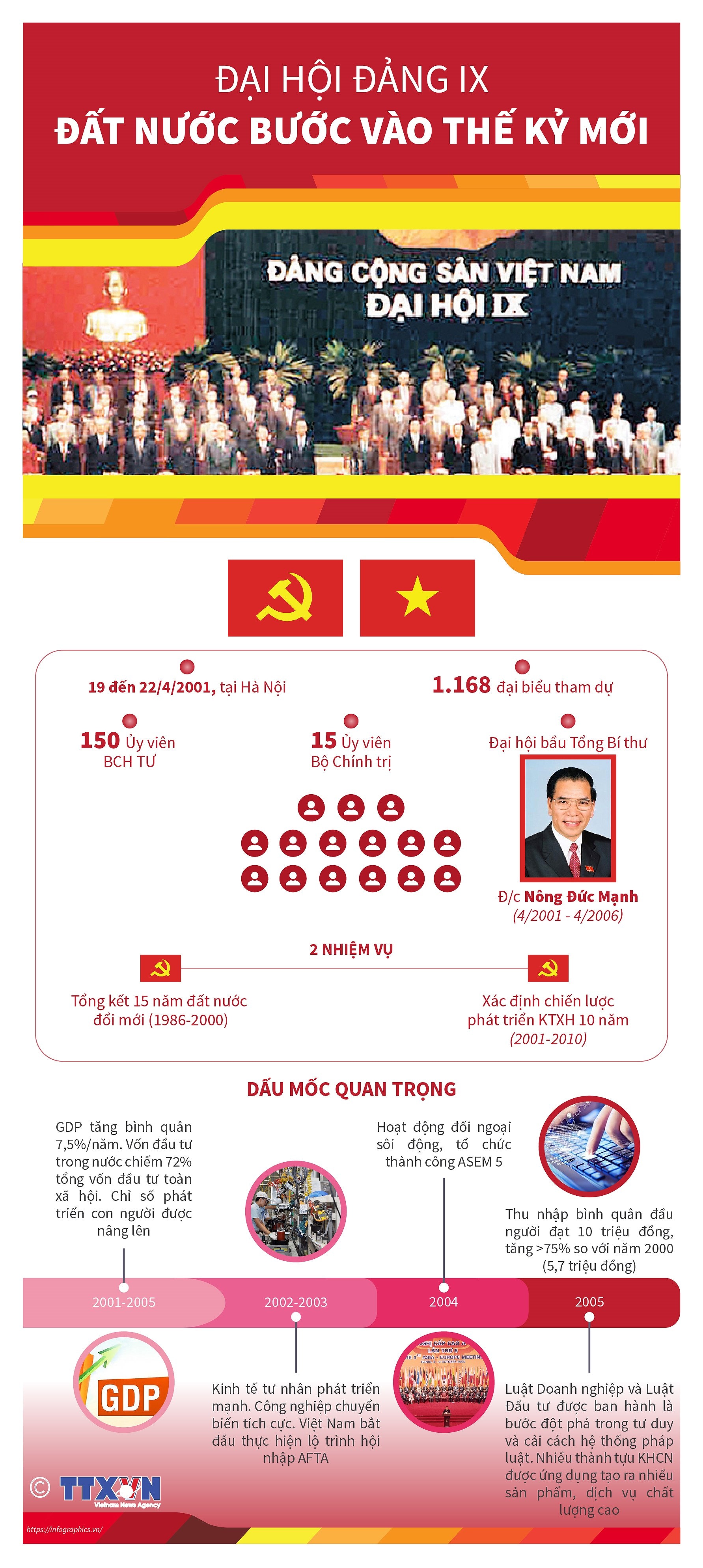
NINTH PARTY CONGRESS
Time:April 19-22, 2001
Location:Hanoi
Number of delegates attending the Congress:1,168
Number of party members in the country:nearly 2.5 million
The congress elected:
- General Secretary: Comrade Nong Duc Manh
- Central Executive Committee: 150 members
- Politburo: 15 members
GENERAL CONTEXT:
- As the 20th century ended and the 21st century began, globalization intensified.
Bilateral and multilateral relations between countries are becoming increasingly extensive across many fields.
The scientific and technological revolution, especially information technology and biotechnology, continues to make leaps and bounds, becoming a direct productive force, driving the development of a knowledge-based economy, rapidly shifting the economic structure, and profoundly transforming various aspects of social life.
- The significant achievements after 15 years of reform have created momentum and strength to push our country's reform process in depth. Alongside this, we also have to cope with challenges: falling further behind economically compared to many countries in the region and the world, deviating from the socialist path, corruption and bureaucracy, and "peaceful evolution" instigated by hostile forces.
HARNESSING THE STRENGTH OF THE ENTIRE NATION, PROMOTING INDUSTRIALIZATION AND MODERNIZATION
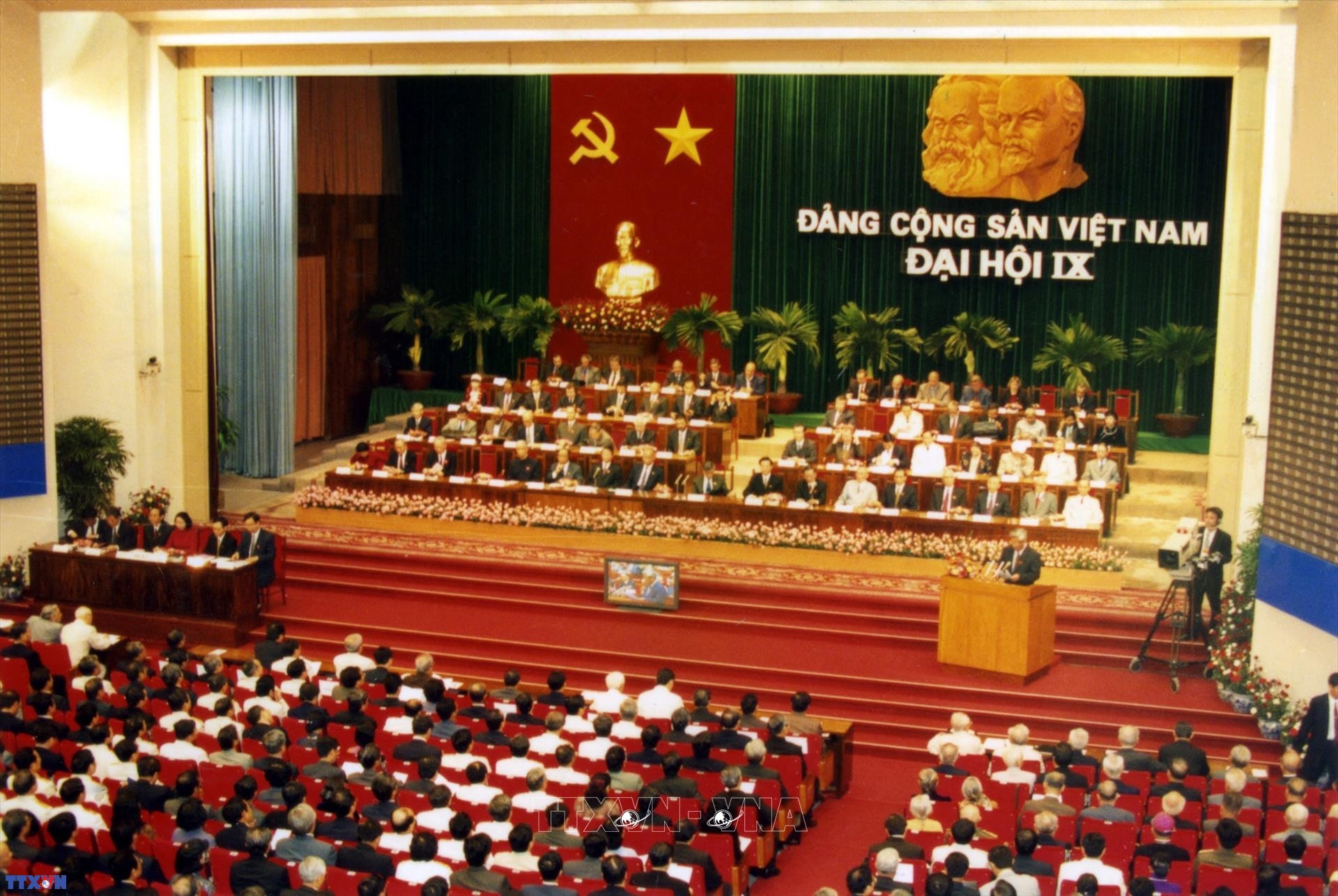
The Congress reviewed the 71-year journey of leading the Vietnamese revolution; summarized the 5 years of implementing the Resolution of the 8th National Congress; 15 years of national renewal, 10 years of implementing the socio-economic strategy, drawing lessons learned, thereby developing and perfecting the guidelines, defining the national development strategy for the first 20 years of the 21st century; outlining the direction and tasks of building our Party to meet the demands of the nation in the new era; and amending and supplementing the Party Charter.
The Congress adopted the Political Report entitled "Promoting the strength of the entire nation, continuing to innovate, accelerating industrialization and modernization, building and defending the socialist Vietnamese Fatherland".
The Congress assessed: Implementing the Strategy for Economic and Social Stabilization and Development (1991-2000), we have achieved tremendous and very important achievements. The economy, which was previously in a state of severe commodity scarcity, now produces goods that meet the essential needs of the people and the economy; it has shifted from a centralized, bureaucratic, and subsidized management mechanism to a socialist-oriented market economy; and from a predominantly two-sector economy (state-owned and collective), it has transformed into a multi-sector economy, with the state-owned economy playing a leading role. The lives of all strata of the people have improved. The country has emerged from the economic and social crisis; broken the blockade and embargo, expanded foreign relations, and actively integrated into the international economy.
Regarding the experiences gained after 15 years of implementing the reform policy, the Congress pointed out the main lessons learned. These are: during the reform process, it is necessary to persistently pursue the goal of national independence and socialism on the foundation of Marxism-Leninism and Ho Chi Minh Thought. Reform must rely on the people, for the benefit of the people, be in line with reality, and always be creative. Reform must combine national strength with the strength of the times. The correct line of the Party is the decisive factor in the success of the reform cause.
Regarding the socio-economic development guidelines, the Ninth Party Congress clearly stated: To accelerate industrialization and modernization, build an independent and self-reliant economy, and transform Vietnam into an industrialized nation; to prioritize the development of productive forces while simultaneously building appropriate production relations in accordance with socialist principles; to maximize domestic resources while leveraging external resources and proactively integrating into the international economy for rapid, efficient, and sustainable development; to ensure economic growth goes hand in hand with cultural development, gradually improving the material and spiritual lives of the people, achieving social progress and equity, and protecting and improving the environment; and to combine socio-economic development with strengthening national defense and security.
The objectives of the 10-year socio-economic development strategy (2001-2010) were: To lift Vietnam out of underdevelopment, significantly improve the material and spiritual lives of the people, and create a foundation for Vietnam to basically become a modern industrialized country by 2020. Human resources, scientific and technological capabilities, infrastructure, economic potential, national defense, and security would be strengthened; the socialist-oriented market economy would be fundamentally established; and Vietnam's position in the international arena would be enhanced.
The Congress elected a Central Committee of 150 members. Comrade Nong Duc Manh was elected General Secretary of the Party.
DOMESTIC EVENTS
- April 29, 2000: Prime Minister Pham Van Dong passed away.
- May 21, 2000: My Thuan Bridge, Tien Giang Province, was inaugurated.
- July 13, 2000: Vietnam and the United States signed a trade agreement. More than a year later, on December 11, 2001, the Vietnam-US Trade Agreement officially came into effect.
- July 20, 2000: The stock market opened in Vietnam, and the Ho Chi Minh City Stock Exchange began operations.
- September 7-9, 2000: President Tran Duc Luong attended the Millennium Summit at the United Nations.
- November 16-19, 2000: US President Bill Clinton paid an official visit to Vietnam.
- December 2000: Vietnam and China signed the Agreement on the Delimitation of the Territorial Sea, Exclusive Economic Zone, and Continental Shelf in the Gulf of Tonkin (during President Tran Duc Luong's official visit to China from December 25 to 29).
- December 28, 2000: Declaration of the completion of universal primary education and the eradication of illiteracy nationwide.
- February 28 to March 2, 2001: Russian President Vladimir Putin visits Vietnam.
- June 27, 2001: Comrade Nguyen Van An was elected Chairman of the National Assembly at the 9th session of the 10th National Assembly.
- October 10, 2001: Inauguration of Terminal 1 at Noi Bai International Airport.
- October 26, 2001: Vietnam was elected to the Executive Board of the United Nations Educational, Scientific and Cultural Organization (UNESCO).
- December 25, 2001: The 10th session of the 10th National Assembly adopted a Resolution amending and supplementing a number of articles of the 1992 Constitution.
- December 27, 2001: The first land border marker between Vietnam and China was erected at the Mong Cai international border gate (Quang Ninh).
INTERNATIONAL EVENT
- March 26, 2000: Vladimir Putin was elected President of Russia.
- May 24, 2000: Israel completed its withdrawal from southern Lebanon, ending 22 years of occupation of the region.
- June 13-15, 2000: The inter-Korean summit in Pyongyang marked the beginning of the reconciliation process between the two Koreas after 55 years of division.
- June 26, 2000: 97% of the human genome code, 85% of the genetic data, and 99% of the human genome were discovered, ushering in a new era for biotechnology.
- August 12, 2000: The Russian nuclear submarine Kursk sank in the Barents Sea, killing 118 sailors.
- December 11, 2000: The European Union (EU) reached an agreement on institutional reform, aimed at expanding the bloc.
- March 7, 2001: Ariel Sharon assumed office as Prime Minister of Israel.
- April 28, 2001: American businessman Dennis Tito, 60 years old, became the first space tourist to travel to the International Space Station (ISS).
- June 7, 2001: British Prime Minister Tony Blair wins a historic second term.
- September 11, 2001: The United States was hit by terrorist attacks in Washington and New York, killing nearly 3,000 people.
- December 5, 2001: Russia and the United States announced the completion of arms reductions in accordance with the Strategic Arms Reduction Treaty Phase 1 (START-I).
- December 11, 2001: China became the 143rd member of the World Trade Organization (WTO).
- December 13, 2001: The United States withdrew from the Anti-Ballistic Missile Treaty (ABM Treaty) signed in 1972.


