Vo Liet Temple
Vo Liet Temple is located on the right bank of the Lam River, in the Re field, in Vo Liet commune, Thanh Chuong district, Nghe An province. Vo Liet Temple is 50km northwest of Vinh city. From Vinh, visitors can reach this historical site by waterway on the Lam River or by road along National Highway 46.
Vo Liet in particular andThanh ChuongGenerally speaking, this land is famous for its tradition of studiousness and patriotism. It is an ancient land with many prominent families and numerous highly accomplished individuals. Throughout the ups and downs of history, this land has borne many different names, such as Thổ Ngọa (during the Trần dynasty), Võ Liệt (during the Lê dynasty), Kim Bảng (in 1945), and after 1945, it reverted to the name Võ Liệt, which it retains to this day.
The commune of Võ Liệt formerly comprised three villages, each with its own famous historical site. Ngũ Phúc village had the Võ Liệt communal house, Chí Linh village had the Phủ ngoại shrine dedicated to General Phan Đà, and Trường Yên village had the Bạch Mã temple. All three villages shared the common vernacular name Võ Liệt.
.jpg)
The Vo Liet communal house, formerly known as Quan Hang Tong, was established by the Vo Liet Village Literary Association to worship Confucius and the local scholars and sages. Construction began in 1859 and was completed in 1860. The communal house was designed and built under the supervision of Mr. Hoang Chinh Truc after he passed his bachelor's degree examination (1858).
Before constructing the communal house, scholar Hoang Chinh Truc researched, visited, and toured Thang Long and Thanh Hoa to learn about architecture. Afterwards, he returned to his hometown and discussed the construction of the Vo Liet communal house with the Confucian scholars in the Literary Society of the district.
.jpg)
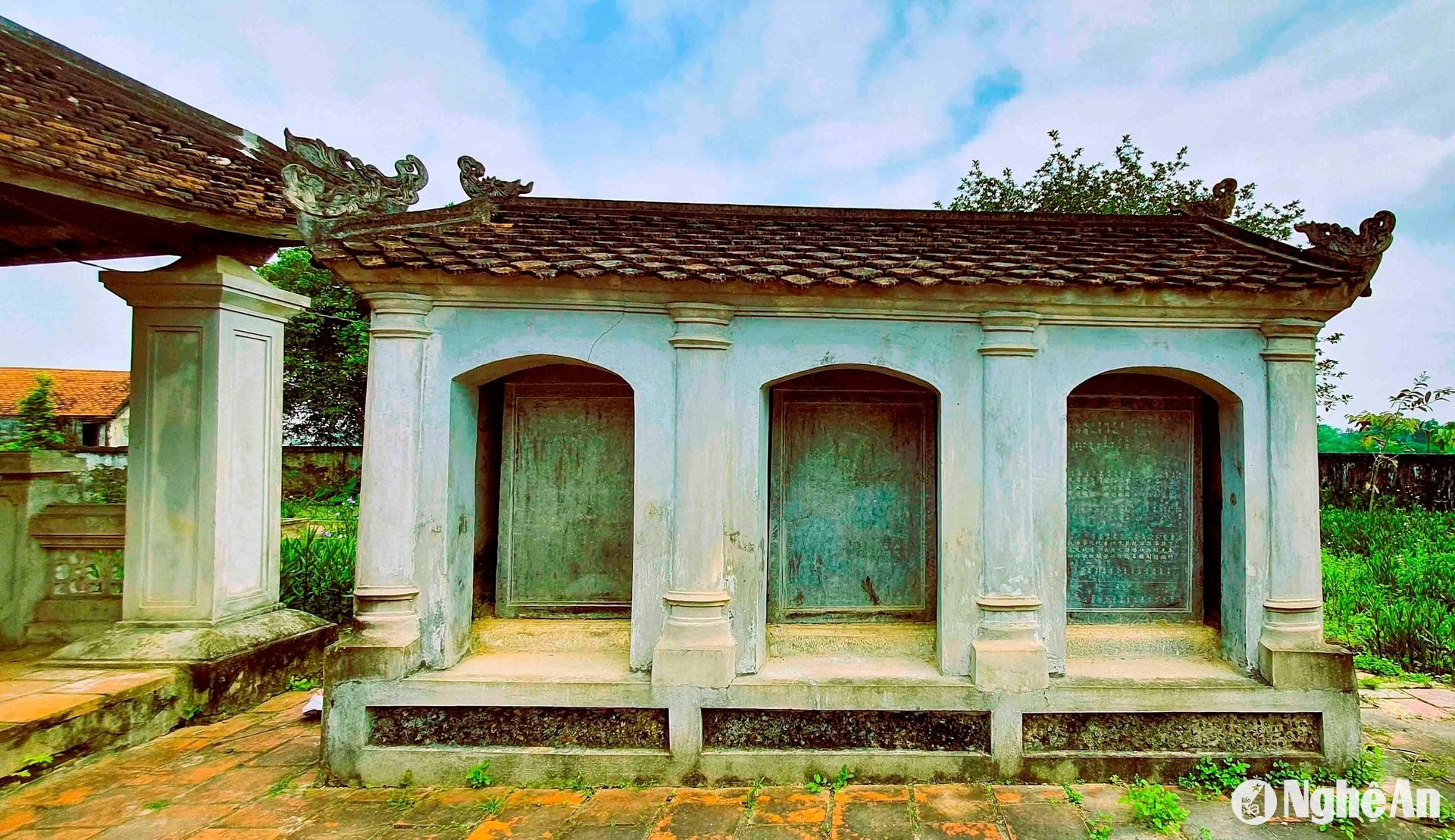
Vo Liet communal house is a cultural relic with a rather unique architecture within the system of Vietnamese village communal houses. The communal house gate has a structure in the style of traditional Northern Vietnamese communal houses with 4 sturdy gate pillars forming one main gate and 2 side gates: left and right. On either side of the courtyard are two stele houses, each with 3 steles inscribed in Chinese characters the names of 445 people who passed the examinations in Vo Liet district, including 377 Bachelors, 63 Masters, 2 Doctors, and 3 Vice-Bachelors, notably Bachelors Tran Van Thang, Nguyen Canh, Do Duc Cao, Nguyen Dinh Thuc… (during the Le dynasty), Masters Vu Duy Tan, Tong Huy Vien, Phan Sy Nhiep, Hoang Nho Nha, Ho Sy Tao… (during the Nguyen dynasty).
The main temple has a square architectural structure, also known as a "mouth" shape, with 54 sturdy ironwood columns and 4 brick columns forming enclosed buildings without gables (except for the upper floor in the back row). The interiors are interconnected, with a small courtyard in the middle. This is a unique and rare architectural feature of the temple.Vo LietInside the temple, there are no Buddha statues or elaborate decorative patterns; the roof is covered entirely with yin-yang scale tiles. Behind the temple is a row of five rooms used as a place for meals and gatherings for the Literary Association…
.jpg)
The tutelary deity of Vo Liet village is General Phan Da, who was instrumental in repelling the Ming invaders during the Le Dynasty. After this communal house was transformed into a Confucian temple, Confucius was brought here to be worshipped. Its dual function—serving as both a Confucian temple and a communal house dedicated to the village's tutelary deity, and a venue for various folk cultural activities—gives this site a unique character compared to other communal houses.
The people of Vo Liet in particular, and the people of Nghe An province in general, have a rich spiritual life. They love folk songs and are captivated by the melodies of the "vi" and "giam do dua" songs. In early spring, many folk festivals are held at Vo Liet communal house to commemorate Phan Da. In the second lunar month, there is the Te Hiep ceremony, and in the eighth lunar month, there is the ceremony honoring Confucius.
Every three years, the people organize the Ky Khoa festival on the 7th day of the first lunar month, marking the beginning of the new year. Candidates from all over gather at Vo Liet communal house to listen to lectures on poetry, prose, and classical texts. The festival features many folk games such as: catching wild boar, boat racing, and planting banana trees...
Vo Liet Temple is not only a historical and cultural relic but also a revolutionary historical site with an important position in the system of relics in the Nghe Tinh region. It has witnessed many significant historical events during the Nghe Tinh Soviet movement (1930-1931)...
Drawing on their long-standing patriotic traditions, when the Nghe Tinh Soviet movement broke out, the people of Thanh Chuong rose up in fierce struggle. On the morning of June 1, 1930, armed with sticks and rulers, the people gathered at Vo Liet communal house and then marched to the district office to present their demands. Faced with the powerful fighting spirit of the masses, District Chief Phan Thanh Ky had to accept the people's demands, promising to submit them to higher authorities for consideration and resolution.
On September 1, 1930, under the leadership of the Thanh Chuong District Party Committee, 20,000 people from five communes crossed the Lam River to besiege the district headquarters, causing the district chief and officials to flee in panic to the Thanh Qua outpost. Faced with the disintegration of the local village administration, the Party branch met at Vo Liet communal house and decided to establish the Red Peasant Association, representing the interests of the workers and openly handling all affairs like a revolutionary government. Vo Liet communal house became the headquarters of the Soviet government…
During this period, activities such as speeches, Vietnamese language classes, recitations of the Internationale, displaying the Party flag, and many other cultural and artistic events were regularly held at the communal house. This was also a place where many learned scholars from other areas were invited by the people to teach their children, including President Ho Chi Minh's father, Mr. Nguyen Sinh Sac, and other scholars such as Ton Lo Xuyen, Phan Boi Chau, Cu Do, and Cu Vanh…
The sound of Soviet drums from Vo Liet communal house in 1930-1931, with the red flag bearing the hammer and sickle of the Party fluttering atop the communal house, evokes a glorious era of a poor but patriotic rural area, which, answering the call of the Party, rose up to revolution against colonialism and feudalism.
During the years 1940-1947, Vo Liet communal house was the venue for meetings to establish and restore the Vo Liet Party Branch (in 1940), the Congress of Delegates of the IV Regional Party Committee under the chairmanship of comrades Nguyen Chi Thanh, Ho Tung Mau, Major General Nguyen Son, and the Congress of the former IV Inter-regional Committee (in 1947)... General Vo Nguyen Giap and many veteran revolutionaries also visited this communal house.
Every year, the festivalrevolutionary traditionThe Thanh Chuong Soviet commemoration, held on September 1st at the communal house, attracted a large number of people and young generations. Vo Liet communal house has become a symbol of national pride for the people of Nghe An province. Because of its immense value, Vo Liet communal house was classified as a National Historical and Cultural Monument by the Ministry of Culture and Information (Decision No. 1288/QD-VH), dated November 16, 1988.