
Tourism in the North and South Central regions: Collaboration is essential for strength.
(Baonghean) - The first-ever scientific conference on tourism development in the North and South Central regions, held in Nghe An, concluded successfully, offering practical insights for regional tourism development. Both areas with successful tourism and those just beginning their journey in this "smokeless industry" gained valuable experience from this meaningful conference. A consensus was reached: collaboration is key to strength.
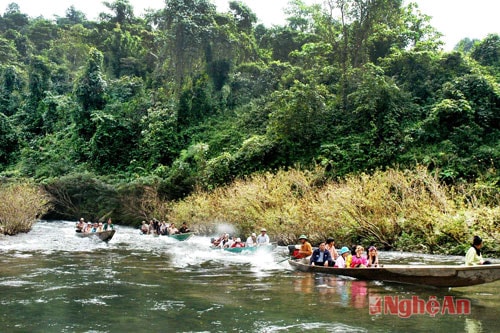 |
| A river cruise on the Giang River into the heart of the Pù Mát primeval forest. Photo: Sỹ Minh. |
A highlight on the national tourism map.
Located on the trans-Vietnam tourism route, the North-South Central region plays a crucial and advantageous role in tourism development, facilitating regional, domestic, and international linkages, and becoming a vital link in national tourism programs. The North-South Central region is also part of the Trans-Asian tourism corridor, thus possessing national and international significance. Furthermore, in the development of national thematic tourism, the North-South Central region is the cradle of the "Central Heritage Route" tourism route, traversing World Heritage sites (Thanh Hoa - Nghe An - Quang Binh - Thua Thien Hue - Quang Nam).
Based on leveraging its tourism potential, tourism in the North and South Central regions has developed at a rapid pace compared to many other parts of the country, achieving significant results. In 2015, the number of international tourists traveling between localities in the North Central region reached 1.7 million, while domestic tourists reached 17 million; total tourism revenue exceeded 15 trillion VND. For the South Central coastal region, the number of international tourists traveling between localities reached nearly 4.9 million; domestic tourists exceeded 17 million; total tourism revenue reached approximately 35.5 trillion VND.
The region has become known as a bright spot in Vietnamese tourism with attractive tourism products, such as beach resort tourism, especially in the coastal areas of Da Nang, Khanh Hoa, and Binh Thuan; heritage tourism to the ancient capital of Hue, Hoi An, and My Son, notably the "Central Vietnam Heritage Route" tourism product; Cham cultural identity tourism; MICE tourism; and border tourism associated with border gates…
However, alongside the achievements, the current state of tourism development in the region reveals many limitations and shortcomings; there has been no breakthrough to truly establish tourism as a key economic sector. One of these limitations is the lack of linkages to create synergy and diversity in the unique identity of tourism products among localities in the region, in promotion and advertising, and in state management of tourism development.
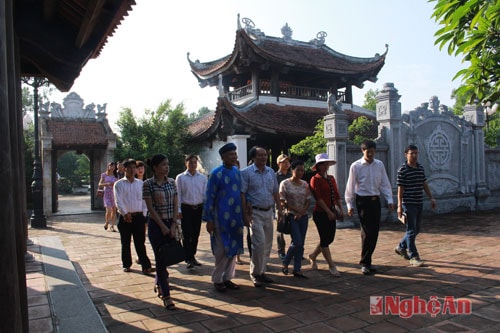 |
| Tour operators survey Quang Trung Temple (Vinh City). Photo: Dao Tuan. |
Many ideas about connection
The issue that was most discussed and analyzed at the workshop held at the end of February in Nghe An was how to work together to create a strong linkage, and how to limit short-sighted, opportunistic business practices that negatively impact tourism.
According to Mr. Nguyen Huu Chien, Deputy Director of the Da Nang Department of Culture, Sports and Tourism, linkage is a crucial issue in the tourism development strategy based on the principle of "business thrives with partnerships." This means that tourism development needs to be interconnected, such as organizing tours and routes, limiting the independence of each province and region. Tourism businesses, when conducting tours, often link destinations and tourism products together. Specifically for Da Nang, along with building a tourism strategy and development, especially in developing and creating tourism products, Da Nang has actively linked with Quang Nam and Thua Thien Hue to organize tours, routes, and festivals to attract tourists to the area.
I believe the province should cooperate more with travel agencies and tour operators in Vietnam to convey the message that Nghe An is a wonderful destination that tourists simply cannot miss when visiting Vietnam.
| Dustin Gerding from New York, USA, believes that the most readily apparent strength of Nghe An's tourism industry is the natural beauty of the land and its people. When tourists visit any locality in Nghe An, such as Pu Mat or Bai Lu, the natural landscape offers a wonderful experience. Furthermore, the people here are very hospitable, making visitors feel welcome and giving them the opportunity to learn many new things about the region's cultural identity. The province's biggest weakness is that not many tourists know about and visit to appreciate its natural beauty and experience its daily life. Therefore, Nghe An needs to strengthen its marketing efforts both domestically and internationally to attract more tourists. |
Mr. Nguyen Manh Cuong, Deputy Director of the Department of Culture, Sports and Tourism of Nghe An province, affirmed that, given its nature as a comprehensive economic sector with a high degree of interdisciplinary and interregional involvement, Nghe An has prioritized linkages to coordinate tourism development. He believes that orientations towards linkages will contribute to changing the "everyone for themselves" mindset, and that linkages are considered vital for tourism. Recognizing this, those working in tourism in Nghe An need to pay more attention to planning, implementing plans, and developing tourism development strategies at the provincial, regional, and national levels, ensuring that the tourism space meets the needs of linkages.
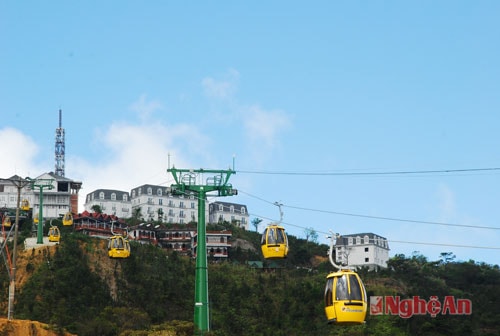 |
| Cable car ride on top of Ba Na Hill (Da Nang). Photo: Tran Hai. |
Working together for development
Strengthening cooperation and linkages will determine the future development of tourism in the North and South Central regions – this is the assertion of many economic experts, organizations, and individuals with extensive experience in tourism. The affirmed principle of linkage is to enhance tourism development cooperation between localities within the region, between the region and other areas nationwide, and with international partners and countries in the region. This aims to diversify tourism products to suit the strengths of each locality, create unique tour packages, improve the quality of tourism products, and promote tourism, while simultaneously creating harmony, unity, and the combined strength of each locality and the region. In this linkage, emphasis should be placed on the leading role of provinces/cities with developed tourism such as Hue, Da Nang, Khanh Hoa, and Binh Thuan.
Forms of linkage include cooperation and tourism development between provinces within each region of North Central Vietnam; South Central Coast; cooperation and tourism development within the framework of North-South provinces; cooperation and tourism development between North and South Central provinces and the Central Highlands; cooperation and tourism development between North and South Central provinces and major domestic tourist markets such as Hanoi and Ho Chi Minh City. International cooperation and linkages for tourism development include ASEAN countries; ASEAN + 3; cooperation within the framework of the East-West tourism corridor; Greater Mekong Subregion (GMS) countries; 3-country one-destination cooperation (Thailand, Laos, Vietnam); 4-country cooperation (Cambodia, Laos, Myanmar, Vietnam)...
The linkages encompass areas such as tourism product development; tourism markets; regional tourism promotion and marketing; tourism human resource development; tourism planning and management; tourism environmental protection; and response to natural disasters and climate change. Among these areas, cooperation and linkages in product development, tourism promotion and marketing, and investment are given top priority.
| Developing tourism in the North and South Central regions by strengthening linkages to complement and support each other, creating a diverse, distinctive, and high-quality system of tourism products and services, is a key strategic direction in the Vietnam Tourism Development Strategy and the tourism development orientation of the North and South Central regions for the period 2016-2020. |
Close, regular, and effective linkages will create new opportunities, new markets, new products, and new tourism spaces, contributing to the socio-economic development of the Central provinces in the new era, an era of increasingly comprehensive and profound international integration.
An Nhan


