
What should we study, and how should we study?
(Baonghean) - Hey dad, I read in the newspaper that the Ministry of Education and Training issued a document requesting localities to decide for themselves whether to stop or continue expanding the VNEN model. Those who want to do it can do it, those who can't do it can stop, no one is forced. Our son Tún is also studying VNEN, dad, should we let him continue or stop?
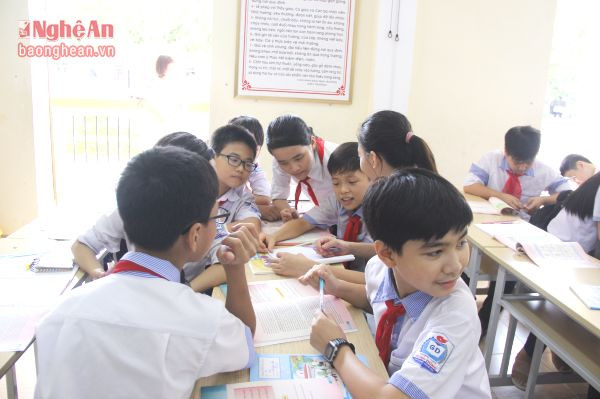 |
| VNEN program class at Hung Dung Secondary School |
- His mother is always worrying about things that don't matter. He's the one studying, not her, so why should she be giving her opinion? We should only consider it when Tún expresses his wish to me: "Dad, I think the VNEN model isn't effective and doesn't suit my abilities. I suggest you let me transfer classes, transfer schools, and go back to the regular curriculum!"
- His father talks like he's in a movie. He's just a kid, what does he know about opinions and aspirations? And I'm saying this for his own sake, not for anyone else's. The neighbor's child goes to a regular school and boasts about getting 9s and 10s, ranking first or second in the class. When my child comes home from school and I ask him, all he says is: 'At school, I got to play games, build models, tell stories to each other…' All useless activities, who knows if they'll amount to anything in the future when it comes to exams?
- Her mother is so short-sighted. That's foreign-style education, focusing on life skills and creating enthusiasm for students. Since it's foreign, of course it has to be more advanced and modern than traditional methods, understand?
- I thought it was something else, but the foreign country I'm talking about is Colombia, not France, the US, or Japan. I did my research thoroughly before saying this. Their model is only for students in remote areas with small class sizes. But here, the classroom is overcrowded, and we don't even have enough textbooks, let alone equipment or models. I don't know what my child is learning, but all they know is that the desks and chairs are arranged facing each other, and they have to twist their backs and necks to see the blackboard. It'll only lead to nearsightedness and spinal deformities, which is really harmful!
- The fault isn't with the model, it's because they're implementing it in a rigid, formulaic way. If you're worried about back pain, just let the children sit normally, and when they need to study in groups, turn them to face each other. If you don't have a ready-made logo model, let them do some crafting, drawing, cutting, and pasting. It's simple, economical, and fun. Why complicate such a small thing? I don't see the mother worrying about what she should be concerned about…
What was his father worried about?
- My concern lies in the organization and the teachers. Don't think that a student-centered, self-managing program means teachers will have an easy time and a lighter workload. Just think about it: Before, teachers only had to lecture endlessly for students to copy down, as easy as feeding a child. Now, teachers have to guide and direct students to understand and absorb the knowledge themselves, like setting the table and encouraging them to eat. Which is harder? Obviously, the second. If teachers can't guide, students won't absorb anything, and that's what I'm worried about.
- His father's point is valid. No matter how advanced foreign models are, we have to adapt them to the actual situation to find the right solutions, otherwise, they're bound to fail. We have to learn from other countries, but we also have to carefully select what to learn and how to learn it, right, Dad?
Hai Trieu


