
Tips for traveling safely with children.
Here are some things to keep in mind when traveling with your children, especially young children, as a family.
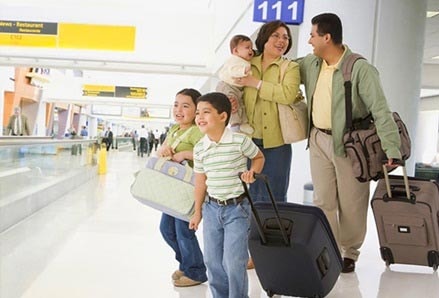
Travel by plane
Parents don't need to worry too much about ear discomfort when flying with their children. For newborns, mothers can breastfeed or bottle-feed; for older children, mothers can give them milk or water; and for even older children, mothers can teach them how to chew gum...
If the children sleep on the plane, it's much easier for the mother. However, if the children fall asleep before boarding, it can be a bit inconvenient for the mother because the whole family has to go through security checks and go up and down the airport floors. Therefore, mothers should choose a convenient flight time to make things easier for their children and themselves.
Eating and drinking on the plane: Moms can confidently put 1-2 cartons of fresh milk in their child's backpack, their carry-on bag, along with a 200ml water bottle. Security will let you through, so you'll have milk for your child on the plane. If it's powdered milk, bring powdered milk and cold water; ask for hot water on the plane, and the flight attendants will give you water to mix the formula. Depending on the child's age, bring snacks on the plane: cakes, bread, and savory snacks. For example, when my son Po went to Malaysia, I still brought homemade rice, and I fed him while waiting to board if that coincided with his main mealtime.
 |
Toys: Moms should bring one of the child's favorite toys and one new toy that the child is playing with for the first time. The criteria for toys to bring on a trip are that they should be compact and stimulate the child's creativity, such as building blocks, a piece of modeling clay, a robot, or a Rubik's Cube. I usually bring my child's storybooks; that's enough for them to play with.
Items to pack: Your child's backpack should contain the following: 2 changes of clothes for your child, 1 shirt for you/him/her in case the child vomits (a pullover shirt that both parents can wear is best), wet wipes, a cloth face towel, a carton of fresh milk and a water bottle, 1 toy/book, snacks if needed, diapers, fever reducer, nasal spray, and sunscreen. Remember that the medicine bag can be in checked baggage, but you need these medications in your carry-on backpack. These are essential items.
Playing with your child: Talk and tell stories to your child frequently, constantly changing the topics of conversation, guiding them in doing things (fastening seatbelts/lowering the tray, taking off/putting on shoes, etc.) to keep them from getting bored and reduce the risk of motion sickness.
By car
If traveling by car, motion sickness is naturally more common, so the first thing parents should pay attention to is the food their child eats before and during the trip: avoid foods that cause stomach upset. For example, if the child is prone to motion sickness and the family is traveling a long distance, give them small amounts of milk at a time. For shorter trips, just give them water, and they can eat and drink later upon arrival.
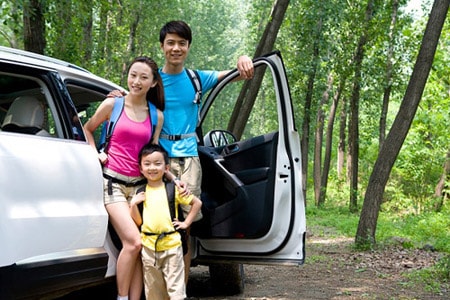 |
Next, foods that easily cause bloating should be minimized as they can easily make the baby nauseous. Parents must constantly monitor their babies; if they see signs that the baby wants to vomit, they should immediately grab a vomit bag/plastic bag/cup/milk cup – anything that can catch the vomit – and put it directly into the baby's mouth. Alternatively, parents can cup their hands together to catch the vomit, then ask their spouse/partner/someone nearby to hand them a bag to pour the baby's vomit into. It's crucial that parents don't panic, as this will only make the baby more frightened.
Travel by train
My family doesn't really like this mode of transportation, but we sometimes have to use it. The reason we don't like it is that trains are noisy and crowded. The biggest advantage of trains is safety. If finances allow, parents can buy air-conditioned sleeper berths; a four-berth compartment on a high-speed train will be comfortable for the whole family, and the child can sleep comfortably whether lying sideways or lengthwise on the bed. Soft seats are suitable for short trips of 3-5 hours, and hard seats are acceptable if there are no other options. Parents with more money can buy a separate train ticket for their child, so the child will have their own seat and parents will have less trouble.
Travel by boat
I've noticed that adults often get seasick, but children rarely do. However, parents shouldn't let their children run and jump around too much because when the ship is very bumpy, children are more likely to vomit and feel tired. Also, pay attention to the food and drinks to avoid vomiting. Let your child sit near the window so they can enjoy the breeze, see the scenery, and clear their head.
According to vietnamnet


