
Engineer returns to village to grow mushrooms and get rich.
(Baonghean.vn) - After graduating from the National University of Ho Chi Minh City, Cao Minh Long, from Hamlet 11, Dien Loc, Dien Chau, decided to return to his hometown to produce mushroom spawn. Pioneering mushroom cultivation in the area, his model has yielded a profit of nearly 40 million VND per month.
Studying Biotechnology at the International University - Vietnam National University Ho Chi Minh City, Cao Minh Long has a particular passion for food production. While still a student, he worked part-time at a mushroom production facility. This provided him with valuable practical experience and knowledge of producing clean, high-quality mushrooms, as well as business connections, laying the foundation for his entrepreneurial journey.
After graduating from university, Long decided to return to his hometown to start a business producing mushroom spawn. According to him, his hometown of Dien Chau has many favorable conditions for developing this model, such as: large garden areas for building warehouses, readily available or inexpensive mushroom growing materials, lower labor costs compared to the city, and a large consumer market.
Therefore, Mr. Long boldly borrowed nearly 1 billion VND to invest in a mushroom production line, including a sawdust mixer, a steam sterilizer, packaging, and various raw materials. In addition, he also installed a misting system to cool the mushrooms during the summer.
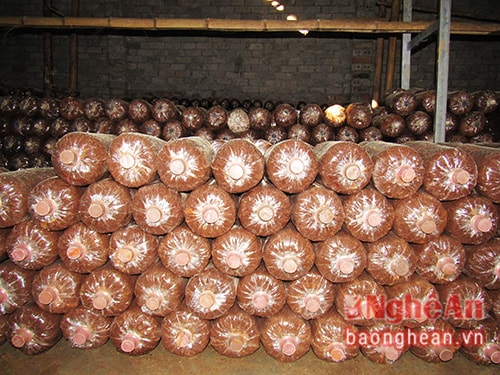 |
| The mushroom spawn bags contain materials such as sawdust, bran, NPK fertilizer, etc. |
Currently, Mr. Long produces three main types of mushroom spawn: oyster mushrooms, red reishi mushrooms, and black wood ear mushrooms, along with cordyceps. The production process for oyster and black wood ear mushroom spawn takes about one month, while the high-grade red reishi mushroom spawn takes 4-6 months.
The production of mushroom spawn (oyster mushrooms, red reishi mushrooms, and black wood ear mushrooms) involves several steps: selecting sawdust (mainly from rubber and acacia trees), composting the sawdust for 1-2 months, then carefully sifting and mixing it. After mixing, the sawdust is bagged and then placed in an autoclave at over 110 degrees Celsius for 10-12 hours. Once the autoclaving is complete, the mushroom substrate bags are removed to cool and then inoculated.
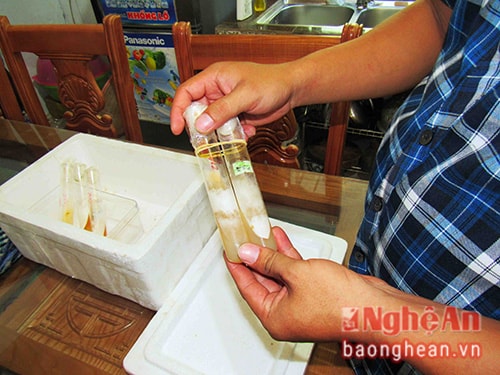 |
| Drawing on the knowledge he accumulated during his university studies, Long independently researched and produced various types of mushroom strains. |
The mushroom strains were researched and produced by Mr. Long himself, based on his accumulated knowledge. He explained: The initial process of producing mushroom spawn uses ingredients including bone broth, potatoes, boiled bean sprout water, bran, and sugar in a clean environment. After completion, the mushroom spawn is inoculated into individual mushroom substrate bags. Each bag of spawn can inoculate 40-50 substrate bags.
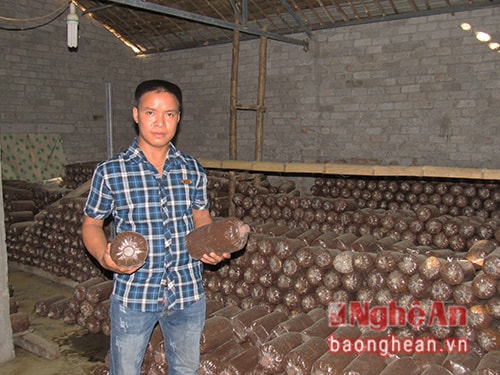 |
| The mushroom spawn has been inoculated into mushroom substrates. Each bag of mushrooms weighs 1.3 kg and costs 4,000 – 5,000 VND/bag. |
Specifically for Cordyceps sinensis, Mr. Long cultivates it in a 35-square-meter room with a temperature of 18-22 degrees Celsius and 80% humidity. The ingredients for producing Cordyceps sinensis include silkworm pupae and rice, produced in a sterile environment. It takes about 4-5 months to produce one jar of Cordyceps sinensis, which sells for 800,000 VND per jar. Mr. Long says he plans to produce 10,000 jars per month in the near future. However, sales are slower due to the higher cost.
However, the difficulty in mushroom cultivation is that the success rate of the spawn is only about 70%. As this was his first time implementing this model, he initially suffered losses because the mushroom spawn did not develop well and had to be discarded. But he persevered, researching cultivation techniques and learning from friends and acquaintances who had experience in mushroom farming to apply to his family's model. Thanks to this, he gradually acquired more effective techniques for cultivating mushroom spawn.
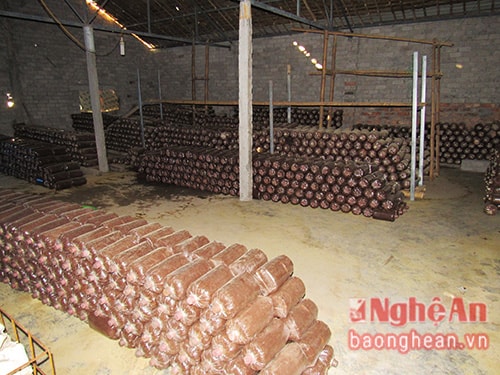 |
| Mr. Long's family's mushroom spawn storage area is covered to protect the mushrooms from direct sunlight, which could affect their growth. Each month, Mr. Long's family produces approximately 20,000 bags of mushroom spawn. |
Although production has only been going on for a little over half a year, Mr. Long's mushroom spawn products are popular in Vinh and Hanoi markets. Each month, his facility exports 20,000-25,000 bags of mushroom spawn, currently selling for 4,000 VND per bag. After deducting production costs, his family earns a profit of nearly 40 million VND per month.
Through developing mushroom production and business, Mr. Long has created jobs for 6 workers, mainly local people, with an income of over 3 million VND per month. He plans to continue expanding the area for mushroom cultivation in the near future.
Discussing the mushroom cultivation model of young engineer Cao Minh Long, Mr. Nguyen Duy Thanh – Chairman of the Farmers' Association of Dien Loc commune – said: “This is the first mushroom cultivation model in the locality, bringing high economic efficiency; opening up a new direction for economic development for the people. In the future, the Farmers' Association will cooperate with Mr. Long to open training classes for farmers on how to produce this high-value economic product. At the same time, we will encourage people to replicate this effective production model.”
Quang An


