
Do rotating savings and credit associations (ROSCA) with installments of 100 million VND or more need to be reported?
A draft decree amending and supplementing Government Decree 144/2006/ND-CP on informal lending schemes (such as rotating savings and credit associations) is being published for public comment, with many regulations expected to limit the risks from these distorted activities.
 |
| Enter image description |
The Ministry of Justice has just published a draft amendment to Decree 144/2006/ND-CP on informal lending groups (collectively referred to as "family groups"), issued by the Government on November 27, 2006, for public comment.
This draft introduces numerous regulations that bind participants in informal lending schemes, as well as the responsibilities of local authorities, with the goal of minimizing the number of cases of fraud and collapse of these schemes that have occurred in practice.
Rotating savings and credit associations (ROSCA) – many variations and forms.
According to the Ministry of Justice, Decree 144 was issued based on the provisions of Article 479 of the 2005 Civil Code, which recognizes the good customs of mutual support and compassion in people's lives.
Over more than 12 years of implementation, Decree 144 has contributed to building a legal basis to ensure the exercise of people's civil rights in establishing and carrying out relationships concerning borrowing and lending in general, and specifically concerning themselves.
To date, in addition to the provisions of Decree 144 of the 2015 Civil Code, family relationships are also indirectly regulated by the 2015 Penal Code (amended and supplemented in 2017, including the crimes of abuse of trust to appropriate property and usury), and Decree 167/2013/ND-CP (regulating the act of lending money with collateral, but the lending interest rate exceeds 150% of the basic interest rate announced by the State Bank at the time of lending)...
The Ministry of Justice recognizes that the demand for lending and borrowing through informal lending schemes is becoming increasingly diverse. In some areas, these schemes have developed on a large scale, become complex, and have been distorted into forms of capital mobilization and usurious lending.
In many cases, the organizers of these groups have exploited the trust of participants to seize their assets, and in fact, several cases of these groups collapsing have occurred, causing serious consequences for individuals and organizations.
This situation stems from certain limitations and inadequacies in Decree 144, such as regulations on participants in informal lending schemes, forms of agreements, ledgers, mechanisms for controlling informal lending, interest rates, etc., leading to difficulties for competent authorities in enforcing the law.
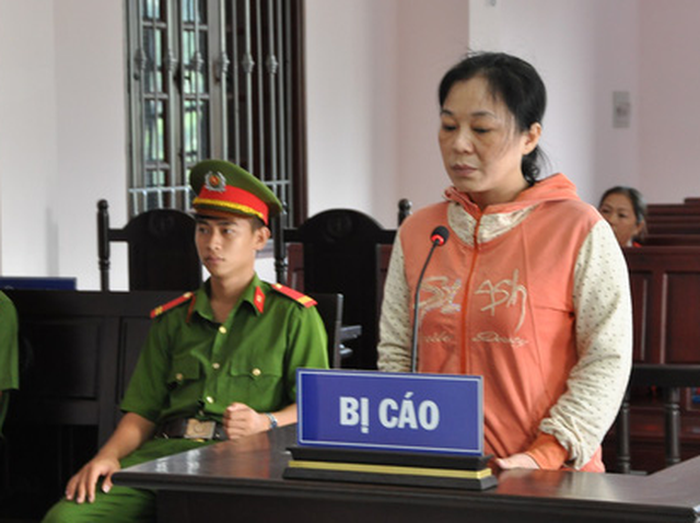 |
| Defendant Nguyen Thi Thu Nhung appears in court in a recent pyramid scheme collapse case in Hau Giang province. Photo: TTO |
Their payment per installment must not exceed 200 million?
Overall, the draft amendment decree also consists of 5 chapters and 32 articles, similar to Decree 144.
In terms of content, the draft adds several regulations that involve a certain degree of state intervention regarding the principles of clan organization, clan leaders, and the role of the government to ensure healthy clan relations and prevent abuse and distortion.
Specifically, Clause 2 of Article 6 of the draft proposes two options for regulating the conditions for the head of the family:
1) "A person may be the head of one or more family lineages at the same time if the total value of the shares in a single family lineage opening does not exceed 200 million VND, except with the consent of all members of the family lineages."
This measure aims to limit the situation where a single head of a family simultaneously owns one or more large-value family clans, which poses a potential risk of fraud or collapse.
2) "A person may not own more than two family clans at the same time, unless all members of those clans agree."
This approach aims to restrict individuals from becoming professional loan sharks, whose primary income comes from this business, thereby preventing various abuses.
Furthermore, to mitigate risks, Article 8 of the draft also proposes that the arrangement of a rotating savings and credit association (ROSCA) must be agreed upon in writing by all members. If the total amount of money involved in a single ROSCA transaction is 100 million VND or more, the written agreement must be notarized and authenticated.
Notably, Articles 15 and 18 of the draft propose a regulation stating that for rotating savings and credit associations (ROSCA) with a total amount of 100 million VND or more per round, participants and the ROSCA organizer have the right and obligation to notify the People's Committee of the commune where they reside.
The People's Committee at the commune level must compile the information.
At the same time, Article 32 of the draft stipulates that the People's Committee at the commune level must be responsible for compiling information on the heads of families and family clans with a value of 100 million VND or more per draw.
This regulation aims to help competent authorities monitor and understand the developments in family-based relationships, take timely action against those who professionally manage these relationships, and limit the breakdown of these relationships that cause disorder in the locality.


