
Opening the warehouse of precious medicinal herbs from Nghe An province.
(Baonghean) - Several products processed from medicinal plant growing areas in Nghe An province have been launched onto the market with positive results. This is an important factor for farmers and businesses to unlock the potential of medicinal plants in the area.
Recently, Con Cuong district, in collaboration with Thanh An Agricultural Science and Technology Services Joint Stock Company, successfully implemented a project to cultivate, process, and supply two medicinal herbs to the market: Solanum torvum and Gymnema sylvestre. These are medicinal plants that adapt well to various conditions, are easy to grow and care for, require little investment, and the model implemented in Chi Khe commune, Con Cuong district, has achieved high yields.
The company purchases, processes, grinds, and packages the products on-site according to standards, bringing them to market in two product lines: herbal tea and tea bags. It is estimated that these medicinal plants could bring growers in Con Cuong an income of around 100 million VND/hectare/year.
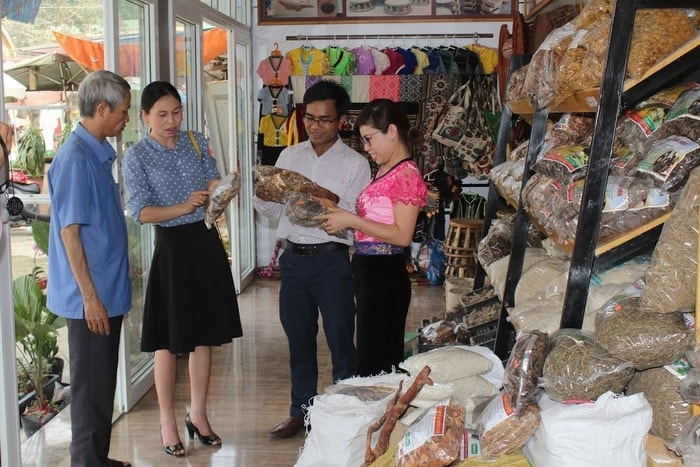 |
| Many types of medicinal herbs are sold at the Que Phong District Cooperative for the Production and Introduction of Typical Products. Photo: Nguyen Nguyen |
Previously, in Que Phong district, a cooperative was established to produce and supply typical products, including many medicinal herbs harvested locally such as Ganoderma lucidum mushrooms, golden flower tea, Cynomorium songaricum, Cynomorium songaricum resin, Cynomorium songaricum, Panax pseudoginseng, banana seeds, and Gynostemma pentaphyllum tea…
According to Ms. Sam Thi Yen, Director of the Cooperative, after 8 months of operation, the Cooperative has purchased over 1 ton of various medicinal herbs, packaged them, and sold them to customers. The issue is that most of the medicinal herbs sold at the Cooperative are used for soaking in alcohol or brewing according to traditional herbal remedies of the local people. The only exception is the cinnamon essential oil, extracted from Quy cinnamon, packaged in small bottles for external application to prevent insect bites.
To protect, develop, and effectively utilize the valuable medicinal plant resources in the area, the People's Committee of Que Phong district has developed a project titled "Conservation and Development of High-Economic Value Medicinal Plants in the period 2015 - 2020". Initially, priority is given to developing golden flower tea, Codonopsis pilosula, and Bon Bo into marketable products.
In the restructuring of crop patterns and rural economic sectors, exploiting the existing potential and advantages of the locality, gradually creating a new production mindset for the people in the form of short-term gains to support long-term development, while simultaneously raising people's awareness of sustainable forest resource protection and the conservation and preservation of rare and valuable local genetic resources. Que Phong strives to achieve a conservation and new planting area of 334.5 hectares of medicinal plants by 2020; mainly focusing on conserving medicinal plants found in natural forests and building pilot planting models in communes. Priority is given to the conservation and development of three medicinal plants: golden flower tea, Codonopsis pilosula, and Bon Bo.
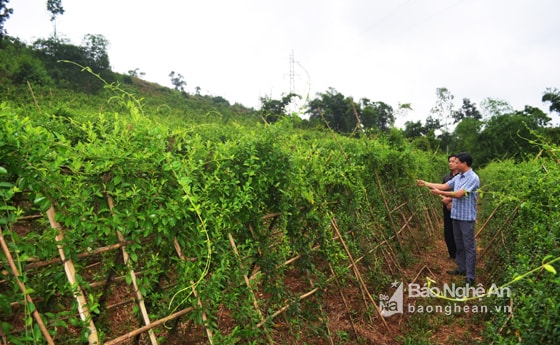 |
| Gymnema sylvestre plants are grown in Chi Khe commune (Con Cuong district). Photo: Nhat Lan. |
Nghia Dan district is also planning to develop medicinal plants grown under forest canopy and in home gardens. Mr. Phan Van Binh, Vice Chairman of the District People's Committee, stated that Nghia Dan plans to attract and encourage businesses to invest in building processing plants for raw medicinal herbs, aiming to develop medicinal plant cultivation. Initially, they will focus on a model of growing ginger in containers placed under trees. However, to ensure product output, the district will sign agreements with businesses to guarantee the purchase of products from farmers, preventing a situation where products have no market.
During the discussion, Mr. Tran Quoc Thanh, Director of the Department of Science and Technology, stated that: To protect and effectively utilize valuable medicinal plant resources in the mountainous districts of the province, a specific policy is needed to protect these valuable medicinal plants. For a long time, local people have been exploiting non-timber forest products, including medicinal plants, leading to the depletion of these resources. Secondly, businesses need to purchase medicinal plants from local people according to established standards and with a serious and scientific harvesting plan. Thirdly, projects to cultivate medicinal plants under the forest canopy should be implemented, both protecting the forest and developing medicinal plants sustainably.
At the same time, localities need to encourage businesses to invest in and process agricultural and medicinal products, aiming to extract medicinal herbs into functional products to serve as raw materials for the production of medicines or functional foods, thereby increasing the value of medicinal products.
Xuan Hoang


