
The US is rushing to develop hypersonic weapons to counter Russia and China.
The US wants to accelerate the development of ultra-fast weapons systems to close the technological gap with its rivals.
|
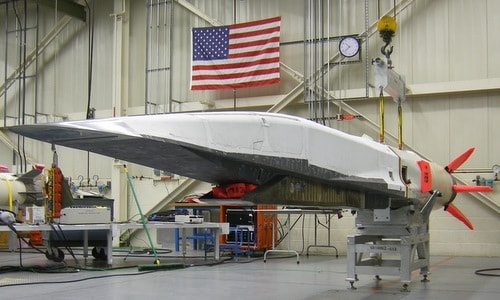
The American X-51A hypersonic glide vehicle. Photo:USAF. |
"I am confident that we can significantly accelerate the pace of research into hypersonic weapons."Sputnikquoting himWill Roper, Assistant Secretary of the U.S. Air Force, made the announcement on May 8.
The US Air Force is pursuing an ambitious hypersonic weapons development project amid significant advances in this field by Russia and China.
Mr. Roper affirmed that the U.S. Air Force accepts weapons systems that are 90% complete, rather than waiting many more years for fully developed and evaluated equipment.
The Pentagon is developing a prototype hypersonic glide vehicle (HGV) that would be launched from an aircraft into space, then use gravity to plummet to its target at high speed. Washington is also researching a "conventional hypersonic weapon" project based on more advanced technologies in the future.
Both weapons are part of a collaborative project between the U.S. Air Force and the Defense Advanced Research Projects Agency (DARPA) of the U.S. Department of Defense. "The two systems have different flight paths and warheads, giving the U.S. Air Force more options when engaging targets," Roper stated.
The race to develop hypersonic weapons was mentioned earlier this year by General John Hyten, commander of the U.S. Strategic Command (STRATCOM). "We have no defenses against such weapons," Hyten declared during a congressional hearing on Russian and Chinese hypersonic weapons technology.
Hypersonic weapons typically travel at speeds of around 6,175-12,000 km/h. In principle, hypersonic weapons trade the extremely high re-entry speed of intercontinental ballistic missile warheads for increased range and the ability to evade enemy air defenses. Additionally, these weapons possess complex maneuverability in flight, making it difficult for missile defense systems to accurately determine their trajectory for interception.
China is believed to be leading the world in hypersonic weapons technology, at least in its application to real battlefields. The DF-17 is the world's first missile system to use a hypersonic warhead, and Beijing is expected to deploy it in 2020.
In his State of the Union address on March 1st, Russian President Vladimir Putin also introduced two hypersonic weapons: the Kinzhal anti-ship missile system, capable of sinking warships from a distance of 2,000 km, and the Avangard hypersonic glide vehicle, with a speed of up to 25,000 km/h and a range of 10,000 km.


