
Nghe An: 19 traditional craft villages are on the verge of collapse.
(Baonghean.vn) - Nghe An has 146 craft villages, of which 19, accounting for 13%, are currently operating poorly or are on the verge of collapse.
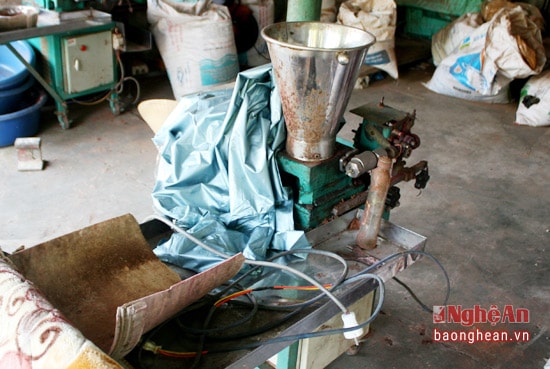 |
| Many incense-making machines at the Dien An incense-making village in Dien Chau district, which cost tens of millions of dong to produce, are now rusted due to infrequent use. Photo: Quang An |
The incense-making village in Hamlet 3, Dien An Commune, Dien Chau District, has existed for over 20 years. However, over time, the craft has gradually declined, and now only one household in the entire village still practices this trade. That household belongs to Mr. Cao Van Hoanh. He sighed: “In the past, people from the village came to my workshop to make incense in large numbers; back then, incense was expensive, and people were enthusiastic about the craft. However, currently, only 3-4 people come to work each day. Sometimes I want to give up the profession because the profit is only enough to cover workers' wages, raw materials, and electricity costs...”
Mr. Cao Duc Dung, Vice Chairman of the Dien An Commune People's Committee, said: The main reason for the gradual decline of the local incense-making craft is that farmers have chosen new jobs with higher incomes, such as working abroad or as construction workers or factory workers, and therefore no longer want to stick with the craft.
In addition, incense making requires significant investment in machinery, raw materials, and labor, while the market is not stable and incense prices are still low, so business owners do not have enough funds to sustain the business in the long term.
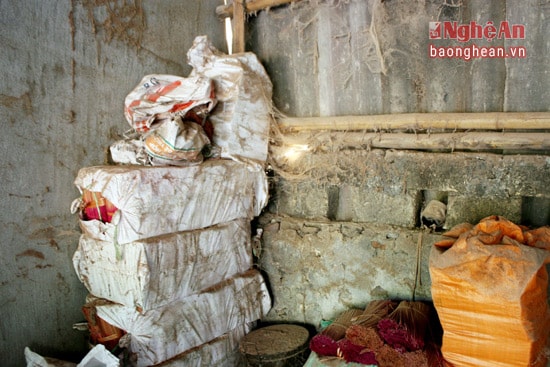 |
| Due to a lack of workers, many sacks containing incense-making materials at Mr. Hoanh's family home in Hamlet 3, Dien An, are covered in cobwebs and dirt. (Photo: Quang An) |
The Da Lam bamboo weaving craft in Da Son commune (Do Luong district) was recognized as a traditional craft village by the Provincial People's Committee in 2005. The main products were bamboo panels woven from bamboo stalks, used for walling houses, covering bricks and tiles, etc. However, since 2010, the government banned the production of building bricks using traditional kilns, causing the bamboo weaving craft here to decline and almost cease operation.
Mr. Tran Dang Van, head of Da Lam hamlet, said: "The weaving craft is declining, so the people in the hamlet have switched to other trades such as carpentry and rice paper making. Currently, there are about 30 households in the hamlet engaged in carpentry, specializing in ceiling construction, and 20 households engaged in rice paper making, providing employment for about 250 workers."
The incense-making village in Dien Chau or the rattan weaving village in Da Lam are just two of many traditional craft villages in Nghe An that are struggling to survive.
According to data from the Provincial Cooperative Union, the province currently has 146 craft villages, with the following groups of crafts: rattan and bamboo weaving, silkworm farming, crochet, brocade weaving; ornamental plant cultivation, civil carpentry, incense making, incense production, food processing, mechanics, and brick and tile production.
However, due to both objective and subjective factors, as many as 19 craft villages are operating poorly or have ceased operations, such as: crochet, silkworm breeding, incense production, fish sauce processing, rattan and bamboo weaving, and basket weaving.
Nghe An province aims to achieve an average annual growth rate of 15% in the value of industrial production by 2020, with exports reaching 285 million USD, accounting for 15% of the province's total export turnover.
X.Hoang - Q.An


