
Nghe An will transform 200 markets.
(Baonghean) - According to the plan set for 2020, over 50% of markets in Nghe An province will switch to a model of enterprises and cooperatives for market operation, business, and management.
The policy of transforming markets was decided by the Provincial People's Committee along with the promulgation of the "Regulations on the process of transforming the organizational, operational, and business models of markets in Nghe An province" (No. 72/2016/QD-UBND, effective from December 26, 2016).
The goal of this transformation is to upgrade market infrastructure in a modern direction, ensuring effective fire prevention and control, environmental hygiene, security and order, and food safety within the markets; creating conditions for traders to effectively exploit business opportunities and actively contribute to the state budget.
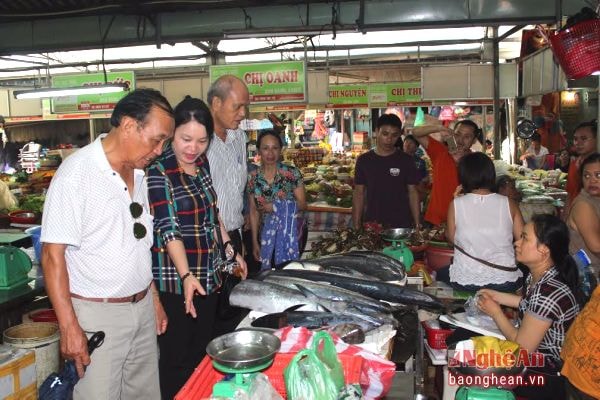 |
| Officials from the Department of Industry and Trade survey the model of a market transformed towards a more civilized approach, ensuring food safety and hygiene at Han Market in Da Nang. Photo: Nguyen Son |
The task of transforming markets was assigned to 9 functional departments and agencies and the People's Committees of districts, cities, and towns, with the Department of Industry and Trade assigned the leading role. Immediately after the provincial policy was issued, the Department of Industry and Trade coordinated and urged localities to review the current status of each market (including land, assets, structures, equipment, etc.); assess the business performance of the market over the past 3 years and the projected performance for the next 3 years (number of stalls, shops, small traders, business sectors; revenue and expenditure results and management and use of revenue and expenditure at the market, etc.).
At the same time, the organization established a district-level market transformation committee to implement procedures, determine transformation methods, contract duration for business operations, market exploitation and management, financial plans, labor allocation and arrangement, and market environmental sanitation management...
According to Ms. Vo Thi An, Deputy Director of the Department of Industry and Trade, the transformation of traditional markets is an essential requirement in the new era, and all transformation processes must have high consensus from the district and commune levels and the small traders when deciding on the choice of investment enterprises or the formation of cooperative models to manage the markets. With the new transformation method, markets will have upgraded infrastructure, ensuring food safety and hygiene requirements, maintaining civilized business practices, and effectively managing revenue for the budget.
In reality, for a long time, many markets have been managed by a single group, with revenue collection being contracted out, resulting in low revenue efficiency and a lack of reinvestment in repairing and upgrading market infrastructure. This has led to the already dilapidated markets becoming even more degraded. The Department of Industry and Trade will actively advise localities to organize the transformation process effectively. For markets located in areas with particularly difficult socio-economic conditions, where capital recovery is slow and the market model transformation process is challenging, the proposed market model transformation plan will include a support mechanism to facilitate the transformation.
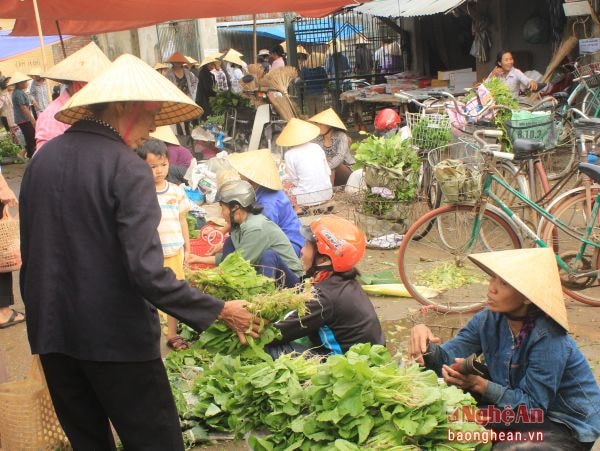 |
| Con Market (Thanh Chuong). Photo: Nguyen Son |
Ensuring a balance of interests
Traditional markets are centers of trade, commerce, and cultural exchange for the people of various localities. Some markets have been established for hundreds of years and are difficult to "renovate into new markets." Therefore, market transformation prioritizes upgrading infrastructure and facilities on the site of the old market, except for market areas that are not included in the planning or affect security and order, in which case relocation plans must be considered.
"However, all forms of transformation must ensure a balance of interests among all parties, namely the interests of small traders and the people; the interests of investors; and contributions to the budget. A fundamental principle in the transformation process is that management levels and investors must work specifically, discuss, and reach an agreement with small traders before proceeding with the transformation...", Ms. Vo Thi An emphasized.
During the discussion, Mr. Phan Duc Thinh, Deputy Head of the Trade Management Department of the Department of Industry and Trade, added: To date, districts are reviewing the actual situation of markets and establishing Market Transformation Committees as directed by the province. The district-level Market Transformation Committee needs to coordinate with investors or cooperatives and traders to develop a set of market regulations (if not already in place) to submit to the competent People's Committee for approval according to the market management decentralization; at the same time, closely monitor the organization and operation of the market under the new model; publicly disclose economic information, policies, legal regulations, and the obligations of all parties to the State in market business activities.
According to Mr. Thinh, the plan is that by the end of November 2017, all districts, towns, and cities must establish Market Transformation Committees and carry out the transformation and management processes of markets according to the new model.
| According to preliminary statistics, the 405 markets in the province contribute approximately 21 billion VND to the budget annually, with Vinh Market alone contributing nearly 6 billion VND. The goal is that by 2020, over 50% of the markets in the province will transition to a business or cooperative model for operation, operation, and management. This includes 100% of wholesale markets, first and second-class markets, markets in wards, and markets in the town centers of districts to be converted to a business or cooperative model for operation, operation, and management. |
Nguyen Nguyen


