
Japanese people are amazed by the 'treasure' in Nghe An.
(Baonghean) - Every day, Katsuhiro Ando, an expert from the JICA (Japan) project on diversifying livelihoods based on heritage tourism in agricultural and fishing villages, visits the villages of Mon Son commune (Con Cuong district) to support the local people in developing community tourism.
Coming from a distant land, Katsuhido Ando has lived and bonded with this place for over a year, almost knowing every concrete road running between rows of vibrant red poinsettias in Mon Son, with lush green rice fields on one side and majestic forests on the other. And when the rice ripens, Katsuhido Ando puts on a conical hat, carries a sickle, and joins the people of Mon Son in harvesting the rice...
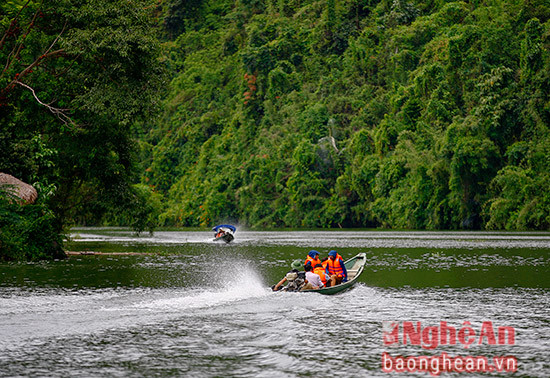 |
| Cruising on the Giang River (Con Cuong). Photo by Quoc Dan. |
In Vietnam, he witnessed buffaloes pulling wooden plows, Thai girls in colorful dresses during the rice planting festival, and Dan Lai children splashing in the clear blue Giang River catching the famous local fish...
The pristine scenery of Con Cuong was breathtakingly beautiful as he sat in a dugout canoe, traveling upstream along the Giang River. The emerald green river reflected the ancient forest, and at sunset, when the boat was still on the river, he felt as if he had wandered into paradise...
Katsuhiro Ando described it as follows: “The feeling was indescribable when I first stepped onto the boat to admire the Giang River, a river like silk draped through the vast forest, its precious water nurturing the villages for generations, providing not only fish, shrimp, and drinking water, but also serving as a pathway for the villagers to connect with the outside world. That feeling stayed with me throughout the journey, especially at the end of the river, where I encountered a Dan Lai ethnic village where the meaning of time no longer existed, completely devoid of any trace of modern life... The Giang River, to me, is rare in the world because of its astonishing pristine beauty.”
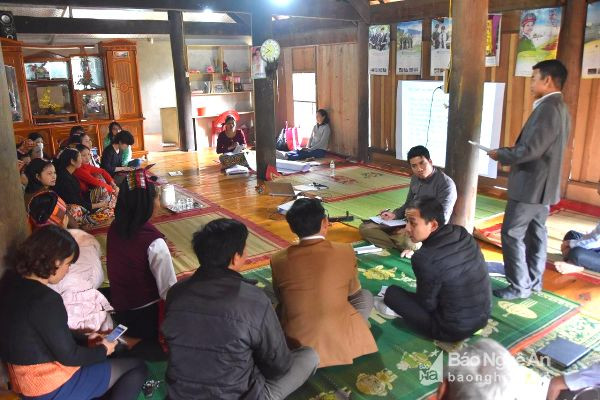 |
| The JICA (Japan) project guides ethnic minority people in Con Cuong district in developing tourism. Photo: Chau Lan. |
Having traveled extensively and supported tourism development in many communities, Katsuhiro Ando believes that the mountainous landscape of Con Cuong is very special. The mountains surround the villages, sometimes interrupted, and looking at a map, you can see that all the rivers and streams flow from the vast Pu Mat forest. The lives of the people here are intimately connected to these rivers and streams; all their activities revolve around them. Therefore, projects must study this to be successful. "This creates a deep, blood-related bond between people and nature, a very good ecosystem," Katsuhiro Ando remarked.
“I've been to Mai Chau – Hoa Binh in Vietnam, famous for its stilt houses nestled in the vast valleys. But the scenery in Con Cuong is even more captivating because, besides the stilt houses, there are also picturesque landscapes like Khe Kem waterfall and Pu Mat primeval forest… If the people of Con Cuong know how to develop these potentials, it will be very good for tourism development. For example, foreigners really like to see items made from bamboo and rattan, especially cooking utensils, such as banana leaves for wrapping sticky rice, bamboo sticky rice containers, or baskets for carrying oranges and rice containers made of rattan and bamboo…”
"Japanese experts have also come to teach the people of Nua village how to cook and use natural tools for cooking, providing bamboo weaving tools for production, helping them restore their traditional crafts. And it would be great if the people understood the harmony between nature and people and utilized it to develop tourism. My friends who came to Con Cuong were all delighted to experience homestay tourism, sleeping in stilt houses, enjoying natural food, waking up to the sound of roosters crowing and streams flowing, and watching the sunrise over the mountain peaks. Currently, it's encouraging that the people of Con Cuong have been very actively cooperating in tourism development, and travel companies have also brought tourists here..." - Katsuhiro Ando said enthusiastically.
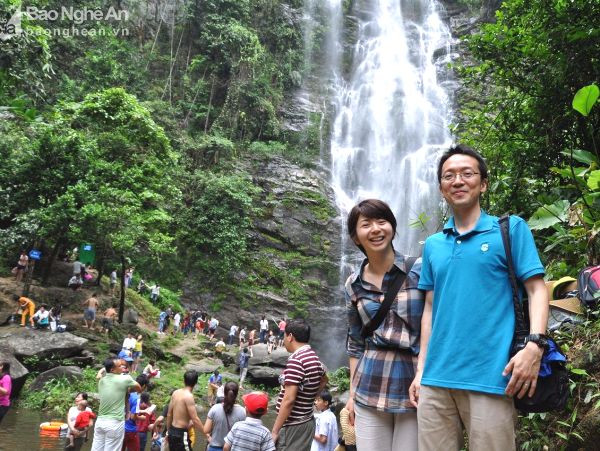 |
| Katsuhiro Ando and a Japanese friend at Khe Kem Waterfall (Con Cuong). Photo: Katsuhiro Ando |
Katsuhiro Ando's feelings – a friend from Japan – are shared by many visitors from afar when they come to Con Cuong. Everyone is eager to explore Khe Kem waterfall, take a boat trip on the Giang River, and admire the Pha Lai dam seemingly floating in the clouds, originating from the pristine Pu Mat forest with its vast expanse of ancient trees blooming in the spring.
Located in the buffer zone of the Western Nghe An Biosphere Reserve, recognized by UNESCO as a World Biosphere Reserve in 2007, Con Cuong district possesses great potential to attract tourists, especially international visitors. It is also an ancient land with pristine mountains and rivers, full of excitement for exploration, the genuine and heartfelt hospitality of the mountain people, and preserved cultural customs.
Con Cuong is located approximately 330km from Hanoi and 130km from Vinh City, situated along the picturesque Lam Giang River. Despite being a mountainous area, the district boasts a vast expanse of fertile, lush land, with captivating mountain and river landscapes. Those traveling to Ky Son or through Laos often stop here to rest before continuing their journey. Because of this, Con Cuong is famous for many specialties of the western Nghe An region, such as pickled bamboo shoots, catfish, snakehead fish, braised river eel, rattan shoot soup, and water spinach. Restaurants in Con Cuong have long been thriving, offering dishes rich in local culinary culture.
Con Cuong is eager for groundbreaking projects. Currently, Con Cuong has been approved as a town with an ecological urban orientation, serving as the economic and cultural center of the Southwest Nghe An region. Specifically, the orientation for the period 2021-2025 aims to build Con Cuong into an ecological urban area; a driving force of the Southwest region; having a significant impact on the socio-economic development of the province; and a hub for trade, goods transit, and commercial services, as well as ecotourism in the Southwest region.
Returning to my Japanese friend Katsuhiro Ando, he and his colleagues continue their project with the hope of a better life for the people of Con Cuong, contributing to the creation of economically viable ecological gardens and products that the people of Con Cuong can produce themselves to meet the needs of tourists, such as orange wine, orange jam, and orange-based soap.
| Con Cuong District Party Secretary Nguyen Dinh Hung said: “Besides focusing on exploiting ecotourism in Pu Mat National Park and Pu Huong Nature Reserve, Con Cuong district will promote attracting investment and building ecotourism resorts in Pha Lai and Co Phat villages in Mon Son commune; Ta Bo and Thac Kem (Yen Khe). We will develop tours, routes, and tourist destinations in the district that are linked to the province's tourism routes, focusing on community-based tourism destinations. We will develop ecotourism in conjunction with community-based tourism, cultural, historical, and spiritual tourism sites. We will preserve and develop historical relics (the national historical relic Bia Ma Nhai, the site where the first Party branch in Western Nghe An was established)... We strive to make Con Cuong one of the tourism centers of Western Nghe An.” |
Chau Lan


