
Nguyen Thi Minh Khai - a staunch female communist fighter.
The tireless struggle for the revolutionary cause of the nation, the heroic sacrifice of Nguyen Thi Minh Khai and other revolutionary fighters will forever shine brightly for generations to come.
Nguyen Thi Minh Khai, whose real name was Nguyen Thi Vinh, was born on November 1, 1910, in Vinh Yen commune, Vinh city, Nghe An province. She studied the Vietnamese language from a young age. After completing the second grade, she moved on to the first grade at Cao Xuan Duc school. Studying under teacher Tran Phu (who later became the first General Secretary of the Indochinese Communist Party), witnessing the suffering of her homeland, and being enlightened by Tran Phu himself, Nguyen Thi Minh Khai embarked on the revolutionary path at the age of 16.
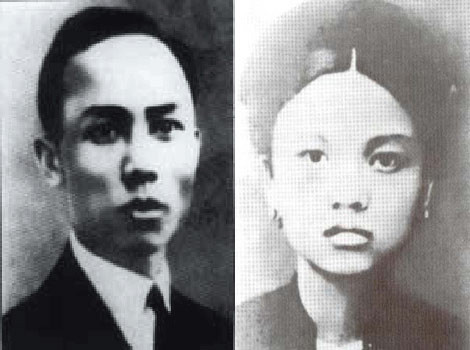 |
| The two leaders were Le Hong Phong and Nguyen Thi Minh Khai. |
In 1927, Nguyen Thi Minh Khai joined the Tan Viet Party. During this time, Nguyen Thi Minh Khai actively participated in resistance movements in her hometown, mobilizing women to participate in strikes and demonstrations demanding amnesty for Phan Boi Chau and commemorating the death of Phan Chu Trinh.
In early 1929, with the organization's approval, Nguyen Thi Minh Khai secretly left her family to participate in revolutionary activities. After the Indochinese Communist Party was founded, she was admitted to the Party and assigned to propaganda work, mobilizing women, training Party members in the Truong Thi and Ben Thuy areas, and organizing the Women's Liberation Association. She organized many training courses, training Party cadres who formed the core force in the Nghe Tinh Soviet Uprising.
In late 1930, Nguyen Thi Minh Khai was sent to Hong Kong (China) to work at the Eastern Bureau of the Communist International. Under the direct tutelage of leader Nguyen Ai Quoc (Ly Thuy) in political theory and revolutionary experience, Nguyen Thi Minh Khai progressed rapidly. Later, she was assigned the task of maintaining contact with Vietnamese revolutionary organizations in Vietnam. While working, Nguyen Thi Minh Khai diligently studied English, French, and Chinese.
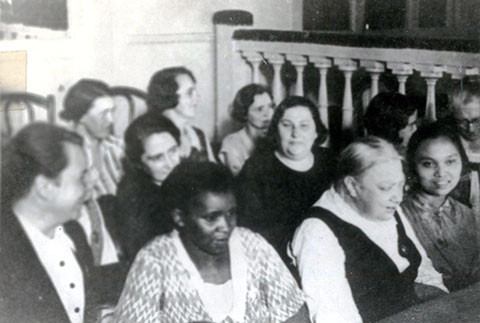 |
| Comrade Nguyen Thi Minh Khai and Mrs. Krupskaya (Lenin's wife) at the 7th Congress of the Communist International in 1935. |
Between 1931 and 1934, Nguyen Thi Minh Khai was arrested by British secret agents in Hong Kong and then handed over to the Guangzhou authorities for imprisonment. Despite being subjected to brutal torture, Nguyen Thi Minh Khai remained steadfast in her revolutionary cause. Later, thanks to the efforts of the Communist International, Nguyen Thi Minh Khai was released. After her release, she was sent to Shanghai to work in the Party's Overseas Leadership Committee and to study at the University of the East.
In late 1934, Minh Khai, along with Le Hong Phong and Hoang Van Non, were official delegates sent to the 7th Congress of the Communist International in Moscow. Nguyen Thi Minh Khai used the pseudonym Phan Lan. On August 16, 1935, for the first time on the platform of an international congress, the 24-year-old Vietnamese woman boldly read a paper on the role of Indochinese women in the struggle against imperialist war and for the protection of peace. After the Congress, Nguyen Thi Minh Khai continued her studies at the University of the East. During these years, Nguyen Thi Minh Khai fell in love with and married Le Hong Phong, a revolutionary fighter.
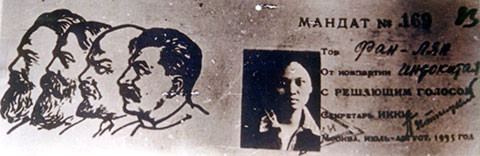 |
| Delegate card of Comrade Nguyen Thi Minh Khai attending the 7th Congress of the Communist International in 1935. |
In early 1936, Le Hong Phong was sent back to Vietnam to carry out revolutionary activities, while Nguyen Thi Minh Khai stayed behind to continue her studies for another year. After graduating from university, Nguyen Thi Minh Khai was assigned to work in Shanghai (China) and was later assigned to work in Saigon (1937). Upon returning to Vietnam, Nguyen Thi Minh Khai was elected to the Southern Regional Party Committee, in charge of the Saigon-Chợ Lớn City Party Committee; at that time, Nguyen Thi Minh Khai was 29 years old.
Having taken on new assignments and operating in extremely difficult, clandestine conditions, she and her comrades remained close to the grassroots, leading the movement to flourish. While Nguyen Thi Minh Khai was actively involved in revolutionary activities, she received news that Le Hong Phong had been arrested. Although she loved her husband dearly, to ensure secrecy, Nguyen Thi Minh Khai could not visit him but could only send gifts through someone else. At this time, Nguyen Thi Minh Khai was pregnant. In the spring of 1939, Nguyen Thi Minh Khai gave birth to her first daughter, whom she named Hong Minh. She only had time to be with her child for a month before entrusting her to the revolutionary base to raise and continuing her revolutionary work.
On September 1, 1939, World War II broke out. The Southern Regional Party Committee assessed the situation and decided to launch an uprising. The French secret police discovered this and intensified their repression of the revolutionary movement. Most of the key Party officials in Southern Vietnam fell into the hands of the enemy, including Nguyen Van Cu, Le Hong Phong, Vo Van Tan, and Nguyen Huu Tien…
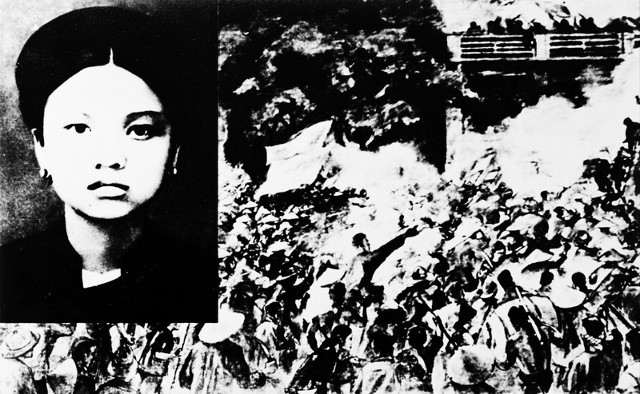 |
| Comrade Nguyen Thi Minh Khai – one of the staunch leaders of the workers' struggle movement – participated in the Southern Uprising in November 1940. |
On July 30, 1940, after attending a meeting of the Provincial Party Committee discussing the plan for the uprising, Nguyen Thi Minh Khai was arrested by the French. They took her to the Saigon Central Prison and subjected her to extremely brutal torture. In prison, Nguyen Thi Minh Khai continued to mobilize women to fight. After the torture, Nguyen Thi Minh Khai used her blood to write on the cell wall verses that highlighted the qualities and integrity of a communist fighter: "Whether beaten or hanged, I remain resolute; Whether restrained or oppressed, I will not betray my word; I will sacrifice and strive for the cause, thoroughly carrying it out until death…"
When the French learned that she was Le Hong Phong's wife, they imprisoned him as well. However, despite not having seen each other for a long time, both revolutionary fighters suppressed their personal feelings to counter the enemy's insidious plot. On one occasion, they brought Le Hong Phong to Nguyen Thi Minh Khai for identification, but Nguyen Thi Minh Khai replied, "I don't know this man."
Despite being imprisoned, Nguyen Thi Minh Khai, in her capacity as Secretary of the Saigon-Chợ Lớn City Party Committee and a member of the Southern Regional Party Committee, still found ways to contact the outside world and continued to lead the Southern Uprising. On November 23, 1940, the Southern Uprising broke out.
The Southern Uprising was suppressed, and the colonial court sentenced Nguyen Thi Minh Khai to death. Unable to subdue the young communist fighter, on the morning of August 28, 1941, Nguyen Thi Minh Khai and several comrades were executed by firing squad in Hoc Mon.
Before her sacrifice, Nguyen Thi Minh Khai managed to do three things: First, she sent a final farewell to her beloved husband who was exiled to Con Dao; second, she thanked her comrades who were raising Hong Minh; and third, she tore up pieces of her prison clothes and knitted a pillowcase to send to her mother as a small token of filial piety for not fulfilling her duty to care for her mother in her old age.
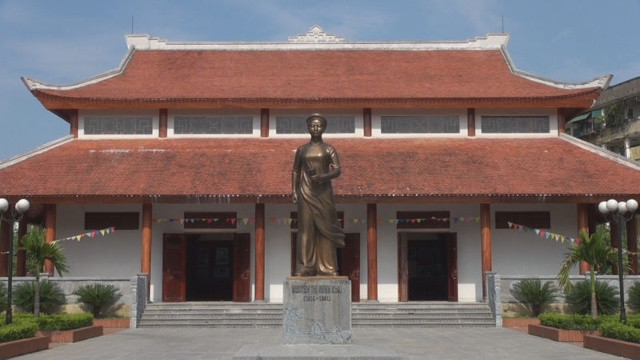 |
| The Nguyen Thi Minh Khai Memorial House is located in Quang Trung Ward, Vinh City, Nghe An Province. |
Nguyen Thi Minh Khai fell at the young age of 31. Before going to the execution grounds, she left a message for her compatriots and comrades:
Who among you is steadfast and resolute?
True talent comes from unwavering determination and perseverance.
Circumstances shaped the soldier's path.
The revolutionary path remains fraught with difficulties.
The tireless struggle for the national revolutionary cause and the liberation of women, the heroic sacrifice of Nguyen Thi Minh Khai and other revolutionary fighters, will forever shine brightly as an example for Vietnamese women to learn from. Her name and noble revolutionary career will be remembered for generations to come, with streets, schools, and even scholarships named after her to help poor, academically gifted students overcome difficulties. Nguyen Thi Minh Khai's name will live on forever with the Vietnamese nation.
Peace(Synthetic)


